Why Train Journeys Calm the Mind
Why do train rides feel so relaxing? The psychology of window gazing, gentle motion and effortless attention, plus ways to turn any journey into rest.
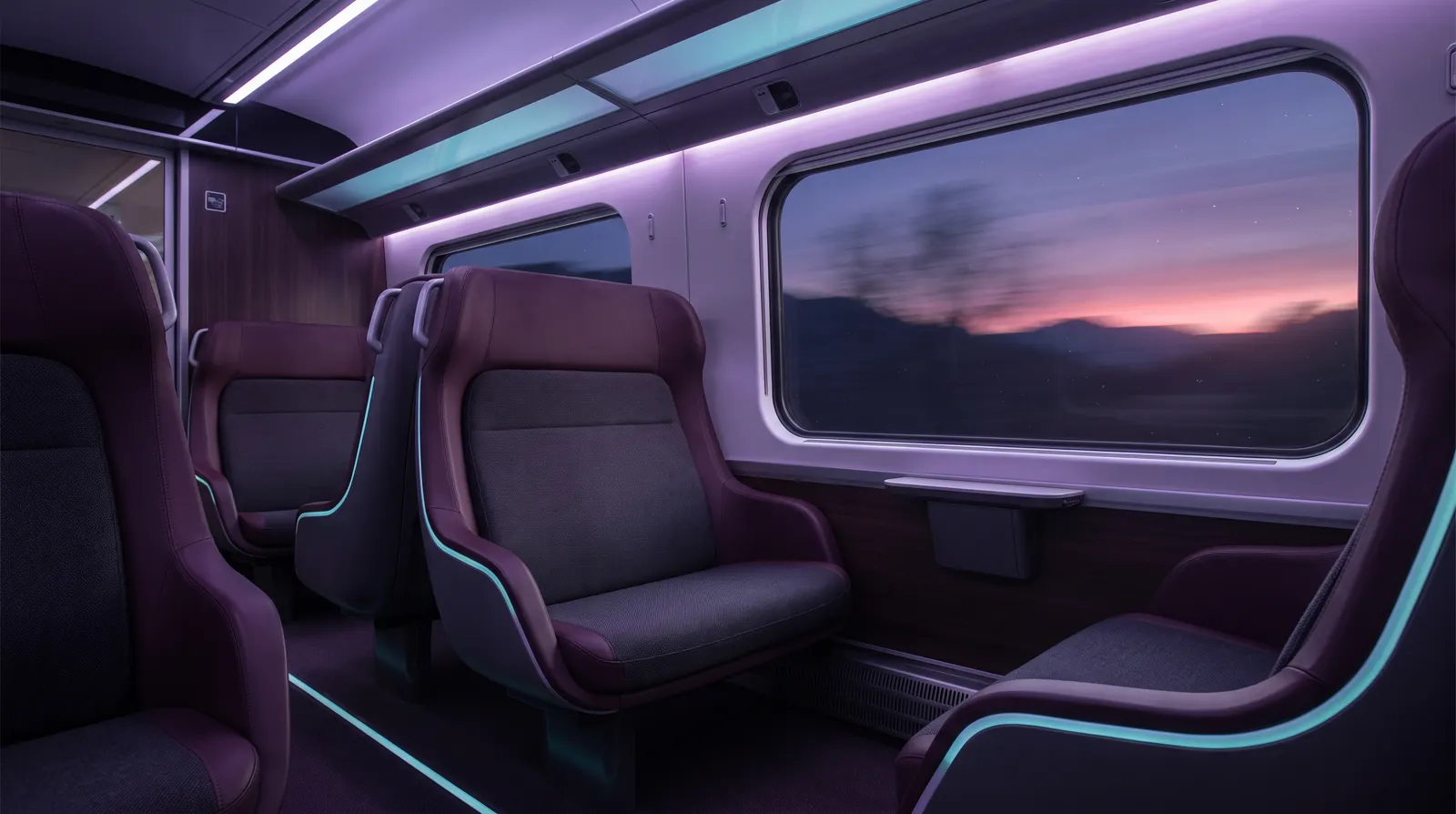
There is a particular state of mind that seems to exist only on trains. You board with a head full of lists, find your seat, and somewhere between the platform and the first long curve of track, something loosens. The landscape begins to pour past the window, fields and back gardens and the briefly glimpsed lives of strangers, and you realise you have been staring for twenty minutes without a single deliberate thought. Writers have chased this state for two centuries; commuters stumble into it on a Tuesday. It is worth asking what, exactly, the train is doing to us.
Because it is doing something. The calm of a train journey is not an accident of nostalgia or the romance of the rails. It is built from several quiet mechanisms working at once: the way a moving window feeds the eyes, the way the body responds to being carried, and the way a journey grants a kind of permission that ordinary rooms do not. Each one can be understood, and, more usefully, each one can be borrowed.
The window does the work
Begin with the view. A train window offers a very unusual visual diet: constant, smooth, predictable motion, with endlessly varied content. Trees give way to water, water to brick, brick to open sky, and none of it demands anything from you. You do not need to steer, brake or judge distances, as a driver must. You simply receive.
Environmental psychologists have a name for the kind of attention this invites. Stephen Kaplan, who developed attention restoration theory, called it soft fascination: gentle, effortless engagement with a scene that holds the eye without gripping it (Kaplan, 1995, Journal of Environmental Psychology). His argument was that modern life exhausts our directed attention, the focused, effortful kind we use for spreadsheets and difficult conversations, and that this resource recovers best not in blank silence but in the presence of stimuli that are interesting enough to occupy the mind and undemanding enough to let it wander. A landscape unspooling past a window at eighty miles an hour is very nearly the definition.
The motion itself matters too. The scenery flows in one continuous direction at a steady rate, a pattern vision researchers call optic flow, and the brain finds this deeply legible. Nothing lurches or surprises. Distant hills drift slowly while near hedgerows blur past, and the eye can choose its own depth of focus, drifting between them. It is the same quality that makes watching a river or falling snow so absorbing: perpetual change inside perfect predictability.
Motion without effort
Then there is the body. A train rocks. Not dramatically, but constantly: a low sway, a rhythmic percussion of wheels over rail joints, a hum through the floor. Being gently rocked is one of the oldest calming signals we know; it is how most of us were first soothed as infants, and the association never entirely leaves. Add the fact that you are travelling at speed while doing absolutely nothing, no pedals, no steering, no vigilance, and the nervous system receives a rare combination: progress without effort. You are getting somewhere, and you are allowed to be completely passive about it.
The contrast with driving is instructive. In a study comparing how different commuters felt about their daily journeys, drivers tended to describe their commutes as stressful, while rail and bus passengers were more likely to describe theirs as merely boring (Gatersleben & Uzzell, 2007, Environment and Behavior). Boring sounds like a complaint, but look at it sideways: boredom is what stress becomes when nothing is required of you. The train passenger's problem is an abundance of unclaimed attention. That is not a problem at all; it is an opportunity wearing dull clothes.
A train grants what the desk never does: permission to be unreachable, unproductive and in motion all at once.
A pocket of permission
The third mechanism is social, and perhaps the most valuable. A journey is a defined interval with clear edges: it begins at one platform and ends at another, and in between you are, in the deepest sense, off the hook. Nobody expects the person on the 14:07 to be answering the door, emptying the dishwasher or improving themselves. Anthropologists speak of liminal spaces, thresholds between one state and another, and the train is the everyday liminal space par excellence. You are neither at home nor arrived, neither working nor officially resting, and in that in-between the usual obligations lose their grip.
I suspect this is why so many people report that their clearest thinking happens on trains. The mind, released from tasks and fed a steady stream of soft fascination, starts to make its own connections. Ideas surface unbidden, in the same way they do in the shower. You could not schedule this state at your desk if you tried; the desk is precisely the place where permission is absent.
How to ride a train like a meditation
None of this requires effort, which is rather the point. But a few small choices protect the state from the things that erode it:
- Sit by the window, facing the direction of travel if you can. The flowing view is the engine of the whole experience; do not give it away.
- Leave the phone in your bag for the first fifteen minutes. Let the window win the opening argument. The feed will still be there at the terminus.
- Let your eyes drift between depths: the blurred near hedge, the middle-distance rooftops, the slow far hills. This gentle refocusing is what makes the gaze restful rather than fixed.
- If your mind is racing, pair the view with a slow breath. Something like a 4-7-8 rhythm, four counts in, seven held, eight out, settles beautifully into the sway of a carriage.
Bringing the window home
Most of us cannot commute by rail through the Lake District, and some of us have no train at all, only a desk and a difficult afternoon. But the ingredients travel: continuous gentle motion for the eyes, rhythm for the body, a defined interval with permission attached. A window seat on a bus offers a version. So does a bench beside a river. On the days I am stuck entirely indoors, I sometimes give myself ten minutes with one of the slow drifting textures in Feelsy on autoplay, which feeds the eye the same unhurried optic flow, colour pouring steadily past like countryside, while the kettle boils. It is not the 14:07 to Edinburgh. But the nervous system, it turns out, is not overly fussy about the destination; it mostly wants the window.
The next time a journey appears in your day, resist the reflex to treat it as dead time to be filled. It may be the only hour you are granted in which nothing is asked of you, the scenery is doing all the work, and being carried is the whole task. That is not lost time. That is the good bit.
Feelsy is a wellness product, not medical advice. If stress, anxiety or sleep problems persist, please speak with a qualified professional.
References
- Kaplan, S. (1995). The restorative benefits of nature: Toward an integrative framework. Journal of Environmental Psychology, 15(3), 169–182.
- Gatersleben, B., & Uzzell, D. (2007). Affective appraisals of the daily commute: Comparing perceptions of drivers, cyclists, walkers, and users of public transport. Environment and Behavior, 39(3), 416–431.
Frequently Asked Questions
Why are train rides so relaxing?
Several mechanisms work at once. The window provides soft fascination: smooth, predictable motion with endlessly varied content that occupies the eye without demanding effort. The carriage gently rocks the body, an ancient calming signal. And a journey is a defined interval in which nothing is expected of you, so the usual obligations lose their grip. Together these give the nervous system progress without effort.
Why do I think more clearly on a train?
A train releases the mind from tasks while feeding it a steady stream of gentle visual interest, and in that state thoughts begin to make their own connections, much as they do in the shower. Attention restoration theory suggests that effortless engagement with a flowing scene lets directed attention, the focused kind used for demanding work, recover. Ideas often surface precisely because nothing is being asked of you.
Is a train commute less stressful than driving?
Research comparing daily commuters found that drivers tended to describe their journeys as stressful, while rail and bus passengers were more likely to describe theirs as boring. Boredom is what stress becomes when nothing is required of you: the passenger has unclaimed attention rather than overloaded attention, which can be turned into rest with a window seat and a little intention.
How can I get the calming effect of a train without travelling?
Borrow the ingredients: continuous gentle motion for the eyes, rhythm for the body, and a defined interval with permission to do nothing. A window seat on a bus, a bench beside a river, or ten minutes watching a slow drifting visual texture can all feed the eye the same unhurried flow. Pairing the view with a slow breathing rhythm such as 4-7-8 deepens the effect.

About the author
Contributing writer
Eleonor writes about contemplative traditions, attention and the cultural history of calm. She has spent two decades collecting the rituals humans use to slow down, from zazen halls to hammams, and translating them for modern, screen-lit lives.
Feel it for yourself.
Feelsy turns reading about calm into practising it. Two minutes of a slow texture is often the whole difference.


Related reading
 Visual Meditation
In Defense of Staring Out the Window
Staring out the window isn't wasted time. The science of soft fascination and attention restoration, and why your brain needs unfocused minutes.
 Visual Meditation
Slow TV: Why Millions Watched a Seven-Hour Train Ride
In 2009 Norway aired a seven-hour train journey, minute by minute, and a nation tuned in. Why slow TV calms the mind, and how to borrow the effect at home.
 Visual Meditation
Why Watching Waterfalls Is So Calming: The Science of Falling Water
Why does watching a waterfall calm the mind so fast? The science of soft fascination, blue space and falling water, and how to borrow the effect indoors.
 Visual MeditationNew
Highway Hypnosis: Why You Can't Remember the Last Ten Miles
You arrive at your exit with no memory of driving there. Highway hypnosis is real and common: here's the science of the road trance and how to use it safely.
 Visual Meditation
Why the Northern Lights Mesmerise Us: Aurora Watching as Visual Meditation
What causes the northern lights, why the aurora feels so calming to watch, and how to turn sky watching into a simple visual meditation practice.
 Visual Meditation
Blue Mind: Why Being Near Water Calms the Brain
What blue mind theory says about why oceans, lakes and rivers soothe us: the research on blue space, water's pull on the eye, and how to use it daily.