Why Watching Jellyfish Is So Mesmerising: Drift Made Visible
Jellyfish tanks slow the heart and quiet the mind like little else. The science of why watching jellyfish is so calming, and how to use drift as meditation.
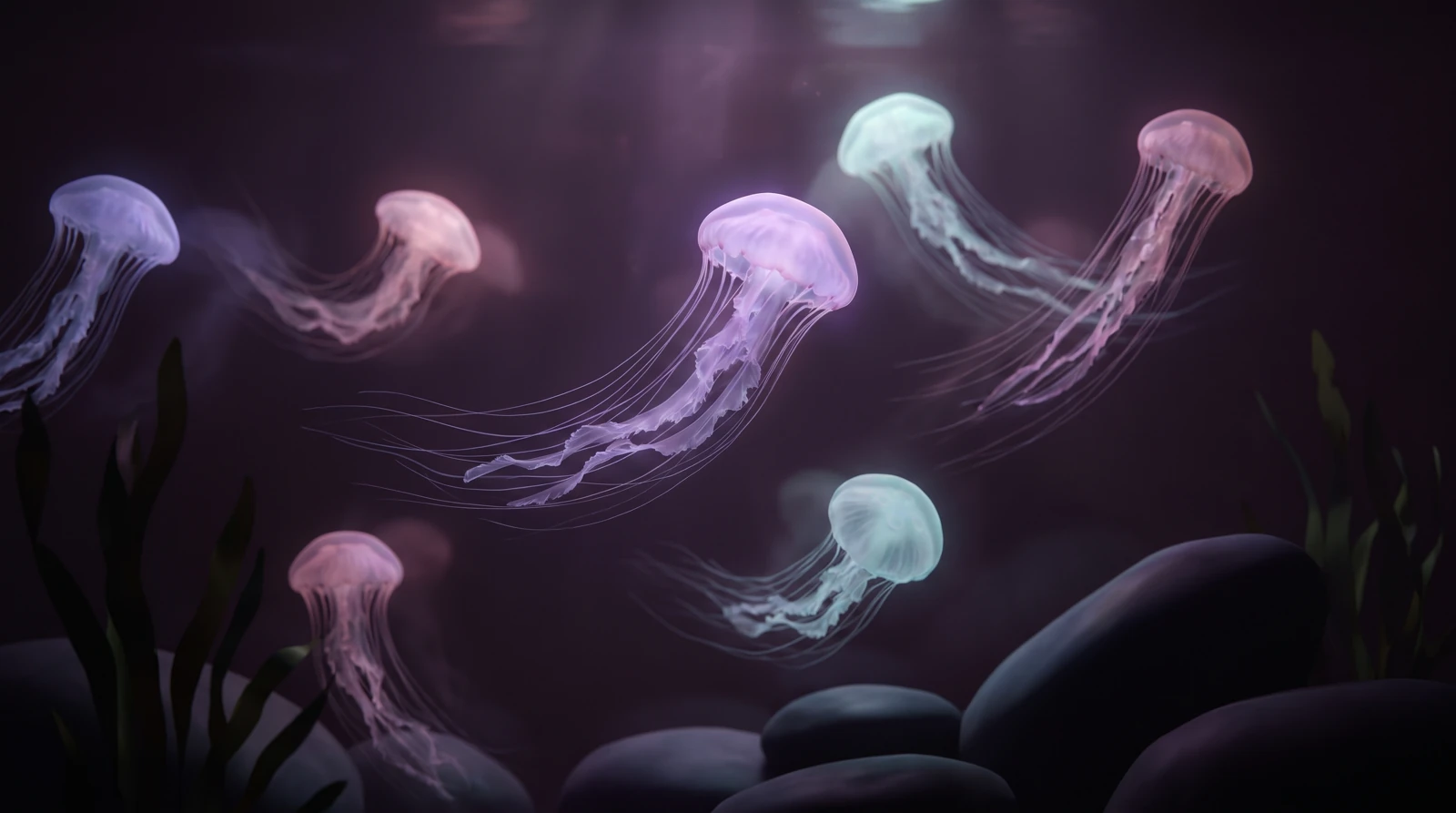
In almost every large aquarium in the world, the same scene repeats. Crowds move briskly past the sharks, pause dutifully at the octopus, and then arrive at the jellyfish gallery and simply stop. Conversation drops to a murmur. Children press their palms to the glass and go quiet. Adults who have been checking their phones all afternoon stand motionless for whole minutes, faces washed in blue, watching bells of glass-coloured tissue open and close against the dark. Nobody plans to be moved by a creature with no brain, no heart and no agenda. And yet the jellyfish tank is, by broad consent, the most tranquil room in the building.
That consent is worth taking seriously, because it points at something precise about how visual attention and calm are wired together. The jellyfish is not performing for us. It is simply the purest living example of a category our nervous system adores: slow, smooth, endlessly varied, utterly unthreatening motion.
What the research says about watching water life
The calming power of watching aquatic life is one of the better-documented corners of this field. Researchers at Plymouth University and the University of Exeter monitored visitors watching a large exhibit at the UK's National Marine Aquarium and found that time in front of the tank lowered heart rate and blood pressure, with mood and interest improving as well; notably, even watching the tank with very little in it produced measurable calming, and the effect deepened as more life was added (Cracknell et al., 2016, Environment and Behavior). The broader literature agrees: a systematic review of so-called blue space research found consistent associations between watery environments and lower stress and better mental wellbeing (Gascon et al., 2017, International Journal of Hygiene and Environmental Health).
Jellyfish refine this general effect into something close to a concentrate. A fish tank contains darting, stopping, chasing: tiny events, tiny plots. A jellyfish tank contains almost nothing but rhythm. The bell contracts, the body glides, the tentacles trail and settle, and the whole cycle begins again, never twice identical. It is motion with the plot removed, and the removal is the point.
A jellyfish is motion with the plot removed. What remains is pure rhythm, and rhythm is what the watching mind rests on.
The pulse, the drift and the breath
Watch a moon jelly for a minute and you may notice your breathing has changed. The bell's pulse sits in a slow, regular band, and human attention has a well-known tendency to entrain to gentle rhythms: we rock with boats, sway with music, breathe with the swell of the sea. The jellyfish offers a visual tempo in the same unhurried range as a long, settling exhale, and the body, given something steady to follow, tends to follow it. This is the same principle that makes paced breathing exercises work; the jellyfish simply externalises the metronome and renders it in silk.
There is also the matter of texture. A jellyfish is translucent, softly lit, and moves the way smoke or ink moves: smooth gradients, no hard edges, no sudden onsets. Sudden movement and sharp contrast are precisely the signals the visual system treats as potential threat, the things that make you flinch at a horror film. The jellyfish is the anti-flinch: every property that would trigger vigilance has been dissolved. What remains is what researchers of soft fascination describe as effortless attention, engagement without demand, the state in which the mind's overworked directing muscle is finally allowed to idle.
Drift as a lesson
Beyond the optics, I suspect the jellyfish calms us because of what it demonstrates. It barely swims; mostly it is carried. It does not grip, plan or resist, and it has crossed half a billion years this way, pulsing gently through whatever current arrives. Watching one, the stray thought surfaces unbidden: perhaps not everything requires steering. The creature is a moving emblem of the attitude every contemplative tradition tries to teach, and it teaches wordlessly, in water, for as long as you care to stand there.
You need not live near an aquarium to borrow the effect. Jellyfish cams and long slow films of tanks translate surprisingly well to a screen in a dim room, and the same visual grammar, slow drift, soft edges, deep colour against the dark, is exactly what Feelsy's flowing textures are built from; I keep one pulsing quietly on autoplay in the evening the way other households keep a fish tank, a patch of unhurried motion for the eyes to graze on while the day dissolves. Pair it with a long exhale on each slow pulse and you have, in effect, a jellyfish of your own.
The crowds at the jellyfish glass are not mistaken, and neither are you when you find yourself unable to look away. Something in us recognises the oldest rhythm in the sea: contract, release, drift, repeat. It is the tempo of a body at rest, played back to us by a creature that has never known hurry. Stand and watch a while. The watching is the practice.
Feelsy is a wellness product, not medical advice. If stress, anxiety or sleep problems persist, please speak with a qualified professional.
References
- Cracknell, D., White, M. P., Pahl, S., Nichols, W. J., & Depledge, M. H. (2016). Marine biota and psychological well-being: A preliminary examination of dose-response effects in an aquarium setting. Environment and Behavior, 48(10), 1242-1269.
- Gascon, M., Zijlema, W., Vert, C., White, M. P., & Nieuwenhuijsen, M. J. (2017). Outdoor blue spaces, human health and well-being: A systematic review of quantitative studies. International Journal of Hygiene and Environmental Health, 220(8), 1207-1221.
Frequently Asked Questions
Why is watching jellyfish so calming?
Jellyfish combine every visual property the nervous system reads as safe: slow, smooth, rhythmic motion, soft edges, gentle light and no sudden onsets. Their pulse sits in the same unhurried tempo as a long exhale, so breathing tends to settle toward it, and research on watching aquatic life has found lower heart rate and blood pressure in front of large tanks.
Is there science behind aquariums reducing stress?
Yes. A study at the UK's National Marine Aquarium found that watching a large exhibit lowered visitors' heart rate and blood pressure and improved mood, with effects strengthening as more marine life was added. A separate systematic review of blue space research links watery environments with lower stress and better mental wellbeing.
Do jellyfish videos work as well as a real tank?
A screen cannot fully replace standing before the glass, but slow jellyfish films and calm drifting visuals carry the same ingredients that do the work: unhurried rhythm, soft gradients and deep colour against darkness. Watched in a dim room, ideally paired with slow exhales, they make an effective everyday substitute for an aquarium visit.
How do I meditate while watching jellyfish?
Treat the jellyfish as a moving anchor. Rest your gaze on one bell, let your breath loosely follow its pulse, exhaling long as it glides, and when your mind wanders, return to the drift rather than scolding yourself. Five to ten minutes is plenty. The aim is effortless attention: watching without gripping.

About the author
Contributing writer
Eleonor writes about contemplative traditions, attention and the cultural history of calm. She has spent two decades collecting the rituals humans use to slow down, from zazen halls to hammams, and translating them for modern, screen-lit lives.
Feel it for yourself.
Feelsy turns reading about calm into practising it. Two minutes of a slow texture is often the whole difference.


Related reading
 Visual Meditation
Why Aquariums Are So Calming: The Science of Watching Fish
Why watching fish lowers stress: what aquarium research found about heart rate, blood pressure and mood, and how to use water and drift as visual meditation.
 Visual Meditation
Why Bioluminescence Is So Mesmerising: The Sea's Living Light
Glowing waves stop us mid-sentence and slow the breath. Here is what makes the sea shine at night, and why watching living light calms the nervous system.
 Visual Meditation
Blue Mind: Why Being Near Water Calms the Brain
What blue mind theory says about why oceans, lakes and rivers soothe us: the research on blue space, water's pull on the eye, and how to use it daily.
 Visual MeditationNew
Apricity: The Forgotten Pleasure of Winter Sun
Apricity is a forgotten English word for the warmth of the sun in winter. Here is why a few minutes of low winter sunlight can soften the darkest months.
 Visual MeditationNew
Momijigari: The Japanese Art of Autumn Leaf Viewing
Momijigari is the old Japanese tradition of travelling to see autumn leaves. Here is why fiery foliage calms the mind, and how to practise it anywhere.
 Visual MeditationNew
Why Libraries Feel So Calming
Step into a library and your shoulders drop. Here is the psychology of hush, tall shelves and shared silence, and how to borrow that feeling for your rooms.