Yoga Nidra: A Guide to Conscious Rest
Yoga Nidra is one of the oldest and most forgiving relaxation practices. Here is what it is, why it works, and how to try your first 20-minute session.
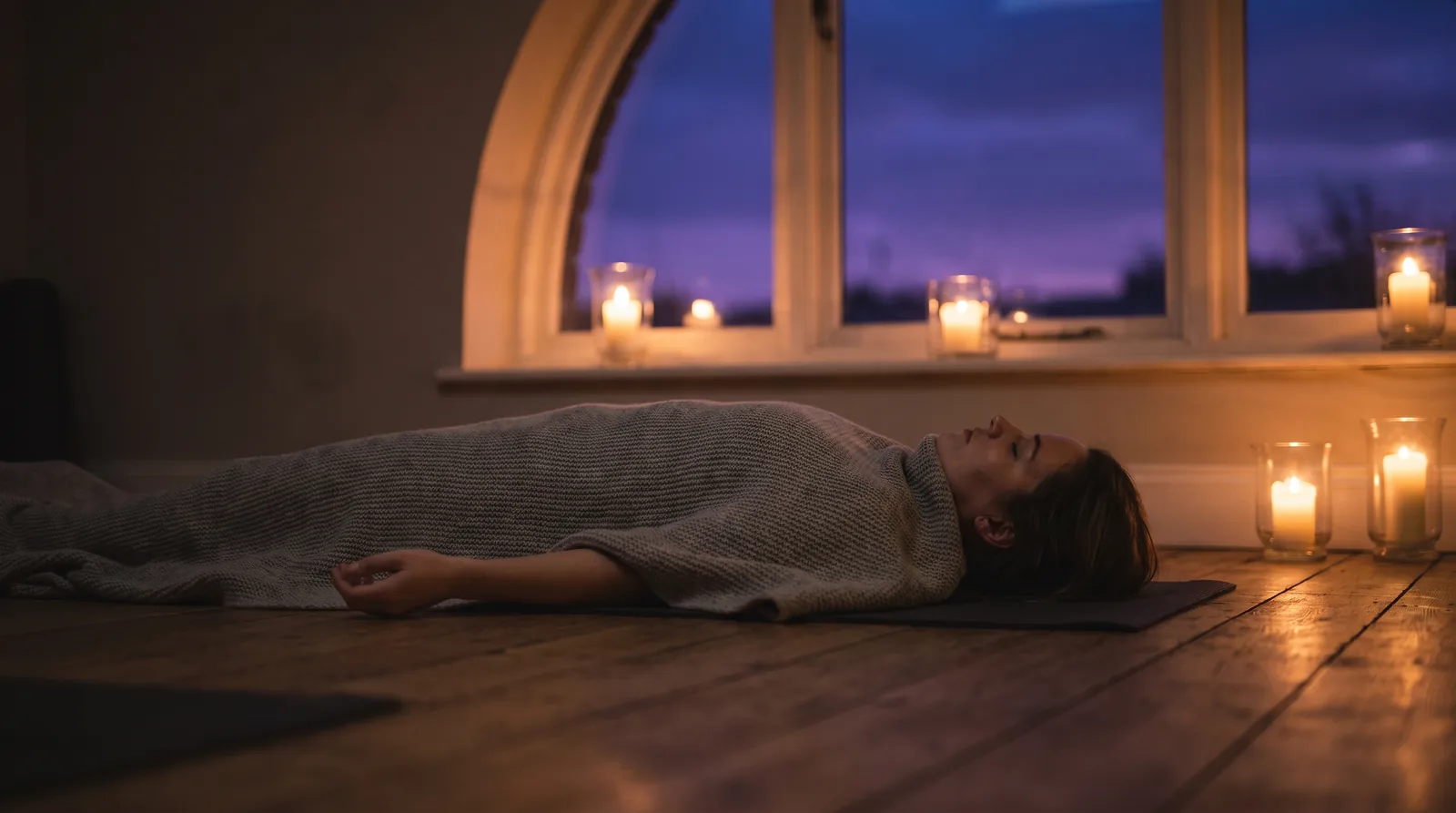
Yoga Nidra is one of the most quietly powerful practices to have survived from classical yoga into modern life. It is often translated as yogic sleep, but that is a slightly misleading name. You do not fall asleep. You enter a state that sits somewhere between waking and sleeping, in which the body rests deeply while the mind stays barely, softly aware. Practitioners often describe a twenty-minute session as feeling like a couple of hours of proper rest.
If you have found seated meditation difficult, or you struggle with sleep, Yoga Nidra is one of the most forgiving entry points on the entire map of contemplative practice.
What Yoga Nidra actually is
Yoga Nidra is a guided, lying-down practice in which a teacher (or a recording) walks your attention slowly through the body in a specific rotation of awareness. First one hand, then the other. Then arms, then legs. Then face, back, front. Then, often, breath, emotions, and images. Nothing is asked of you except to listen and stay soft.
There is no visualisation you have to succeed at. There is no mantra to memorise. The teacher's voice does the work, and your only job is to keep the body still and the attention loose enough to follow. If you drift, you drift. If you almost fall asleep, you almost fall asleep. Either is fine.
The lineage in one paragraph
Yoga Nidra was systematised in its modern form by Swami Satyananda Saraswati in the mid twentieth century, drawing on much older tantric practices of nyasa (placing attention on specific points of the body). It sits inside the wider family of yogic and contemplative traditions we described in the tour of ancient relaxation practices, and it is the direct ancestor of the sleepcast and body-scan formats now used in almost every serious sleep and meditation app.
You do not fall asleep. You rest at the edge of it, on purpose, for twenty minutes.
Why it works so well for restless minds
Sitting still with your eyes closed and no instructions is the hardest form of meditation. Yoga Nidra is the opposite. You are lying down, a voice is guiding you, and the pace is slow enough that even a very busy mind eventually surrenders. There is nothing to control.
For readers who have tried and given up on traditional meditation, this is often the breakthrough practice. It is discussed in more detail in meditation for people who cannot meditate, where it sits alongside visual meditation as one of the two gentlest on-ramps.
What happens in your body
During a good Yoga Nidra session, your body enters a state of deep parasympathetic activation. Heart rate slows. Breath lengthens without effort. Muscles release. Brainwave activity shifts towards patterns associated with deep relaxation and, in longer sessions, towards the edge of slow-wave sleep while consciousness stays present.
The mechanisms overlap significantly with the broader physiology of slow, guided practices. The research on slow breathing more generally shows the same pattern: paced, slow, low-effort attention on the body raises heart rate variability and parasympathetic tone (Zaccaro et al., 2018, Frontiers in Human Neuroscience). Yoga Nidra is essentially a longer, more elaborate version of that shift, delivered by a voice instead of a count.
The classical structure of a session
Most Yoga Nidra sessions follow a recognisable arc.
- Settling. You lie down (usually on your back, sometimes with a bolster under the knees), get comfortable, and are invited to stop moving.
- Sankalpa. A short, positive intention or resolution, chosen once and repeated at the start and end of the practice. Traditional but optional.
- Rotation of consciousness. The teacher guides attention through the body in a specific sequence, often quite fast at first (right thumb, second finger, third finger, and so on), which prevents the mind from analysing.
- Breath awareness. Attention rests on the breath in different locations without changing it.
- Opposites. The teacher pairs sensations (heavy and light, warm and cool) to loosen the mind's tendency to categorise.
- Imagery. Simple, archetypal images are named slowly. You may or may not see them.
- Return. The sankalpa is repeated. Attention returns gradually to the room, and you sit up.
Not every session follows this template exactly. Modern versions often shorten or reorder it. The essential ingredients are the lying-down posture, the guided voice, and the slow rotation of awareness.
How to try your first session
- Set aside twenty minutes when you will not be interrupted. After work is a common favourite. Before sleep is also excellent.
- Lie flat on your back on a firm surface. A yoga mat or a rug on the floor is better than a soft bed for a first attempt. A cushion under the head and a rolled blanket under the knees are welcome.
- Cover yourself with a light blanket. Body temperature drops in deep rest and cold can pull you out.
- Use headphones with a good recorded Yoga Nidra session, or an in-app narrated body scan. Twenty minutes is a comfortable first length.
- Follow the voice. When your mind wanders, no problem. Come back on the next instruction.
- When the session ends, sit up slowly. Give yourself a minute before you stand.
For a wider frame on how this fits with sleep specifically, pair the practice with the ritual described in how to fall asleep faster.
Common questions
What if I fall asleep?
It happens, especially at first. It is not a failure. Your body clearly needed the sleep. Over time, as your nervous system learns the shape of the practice, you will stay on the edge more often.
Do I need a sankalpa?
No. It is a beautiful tradition and it can add depth, but the physiological benefits of the practice are present with or without it. If you do choose one, make it a short, present-tense sentence you actually believe (I am at peace with myself, for example), and use the same one for a long time.
How often should I practise?
Two or three sessions a week is a strong, sustainable starting point. Every day is beautiful if you have the time. Even once a week produces noticeable effects.
Is it the same as a body scan?
Body scans are a modern descendant of Yoga Nidra and share most of its ingredients. A traditional Yoga Nidra is usually longer, more structured, and includes imagery and opposites in addition to the body scan itself.
The quiet promise
Yoga Nidra will not turn your life around in a week. What it will do, if you give it a fair try, is teach your body that deep rest is available without unconsciousness. Once your nervous system knows that, a lot of things get easier: sleep, breath, the space between one difficult moment and the next. It is one of the oldest gifts contemplative practice has to offer. It is still one of the best.
Feelsy is a wellness product, not medical advice. If stress, anxiety or sleep problems persist, please speak with a qualified professional.
References
- Zaccaro, A., Piarulli, A., Laurino, M., et al. (2018). How breath-control can change your life: A systematic review on psycho-physiological correlates of slow breathing. Frontiers in Human Neuroscience, 12, 353.
Frequently Asked Questions
What is Yoga Nidra?
Yoga Nidra is a guided, lying-down practice often translated as yogic sleep, though you do not actually fall asleep, instead entering a state between waking and sleeping where the body rests deeply while the mind stays barely, softly aware. A teacher or recording walks your attention slowly through the body, and practitioners often describe a twenty-minute session as feeling like a couple of hours of proper rest.
Where does Yoga Nidra come from?
It was systematised in its modern form by Swami Satyananda Saraswati in the mid twentieth century, drawing on older tantric practices of nyasa, or placing attention on specific points of the body. It is described as the direct ancestor of the sleepcast and body-scan formats used in almost every serious sleep and meditation app today.
What happens in the body during Yoga Nidra?
The body enters a state of deep parasympathetic activation, with heart rate slowing, breath lengthening without effort, and muscles releasing. This overlaps with research on slow breathing more generally, which shows that paced, low-effort attention on the body raises heart rate variability and parasympathetic tone (Zaccaro et al., 2018).
What does a typical Yoga Nidra session involve?
Most sessions follow a recognisable arc: settling into a lying position, an optional sankalpa or short positive intention, a rotation of consciousness moving attention through the body, breath awareness, pairing of opposite sensations like heavy and light, simple imagery, and finally a return to full awareness where the sankalpa is repeated before sitting up.
What if I fall asleep during Yoga Nidra, or don't want to use a sankalpa?
Falling asleep, especially at first, is not a failure, it usually just means your body needed the sleep, and over time you will learn to stay on the edge more often. A sankalpa is a beautiful tradition but optional, since the physiological benefits of the practice are present with or without one, and two or three sessions a week is described as a strong, sustainable starting point.

About the author
Contributing writer
Eleonor writes about contemplative traditions, attention and the cultural history of calm. She has spent two decades collecting the rituals humans use to slow down, from zazen halls to hammams, and translating them for modern, screen-lit lives.
Feel it for yourself.
Feelsy turns reading about calm into practising it. Two minutes of a slow texture is often the whole difference.


Related reading
 Sleep
SleepHow to Fall Asleep Faster: Sound, Light and Ritual
Falling asleep is a skill, not a stroke of luck. Here is how sound, light and a 15-minute ritual can quiet a racing mind and shorten the trip to sleep.
 Visual Meditation
Meditation for People Who Can't Meditate
If sitting still with your eyes closed feels impossible, you are not broken. Here is a gentler on-ramp built around senses, movement and very small doses.
 Ancient Wisdom
Ancient Practices for Modern Calm: A World Tour
Humans have engineered calm for thousands of years. A tour through Zen, pranayama, hammam culture, forest bathing and the ancestors of visual meditation.
 Ancient Wisdom
Döstädning: The Gentle Swedish Art of Death Cleaning
What Swedish death cleaning really means: the calm philosophy of döstädning, how it differs from ordinary decluttering, and how to begin at any age.
 Ancient Wisdom
How to Start a Gratitude Journal You Will Actually Keep
How to start a gratitude journal that actually helps: what the research found, why most lists go stale, and the very old art of counting blessings.
 Ancient Wisdom
Haiku as Meditation: Seventeen Syllables of Attention
How writing haiku trains attention: why the tiny form works like meditation, what noticing small moments does for wellbeing, and how to write your first.