Bonsai and Penjing: The Slow Art of Growing Patience
Bonsai began as Chinese penjing: a landscape grown in a tray over decades. Why tending a miniature tree calms the mind, and how to begin without owning one.
By Mei Lin
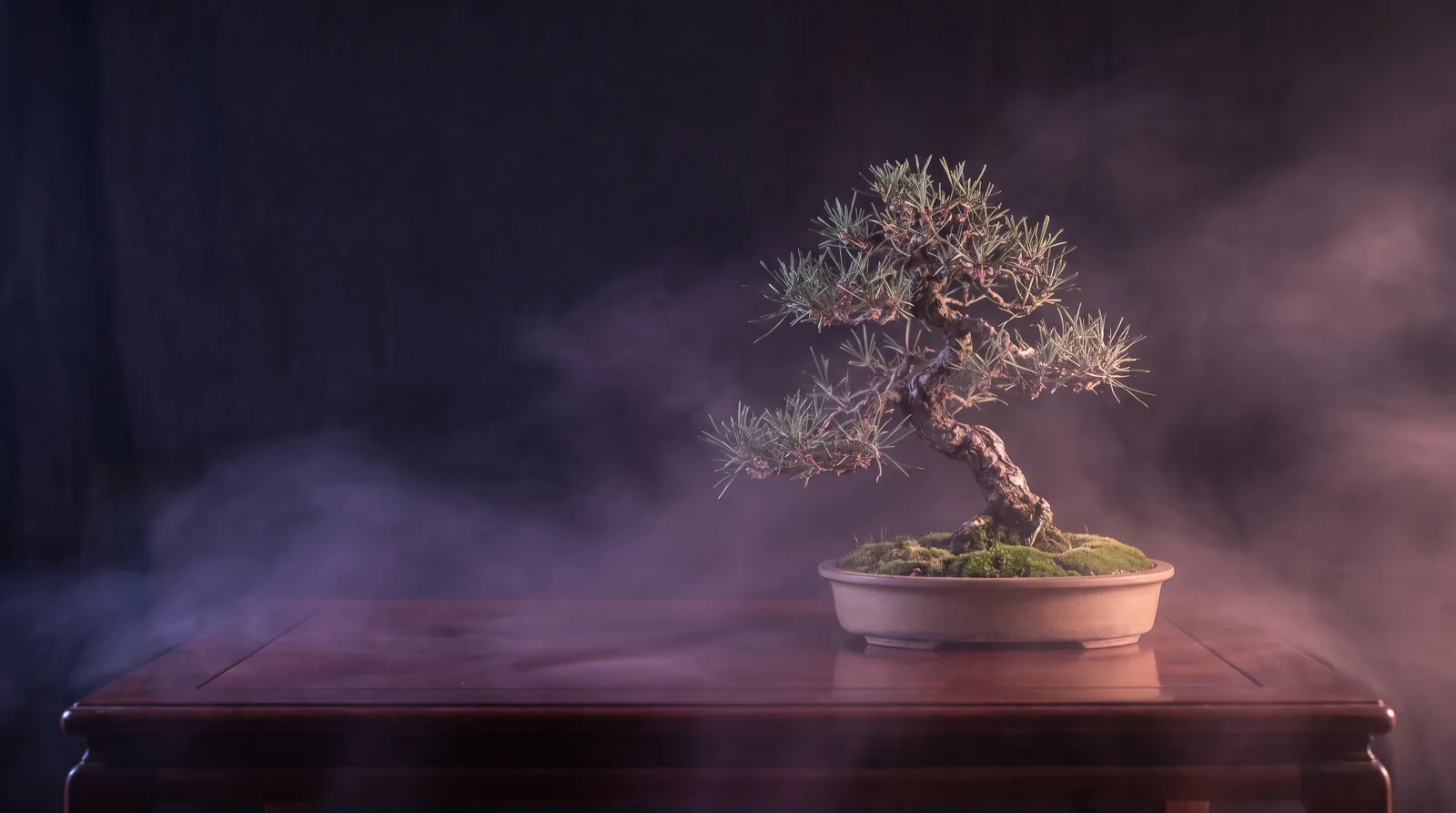
On a balcony four floors above a Shanghai lane, a neighbor of my childhood kept eleven small trees. Elms, a juniper, one flowering apricot that was older, he claimed, than his marriage. Every morning he stood among them with a brass watering can and a pair of scissors he used perhaps twice a week, and mostly he just looked. As a girl I found this unbearably boring. He owned trees that did almost nothing, and he attended to them as if they were news. It took me decades to understand that the trees were not the practice. The looking was the practice. The trees were simply patient enough to teach it.
Penjing before bonsai
The art most of the world knows by its Japanese name, bonsai, began in China as penjing: tray scenery. More than a thousand years ago, Chinese gardeners and scholars were already growing miniature trees and arranging stone, moss and water in shallow basins, composing whole landscapes small enough to hold. Penjing is the potted cousin of shan shui painting: the same misty mountains and bent pines, rendered not in ink but in living wood. The tradition traveled to Japan, where it was refined toward a single tree in quiet balance, and from there it circled the globe. The lineage matters because it explains what these trees are for. A penjing was never a houseplant. It is a landscape for the mind to walk in, a mountain range the size of a teapot, kept by someone willing to think in decades.
Why a tree teaches what a screen cannot
Everything else in modern life answers immediately. The tree does not. Wire a branch toward the light today and the wood will accept the suggestion over a year, perhaps two. Prune in spring and the reply arrives in autumn. This is the slowest feedback loop most of us will ever voluntarily enter, and that is exactly its value. You cannot refresh a juniper. You can only water it, turn it toward the sun, remove what is dead, and come back tomorrow. The practitioner's word for this is not control but cooperation: the tree proposes, you edit gently, the seasons decide. People who keep bonsai often say the tree trains them far more than they train the tree, and what it trains is precisely the muscle our notifications have been quietly dismantling: the ability to care about something that will not respond today.
You cannot refresh a juniper. The tree proposes, you edit gently, the seasons decide.
What tending does to the body
The calm of working with plants is not only poetic; it has been measured. In one experiment, researchers gave stressed participants either half an hour of gardening or half an hour of indoor reading, and found that gardening produced a fuller recovery: salivary cortisol, the stress hormone, dropped more sharply, and positive mood was fully restored where reading left it flat (Van Den Berg & Custers, 2011, Journal of Health Psychology). Tending a miniature tree concentrates that same medicine into a few square feet: hands in contact with soil and leaf, eyes resting on green, a task that is real but small, absorbing but never urgent. Ten attentive minutes with a watering can ask nothing of you and return more than they ask.
The lesson of the lost tree
Every keeper of small trees eventually tells you the same story, usually quietly: the one they lost. A juniper that browned in a single hot week, an elm that never woke from winter. My neighbor lost his apricot the year I left for university, and I remember being surprised that he was not more surprised. Trees die, he said, watering the others. What the tradition teaches here is something Chinese contemplative arts return to again and again, and that wabi-sabi later named in Japan: care is not control, and love of a living thing is inseparable from its impermanence. You can do everything correctly and still lose the tree. You continue anyway, because the practice was never a contract with a guaranteed outcome; it was a daily agreement to pay attention. This is a hard lesson delivered in the gentlest possible classroom, and people who absorb it there often report that it travels: to gardens, to work, to the people they love. Tend faithfully, hold lightly.
Begin without owning a tree
The honest entry into this practice is not a purchase but a habit of attention, and you can start it today. Visit a public penjing or bonsai collection if your city hides one; stand in front of the oldest tree and let its timescale embarrass your inbox. Or begin with any plant already on your windowsill: give it one unhurried minute each morning, the neighbor's ritual, looking before doing. Notice what changed overnight, which is always something and never much. I keep a version of this on the days I travel, letting one of Feelsy's slow botanical textures drift on autoplay beside my tea, a pocket landscape when the balcony is far away. And if a tree does eventually come to live with you, buy a young, forgiving species and let it teach you the first lesson every keeper learns: the scissors are used twice a week. The looking is every day.
Feelsy is a wellness product, not medical advice. If stress, anxiety or sleep problems persist, please speak with a qualified professional.
References
- Van Den Berg, A. E., & Custers, M. H. G. (2011). Gardening promotes neuroendocrine and affective restoration from stress. Journal of Health Psychology, 16(1), 3-11.
Frequently Asked Questions
What is the difference between penjing and bonsai?
Penjing, meaning tray scenery, is the older Chinese art from which bonsai descends: miniature trees arranged with stone, moss and water into whole landscapes, a living cousin of shan shui ink painting. The tradition traveled to Japan, where it was refined toward a single tree in quiet balance and given the name bonsai, the form most of the world knows today.
Why is bonsai considered a meditation?
A bonsai answers on the timescale of seasons, not seconds: a wired branch takes a year or two to accept its new direction, and spring pruning is answered in autumn. Tending one means entering the slowest feedback loop most of us will ever choose, which trains the ability to care about something that will not respond today. Keepers often say the tree trains them more than they train the tree.
Does gardening actually reduce stress?
In one experiment, stressed participants who gardened for half an hour recovered more fully than those who read indoors: their cortisol, the stress hormone, dropped more sharply and their positive mood was fully restored where reading left it flat (Van Den Berg & Custers, 2011). Tending a miniature tree concentrates the same ingredients into a few square feet: soil, leaf, and a task that is absorbing but never urgent.
How do I start bonsai as a beginner?
Start with attention rather than a purchase. Visit a public bonsai or penjing collection and stand with the oldest tree, or give any plant on your windowsill one unhurried minute of looking each morning before doing anything to it. If a tree does come to live with you, choose a young, forgiving species and remember that the scissors are used twice a week while the looking is every day.
About the author
Contributing writer
Mei grew up in Shanghai around tea that could not be hurried and grandmothers who considered stillness a skill. She writes about slow hands and sensory ritual: tea, calligraphy, qigong, and the quiet crafts that taught the world how to pay attention.
Feel it for yourself.
Feelsy turns reading about calm into practising it. Two minutes of a slow texture is often the whole difference.


Related reading
 Ancient Wisdom
The Zen Garden: Why Raking Gravel Stills the Mind
What a zen garden is and why it calms: the history of karesansui, the perception science of Ryoan-ji, and a way to practise dry-garden attention at home.
 Ancient Wisdom
Shinrin-Yoku: Why Forests Calm the Human Mind
Japan turned a walk in the woods into preventive medicine. The research behind forest bathing, what it does to stress physiology, and how to practise it without a forest.
 Visual Meditation
Shan Shui: Why Misty Mountain Paintings Quiet the Mind
Why Chinese landscape painting calms the mind: what shan shui is, the psychology of mist and negative space, and how to look at a painting as meditation.
 Ancient Wisdom
Döstädning: The Gentle Swedish Art of Death Cleaning
What Swedish death cleaning really means: the calm philosophy of döstädning, how it differs from ordinary decluttering, and how to begin at any age.
 Ancient Wisdom
How to Start a Gratitude Journal You Will Actually Keep
How to start a gratitude journal that actually helps: what the research found, why most lists go stale, and the very old art of counting blessings.
 Ancient Wisdom
Haiku as Meditation: Seventeen Syllables of Attention
How writing haiku trains attention: why the tiny form works like meditation, what noticing small moments does for wellbeing, and how to write your first.