The Zen Garden: Why Raking Gravel Stills the Mind
What a zen garden is and why it calms: the history of karesansui, the perception science of Ryoan-ji, and a way to practise dry-garden attention at home.
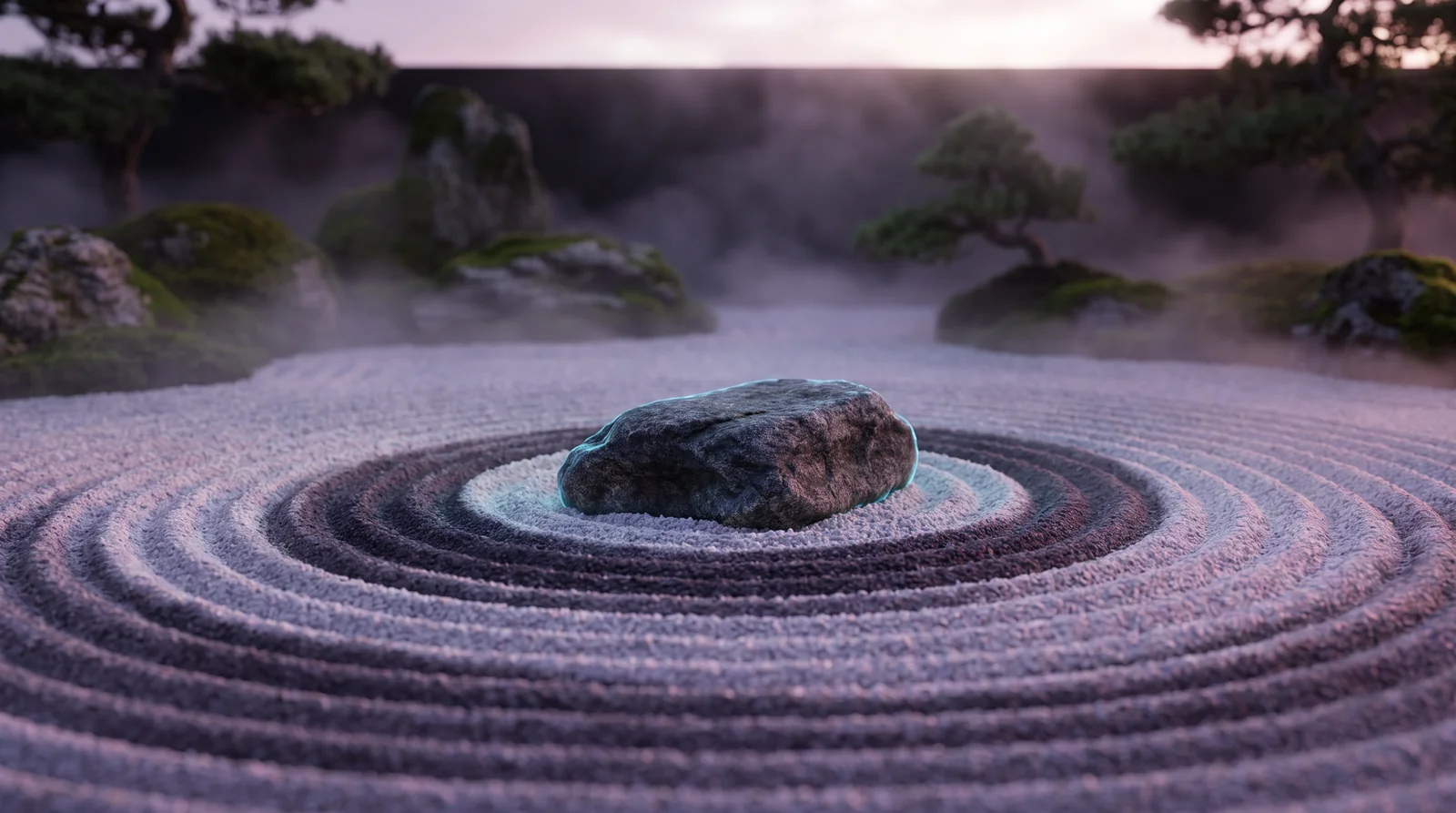
In the north-west corner of Kyoto there is a garden with no flowers, no pond, no shade tree, and, by most definitions, no garden. Fifteen stones sit in a rectangle of raked white gravel about the size of a tennis court. Visitors arrive by the coachload, remove their shoes, sit down on a wooden veranda, and look at it. Most fall quiet within a minute or two, which is remarkable in any tourist attraction, and they stay quiet, some of them, for a very long time. The garden is Ryoan-ji, laid out around the end of the fifteenth century, and it has been performing this small hypnosis on visitors for five hundred years. Nobody who made it left a word of explanation. The stones, as one abbot liked to say, are the explanation.
What most of us call a zen garden has a proper name: karesansui, the dry landscape. Water is the heart of the classical Japanese garden, and the dry garden's founding gesture is to remove it and then depict it anyway. Gravel stands for the sea; the raked lines are its currents; stones are islands, or mountains rising from cloud. It is landscape painting conducted in mineral, a cousin of the Chinese ink traditions that arrived with Zen Buddhism itself, and it was made for the same audience: people living at close quarters, short of space and time, who needed a mountain range that could fit beside a meditation hall.
A landscape with almost nothing in it
The first thing the dry garden teaches is that calm is partly a matter of subtraction. A flower bed asks the eye to do work: colour to parse, growth to assess, deadheading to notice. Gravel and stone ask for almost nothing. Nothing in a karesansui blooms, fades, beckons or needs you. The composition changes at the speed of moss, which is to say, at a speed the nervous system reads as eternity. What remains, once every demand is removed, is pure arrangement: mass and emptiness, placed with enormous care, and the emptiness is doing most of the work. Like the untouched silk in an ink painting, the raked void gives the eye somewhere to rest between thoughts.
There may be more design in that restfulness than the eye can report. When researchers analysed the empty space at Ryoan-ji, they found that the gaps between the stone groups form a hidden branching structure, converging, like a tree seen from above, on the veranda where visitors have always been seated to look (Van Tonder, Lyons and Ejima, 2002, Nature). Shift the stones slightly in a model and the structure collapses. Whether the garden's makers computed this or simply felt their way to it, the finding suggests something lovely: that the most famous emptiness in Japan is not empty at all, but tuned, the way a bell is tuned, to the exact spot where a tired person sits down.
The most famous emptiness in Japan is not empty at all, but tuned, the way a bell is tuned.
The rake is the practice
Visitors see the finished garden; monks know it chiefly as a chore. The gravel must be raked, and raking is slow, repetitive, mildly effortful work that occupies the hands, the eyes and the breath all at once. Temple training has never treated such work as an interruption to meditation. It is meditation, filed under samu, the practice of labour done with full attention, and the dry garden may be the only art form on earth whose maintenance is its meaning. Anyone who has raked leaves into long, even rows, or smoothed sand on a beach with the flat of a hand, knows the state it produces: a narrowing of the world to the line being drawn, and a quietness that arrives without being asked.
This is the same handrail for attention that runs through so many older practices: the calligrapher's stroke, the tea maker's pour, the slow circling arms of qigong. Give the restless mind one simple, continuous, physical thing to do, and it stops auditioning disasters. The rake adds a satisfying finality: behind it, order; ahead of it, disorder; and a clean line between the two that moves at exactly the speed of your own effort. Small desktop zen gardens, a tray of sand and a wooden rake beside the keyboard, are usually sold as novelties. They are better understood as the cheapest piece of contemplative equipment a desk can hold.
Practising the dry garden at home
You do not need gravel, a courtyard or a single stone to borrow what karesansui knows. You need its three habits: subtraction, arrangement and slow lines. Here is a practice that takes ten minutes and works on a windowsill, a desk or a kitchen table.
- Clear a rectangle. Choose one small surface and remove everything from it. Work unhurriedly; the clearing is part of the practice, not preparation for it. What you are making is emptiness, and it should be made carefully.
- Place three things. Choose three objects with some weight to them, a stone, a cup, a bowl, and arrange them in the cleared space until the arrangement looks inevitable. Move them by centimetres. Notice that some placements rest the eye and others do not, and that you can feel the difference before you can explain it.
- Draw slow lines. If you have a tray of sand, rice or salt, rake furrows around your objects with a fork or your fingertips, letting each line take a full breath. If not, trace the outline of the arrangement with your eyes at the same unhurried pace, circling each object the way raked gravel circles a stone.
- Sit at your veranda. Move back, settle where the whole rectangle is visible, and look at what you have made for two quiet minutes. When thoughts pull you away, return to the space between the objects rather than the objects themselves. The gaps are the garden.
A sea that fits beside the kettle
I keep my own dry garden ambitions modest: a cleared corner of the desk, a grey stone from a Welsh beach, and, on evenings when the day refuses to end, a screen. One of Feelsy's slow sand textures, drifting in ripples across the dark, does for my eyes what the rake does for the monk's gravel: it draws long, patient lines and asks me only to follow them. I let autoplay carry one scene into the next, the way a garden carries the eye from stone to stone, and somewhere in the following, the day loosens its grip. Five centuries of visitors to a rectangle of raked stones would recognise the transaction at once. Sit down at the edge of something calm and almost empty, and let it lend you its arrangement.
Feelsy is a wellness product, not medical advice. If stress, anxiety or sleep problems persist, please speak with a qualified professional.
References
- Van Tonder, G. J., Lyons, M. J., & Ejima, Y. (2002). Visual structure of a Japanese Zen garden. Nature, 419(6905), 359–360.
Frequently Asked Questions
What is a zen garden or karesansui?
Karesansui, the dry landscape, is the proper name for what is commonly called a zen garden, a composition of raked gravel and stones with no water, flowers or shade tree. Gravel stands for the sea, raked lines represent its currents, and stones represent islands or mountains, making it landscape painting conducted in mineral.
What did researchers discover about the empty space at Ryoan-ji?
Researchers analysing the famous garden at Ryoan-ji found that the gaps between its stone groups form a hidden branching structure that converges on the veranda where visitors have always sat to view it. Shifting the stones even slightly in a model collapsed this structure, suggesting the layout is tuned precisely to where a tired viewer sits.
Why is raking the gravel itself considered meditation?
Monks treat raking as samu, the practice of labour done with full attention, since it is slow, repetitive, mildly effortful work that occupies the hands, eyes and breath at once. This gives the restless mind one simple, continuous physical task, which is the same principle behind calligraphy strokes and slow qigong movements.
Why does a nearly empty garden feel calming rather than boring?
Gravel and stone ask almost nothing of the eye, since nothing in them blooms, fades or beckons, so the composition changes at the pace of moss, which the nervous system reads as eternity. What remains is pure arrangement of mass and emptiness, and like untouched silk in an ink painting, the raked void gives the eye somewhere to rest between thoughts.
How can you practise a dry-garden style meditation at home?
Clear a small rectangle of a desk or windowsill, place three weighted objects like a stone, cup or bowl until the arrangement feels inevitable, then draw slow lines around them with a fork in sand or simply trace the outline with your eyes at an unhurried pace. Finally sit back and look at what you have made for two quiet minutes, returning attention to the gaps between objects rather than the objects themselves.

About the author
Contributing writer
Eleonor writes about contemplative traditions, attention and the cultural history of calm. She has spent two decades collecting the rituals humans use to slow down, from zazen halls to hammams, and translating them for modern, screen-lit lives.
Feel it for yourself.
Feelsy turns reading about calm into practising it. Two minutes of a slow texture is often the whole difference.


Related reading
 Ancient Wisdom
Sand Mandalas and the Art of Letting Go
Tibetan monks spend days building an intricate sand mandala, then sweep it away. What the ritual teaches about impermanence, process and why watching can be meditation.
 Visual Meditation
Shan Shui: Why Misty Mountain Paintings Quiet the Mind
Why Chinese landscape painting calms the mind: what shan shui is, the psychology of mist and negative space, and how to look at a painting as meditation.
 Ancient Wisdom
Shinrin-Yoku: Why Forests Calm the Human Mind
Japan turned a walk in the woods into preventive medicine. The research behind forest bathing, what it does to stress physiology, and how to practise it without a forest.
 Ancient Wisdom
Döstädning: The Gentle Swedish Art of Death Cleaning
What Swedish death cleaning really means: the calm philosophy of döstädning, how it differs from ordinary decluttering, and how to begin at any age.
 Ancient Wisdom
How to Start a Gratitude Journal You Will Actually Keep
How to start a gratitude journal that actually helps: what the research found, why most lists go stale, and the very old art of counting blessings.
 Ancient Wisdom
Haiku as Meditation: Seventeen Syllables of Attention
How writing haiku trains attention: why the tiny form works like meditation, what noticing small moments does for wellbeing, and how to write your first.