Embroidery as Meditation: The Quiet Work of Needle and Thread
Embroidery slows the hands and settles the mind one stitch at a time. Why needlework is so calming, what research on craft found, and how to begin.
By Mei Lin
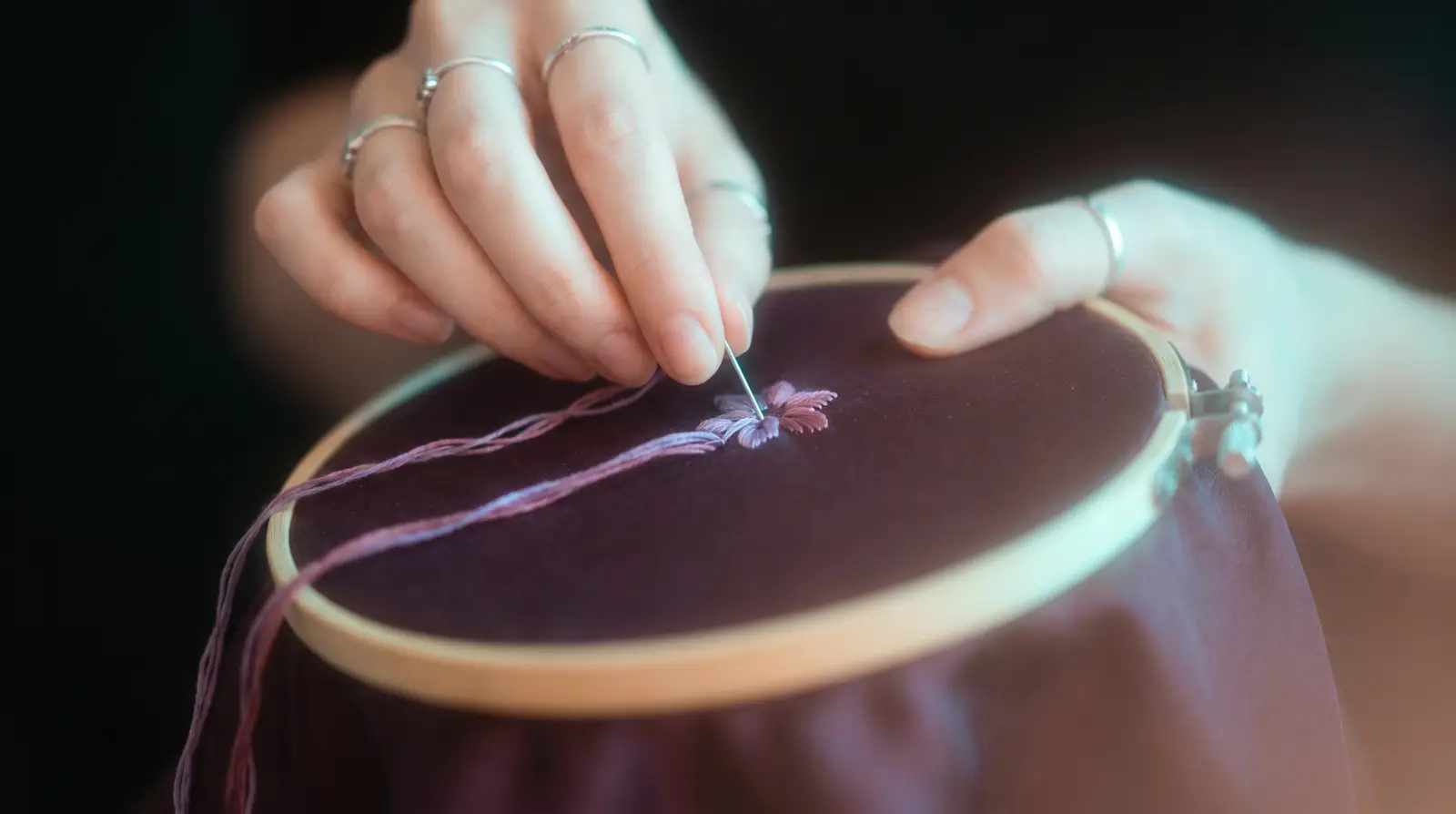
My grandmother's embroidery hoop hung on a nail by the kitchen window in Shanghai, and I never once saw her hurry at it. She stitched in the hour after lunch, when the light came in flat and gold: one stitch, a small pull of thread, a pause to smooth the silk with her thumb. As a child I assumed she was making a picture. Now I think the picture was almost beside the point. The stitching itself was the practice, a way of sitting still with busy hands, and it left her softer than any nap ever did.
One stitch, then the next
Embroidery cannot be rushed. The needle goes down, the needle comes up, the thread follows at the speed the thread follows. Force it and the silk puckers; hurry it and the knots arrive. So the craft imposes its own tempo, and the mind, given no choice, eventually accepts the terms. Each stitch is tiny and complete, a whole task finished every few seconds. For anyone whose working life is made of tasks that never quite end, there is deep relief in work that ends constantly, in miniature, all afternoon.
The scale matters too. Embroidery narrows the world to a hoop: one small circle of cloth where the eyes and the hands agree to meet. Attention in daily life is a flock of startled birds. At the hoop it becomes one bird, on one branch. The needle gives the mind a fingertip-sized home, and thoughts that circle it tend to land.
What research says about needle and mood
The research on stitching crafts, though young, points a consistent direction. An international survey of more than 3,500 knitters, published in the British Journal of Occupational Therapy, found that more frequent knitting was associated with feeling calmer and happier, with respondents describing the rhythmic, repetitive movements as a route to relaxation (Riley, Corkhill and Morris, 2013). Work on textile crafts more broadly, including an Art Therapy study of women who create with textiles, suggests these makers use their craft deliberately to restore mood and settle arousal after difficult days (Futterman Collier, 2011). Anyone who has watched a stitcher lose an hour to a hoop will find none of this surprising: the needle is a small tool that reliably does a large quiet thing.
The thread moves at the speed of a settled breath, and the mind follows it.
The rhythm the hands remember
Like kneading dough or sweeping a courtyard, embroidery is rhythm work. The same small motion repeats with slight variation, both hands engaged, the breath falling in beside the beat without being asked. Repetitive skilled movement of this kind is one of the oldest ways humans have settled themselves; long before anyone spoke of mindfulness, people were spinning, weaving, mending and stitching their way to the same steadiness. The hands keep a slow pulse, and the body, hearing it, concludes that nothing is wrong. You cannot stitch and brace at the same time.
Su xiu: patience as inheritance
In Suzhou, near where my grandmother was raised, embroidery was refined over centuries into su xiu, one of China's great needle traditions. Masters of it split a single silk thread into finer and finer filaments, sometimes dozens from one strand, to render the gradient of a fish's scale or the mist on a mountain. A single work can ask months or years. No one stitches that way to finish quickly; the tradition exists because generations of makers accepted that some beauty only arrives at the needle's pace. My grandmother put it more plainly: slow hands, quiet heart. She meant it as an observation, not an instruction. The hands go slowly, and the heart follows.
How to begin stitching
- Start small and plain: a hoop, a square of cotton, a needle, two or three colors of thread. A simple outline pattern helps, but even rows of running stitch are enough.
- Give it fifteen unhurried minutes, ideally with the phone in another room. Let the first minutes be clumsy; threading and knotting are part of the ritual.
- Let the stitches be uneven. The unevenness is the record of a human hour, not a flaw in it.
- End by smoothing the cloth flat and looking at what the hour left behind, then put the hoop somewhere you will see it tomorrow.
When the eyes tire, let them rest somewhere equally slow. I often close a stitching session with two minutes of a drifting texture in Feelsy and one round of its 4-7-8 breathing exercise: the same unhurried rhythm, carried from the hands to the breath.
The picture is beside the point
My grandmother left an unfinished piece on the hoop by the window, a branch of plum blossom missing half its petals, and for years that bothered me. It does not anymore. The petals she did stitch had already done their work, hundreds of quiet afternoons of it. Embroidery will give you handkerchiefs and hoop art and gifts, and those are real pleasures. But its first gift is the hour itself: a stretch of time with a beginning, a rhythm, and a needle's-width of world to attend to. The picture can wait. The practice is the point.
Feelsy is a wellness product, not medical advice. If stress, anxiety or sleep problems persist, please speak with a qualified professional.
References
- Riley, J., Corkhill, B., & Morris, C. (2013). The benefits of knitting for personal and social wellbeing in adulthood: Findings from an international survey. British Journal of Occupational Therapy, 76(2), 50-57.
- Futterman Collier, A. (2011). The well-being of women who create with textiles: Implications for art therapy. Art Therapy, 28(3), 104-112.
Frequently Asked Questions
Is embroidery good for anxiety?
Many people find it deeply settling. Each stitch is a tiny completed task, the repetitive rhythm engages both hands, and the hoop narrows attention to one small circle of cloth, which leaves little room for circling thoughts. Survey research on knitting, a close cousin, found more frequent stitching associated with feeling calmer and happier.
How is embroidery a form of meditation?
It shares meditation's essential structure: a single point of focus, a repeating rhythm, and a pace you cannot force. The needle gives the mind a fingertip-sized anchor the way a breath or a candle flame does, and the craft's own tempo, slow by necessity, sets the tempo of thought. You cannot stitch and brace at the same time.
What do I need to start embroidery for relaxation?
Very little: a hoop, a square of cotton, a needle, and two or three colors of thread. A simple outline pattern helps, but even rows of running stitch are enough. Give it fifteen unhurried minutes with the phone in another room, and let the stitches be uneven; the unevenness is the record of a human hour.
What is Suzhou embroidery?
Su xiu is one of China's great embroidery traditions, refined over centuries in the city of Suzhou. Its masters split a single silk thread into dozens of finer filaments to render subtle gradients, and a single work can take months or years. It is a tradition built on the acceptance that some beauty only arrives at the needle's pace.
About the author
Contributing writer
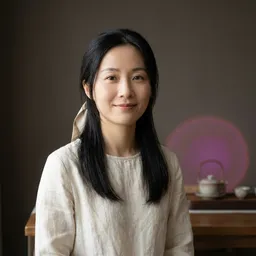
Mei grew up in Shanghai around tea that could not be hurried and grandmothers who considered stillness a skill. She writes about slow hands and sensory ritual: tea, calligraphy, qigong, and the quiet crafts that taught the world how to pay attention.
Feel it for yourself.
Feelsy turns reading about calm into practising it. Two minutes of a slow texture is often the whole difference.


Related reading
 Breath & Body
Knitting as Meditation: Why Repeating Stitches Calms the Mind
Why knitting soothes anxiety: rhythm, repetition and the quiet focus of busy hands, what knitters report about calm, and how to begin the practice.
 Visual Meditation
Zentangle: The Meditative Drawing Practice Anyone Can Learn
Zentangle turns simple repeated pen strokes into a calming ritual. Learn how the method works, why structured drawing soothes anxiety, and how to begin tonight.
 Visual Meditation
Calligraphy as Meditation: Why Slow Writing Calms a Fast Mind
Why calligraphy calms a racing mind: the science of slow writing and attention, and how to practice mindful handwriting with any pen and ten quiet minutes.
 Breath & BodyNew
The Slow Morning Ritual: How to Start Your Day Without Rushing
A slow morning is not a long one. How a few unhurried minutes of warmth, breath and quiet before the scroll can change the shape of your entire day.
 Breath & Body
ADHD 'Object Permanence': Why Out of Sight Really Is Out of Mind
Forgetting things exist the moment they leave your sight isn't carelessness. Here's what's actually behind ADHD 'object permanence' issues, and what helps.
 Breath & Body
ADHD Waiting Mode: Why a 3 p.m. Appointment Eats the Whole Day
ADHD waiting mode is when one afternoon appointment freezes your entire day. Here's the science of why waiting feels unbearable, and what actually helps.