Ensō: The Zen Circle You Draw in One Breath
The ensō, Zen's hand-drawn circle, is a one-breath meditation in ink. Its meaning, its history, and how drawing one imperfect circle steadies the mind.
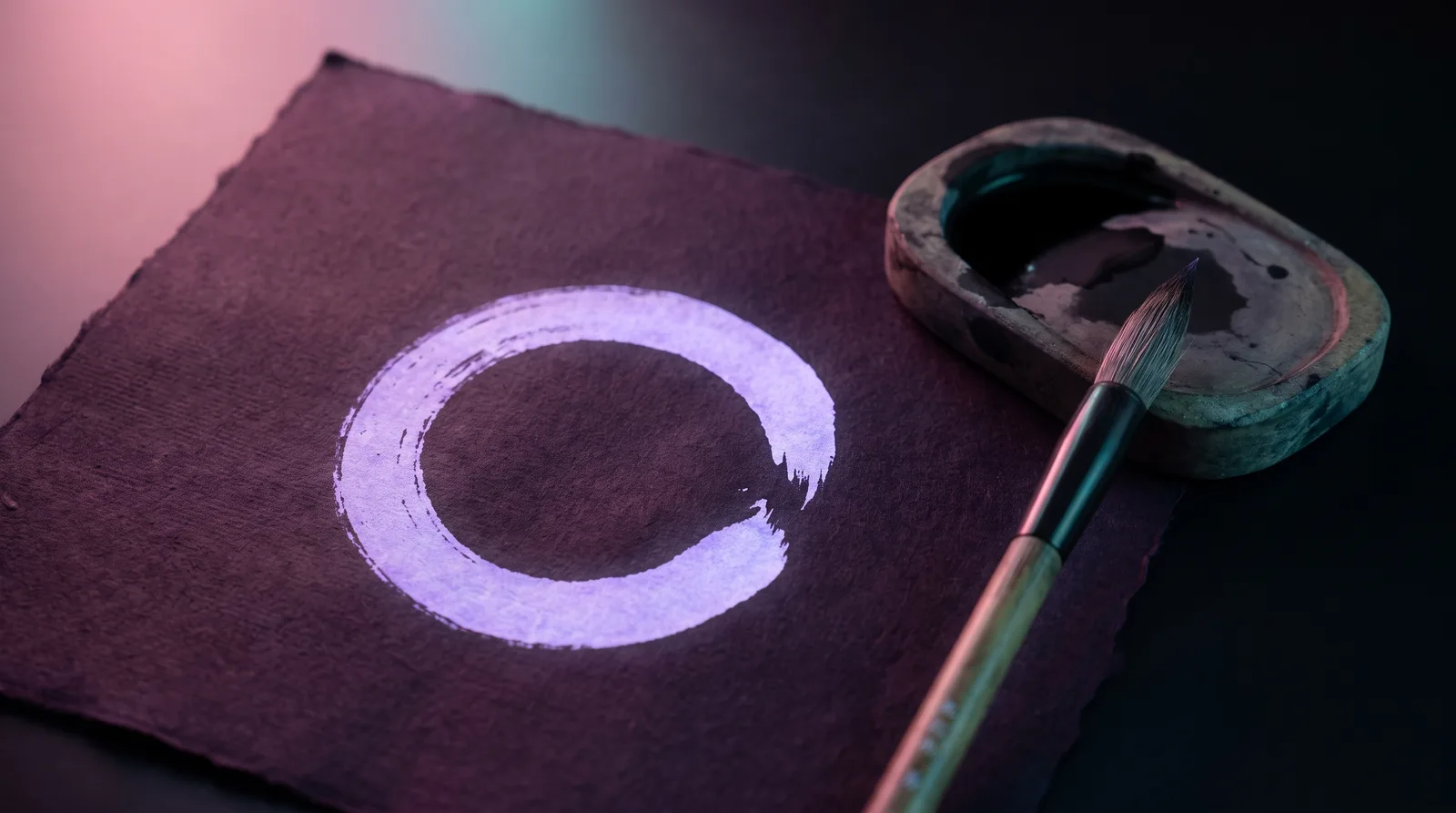
Somewhere in nearly every book on Zen, you will find it: a single circle, drawn in ink, in one stroke. It is usually a little lopsided. The line swells and thins, the ink runs dry towards the end, and often the circle does not quite close. This is the ensō, and the imperfections are not flaws in the reproduction. They are the entire point.
The ensō may be the most distilled artwork human beings make: one breath, one movement, no correction possible. And unlike most contemplative practices, which happen invisibly somewhere behind the eyes, this one leaves a record on paper. You can look at an ensō and see, preserved in ink, the exact state of the mind and hand that made it. That is why Zen teachers have used the circle for centuries as something between a signature, a self-portrait and an examination.
Where the circle comes from
The ensō belongs to the tradition of Zen ink painting and calligraphy that flowered in Japan from roughly the seventeenth century, practised largely by monks for whom brushwork was an extension of sitting practice. The circle appears again and again in the work of masters such as Hakuin, the great eighteenth-century reviver of Rinzai Zen, whose ensō sit alongside his fierce, comical portraits of Bodhidharma. Teachers would brush a circle, sometimes adding a wry inscription beside it, and the result served as a teaching in itself: a gift to a student, a greeting, a challenge.
What does the circle mean? The tradition, characteristically, declines to settle the question. The ensō has been read as emptiness and as fullness, as the moon, as a rice cake, as the universe, as the moment of enlightenment, as nothing more than a circle. Some are drawn closed, suggesting completeness; many are left open, a gap where the world can breathe in and out. The refusal of one fixed meaning is itself instructive. The circle is less a symbol to decode than a mirror: what you see in it has rather a lot to do with what you brought.
The circle records the exact state of the hand that drew it, which is why you cannot fake one.
Why one stroke changes everything
The discipline of the ensō comes from its constraints. Traditionally it is drawn in a single stroke, in a single breath, and it cannot be corrected, because ink on absorbent paper forgives nothing. Hesitate, and the line blots. Rush, and it thins to scratchiness. Try to control the outcome too tightly, and the circle goes stiff and dead on the page. The only approach that works is the one Zen keeps recommending for everything: prepare carefully, then commit completely and let go of the result.
This is what makes the practice so useful to a modern, revision-addicted mind. Nearly everything we produce now is endlessly editable, and our attention has learnt to hover accordingly, half in the work and half in the anticipated correction of it. The ensō deletes that second half. For the second or two the brush is moving, there is nothing to optimise and nowhere to hover. It is one of the shortest complete acts available to a human being, and completing something, wholly and without appeal, turns out to be a peculiarly restful experience.
Drawing your first circle
You do not need proper sumi ink and rice paper to begin, though the real materials are inexpensive and their textures are half the pleasure. A brush pen and ordinary paper will teach you the essentials. What matters is the ritual shape of the thing: settle, breathe, commit, look, let go.
- Sit comfortably at a table with the paper square in front of you. Take a few slow breaths and let your shoulders down; the circle will faithfully record any hurry you bring to it.
- Load the brush generously. Rest its tip lightly on the paper, roughly where seven would sit on a clock face.
- As you exhale, draw the circle in one continuous, unhurried movement, letting the elbow and shoulder steer rather than the fingers.
- Lift the brush, sit back, and look at what arrived. No correcting, no second attempt on the same sheet. Whatever it is, it is a true record of that breath, that hand, that morning.
Draw one a day for a week and date them. The circles will change, and, more interestingly, they will tell you things: the tight small circle of a deadline week, the loose confident sweep of a Sunday. My own from this winter form an unflattering but honest diary.
Watching the circle instead
There is also a quieter way in, because the ensō rewards looking almost as much as drawing. Sitting with a single brushed circle, following the line from its wet beginning to its dry, fraying end, is a small act of visual meditation in itself; the eye travels the stroke at the speed the brush once moved, a kind of replay of someone else's breath. Slow circular motion holds attention in the same soft way outside calligraphy too, which is partly why watching ink bloom and curl in Feelsy's drifting textures settles the mind so readily: the eye is given one continuous line to follow, and it follows, and the rest of the day loosens its grip. If a brush feels like too much ceremony tonight, trace one slow circle on a screen texture with a fingertip and watch the colour answer; it is nearer to Hakuin than it sounds.
Feelsy is a wellness product, not medical advice. If stress, anxiety or sleep problems persist, please speak with a qualified professional.
Frequently Asked Questions
What does the enso circle mean?
The tradition deliberately declines to fix one meaning. The ensō has been read as emptiness, fullness, the moon, the universe and the moment of enlightenment, and some artists leave the circle open while others close it. It is best understood as a mirror rather than a code: a one-stroke record of the mind and hand that drew it, in which viewers find their own reading.
How do you draw an enso?
Settle at a table, breathe slowly, and load a brush or brush pen generously. Rest the tip on the paper and, on an exhale, draw the whole circle in one continuous unhurried stroke, steering from the elbow and shoulder rather than the fingers. Then lift the brush and look at the result without correcting it or repeating it on the same sheet. The single uncorrectable stroke is what makes the practice meditative.
Why is the enso always imperfect?
Because it is drawn in one stroke on absorbent paper, the ensō cannot be edited: any hesitation blots, any hurry thins the line, and the ink often runs dry before the circle closes. Zen treats these irregularities as the truthful part, a record of one particular breath and moment rather than an ideal shape. A perfectly even, mechanical circle would defeat the purpose.
Do I need special ink and paper to practise enso?
No. Traditional sumi ink, an ink stone and rice paper deepen the ritual and their textures are part of the pleasure, but a simple brush pen and ordinary paper teach the essentials perfectly well. What matters is the shape of the act: settle, breathe, commit to one stroke, look at what arrived, and let it be.

About the author
Contributing writer
Eleonor writes about contemplative traditions, attention and the cultural history of calm. She has spent two decades collecting the rituals humans use to slow down, from zazen halls to hammams, and translating them for modern, screen-lit lives.
Feel it for yourself.
Feelsy turns reading about calm into practising it. Two minutes of a slow texture is often the whole difference.


Related reading
 Visual Meditation
Calligraphy as Meditation: Why Slow Writing Calms a Fast Mind
Why calligraphy calms a racing mind: the science of slow writing and attention, and how to practice mindful handwriting with any pen and ten quiet minutes.
 Ancient Wisdom
What Is a Zen Koan? The Question You Cannot Think Your Way Out Of
Zen koans are questions designed to exhaust the thinking mind. What koans are, where they came from, and why sitting with one is so strangely calming.
 Ancient Wisdom
Shoshin: Why Beginner's Mind Is the Expert's Secret
Shoshin, or beginner's mind, is the Zen practice of meeting familiar things as if for the first time. Learn what it means and how to practise it daily.
 Visual Meditation
How to Be More Present: The Quiet Art of Actually Being Here
Why being present feels so difficult, what a wandering mind costs us, and gentle, practical ways of returning to the moment without forcing attention.
 Visual Meditation
The Overview Effect: Why Seeing Earth From Space Quiets the Mind
What the overview effect is, why astronauts describe awe and lasting calm after seeing Earth from space, and how to borrow that shift in perspective at home.
 Visual Meditation
Why Fog Is So Calming: The Strange Peace of a World Gone Soft
Foggy mornings quiet something in us. The psychology of why fog feels so calming, from softened light and sound to the restful pull of a smaller world.