Why Jigsaw Puzzles Are So Relaxing: A Meditation in a Thousand Pieces
Jigsaw puzzles quiet the mind with sorting, searching and small clicks of completion. The psychology of why puzzling relaxes, and how to do it mindfully.
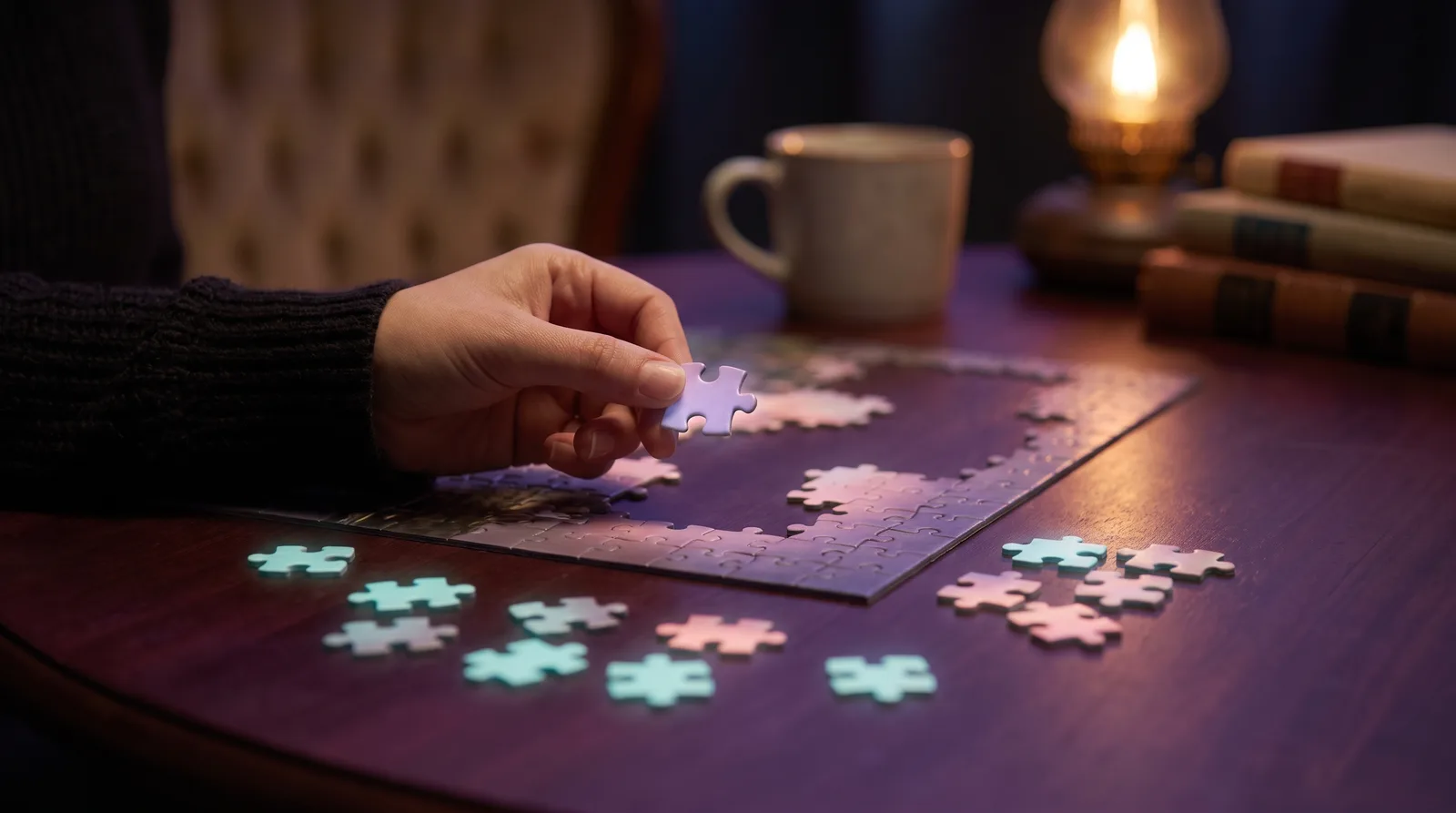
There is a particular silence that gathers around a jigsaw puzzle. Anyone who has spent an evening at the puzzle table knows it: a low, absorbed hush in which an hour disappears and, mysteriously, so does the day's residue. The jigsaw is having one of its periodic revivals, and the usual explanation is nostalgia. I think the truer explanation is that puzzling is one of the most complete attention practices available to the modern household, disguised as a cardboard pastime.
A bounded world on a table
Consider what a puzzle offers that the rest of life rarely does. The problem is finite: one thousand pieces, no more. The goal is unambiguous: the picture on the box. Progress is visible and irreversible in the most soothing sense, for a placed piece stays placed. Nothing in the puzzle can surprise you, disappoint you or ask for a reply by Friday. In a week made of open loops, the jigsaw is a closed one, and the nervous system can tell the difference at a glance.
This boundedness is precisely what most anxious evenings lack. Worry is a puzzle with no edge pieces. The jigsaw, by contrast, begins by letting you build the frame.
The soft work of searching
The heart of puzzling is visual search: scanning a field of shapes for a curve of sky, a fleck of rooftop red. This is attention of a very particular temperature, engaged but not strained, the same register as birdwatching or beachcombing. The task occupies the visual system and the hands so thoroughly that verbal rumination, the inner monologue that narrates our worries, is quietly crowded out. You cannot compose a resentful email while hunting for a mostly-blue piece with one flat side. The mind does not empty; it fills with something harmless.
And then there is the click. Each correctly seated piece delivers a tiny, certain completion, dozens of times an hour. These little resolutions are cousins of the pleasures we describe in oddly satisfying videos: small promises kept, over and over, until the body starts to believe the world is orderly after all.
Worry is a puzzle with no edge pieces. The jigsaw begins by letting you build the frame.
What the research says
Puzzling has also attracted the attention of cognitive scientists. A study of adult jigsaw puzzlers found that the activity engages multiple cognitive abilities at once, including perception, mental rotation, working memory and reasoning, and explored it as a potential protective factor for cognitive ageing (Fissler et al., 2018, Frontiers in Aging Neuroscience). The relaxation is not evidence of idleness, in other words. The brain is thoroughly exercised; it is the emotional machinery that gets the evening off.
That combination, cognitively busy yet emotionally becalmed, is rarer than it sounds, and it is much of what people are seeking when they say they want to switch off. We do not really want the mind off. We want it employed somewhere safe.
The companionable silence of the puzzle table
There is also a social grace to the jigsaw that deserves mention. It is one of the few activities two people can share without either performing or conversing. A couple, a parent and a teenager, old friends: each works their own corner, remarks occasionally on a found piece, and lapses back into the hush. Psychologists of friendship talk about the ease of side-by-side activity, and the puzzle table is its natural habitat. Some of the most restful hours in a household happen there, in a silence that would feel awkward anywhere else in the room but feels companionable over a half-built sky.
Puzzling as practice
A few small adjustments turn an ordinary session at the table into something closer to meditation.
- Sort slowly, and let the sorting count. Turning and grouping pieces is the practice, not the chore before it.
- Work by colour and texture rather than urgency. Follow whatever region of the picture draws the eye, the way one follows a slow visual rather than commanding it.
- Leave the phone in another room. The puzzle's pace only settles you if nothing faster keeps interrupting it.
- Stop before you are tired, leaving a corner unfinished. An open invitation on the table is a kinder ending than a depleted triumph at midnight.
Done this way, half an hour of puzzling has the same architecture as formal visual meditation: a gentle anchor for the eyes, a light task for the hands, and permission for everything else to stand down. It is the tabletop cousin of watching slime fold or particles drift in Feelsy, and the two pair rather well, a slow texture with soft sound in the background while the hands sort a sky into being.
The picture on the box
It is customary to say the pleasure of a jigsaw lies in the journey rather than the finished picture, but I am not sure that is quite right. The pleasure lies in knowing the finished picture exists. Somewhere on the table, order is guaranteed; your only job is to find it one piece at a time. Few things in adult life come with that promise. For the price of a box of cardboard, it is a promise worth keeping on the shelf.
Feelsy is a wellness product, not medical advice. If stress, anxiety or sleep problems persist, please speak with a qualified professional.
References
- Fissler, P., Küster, O. C., Laptinskaya, D., Loy, L. S., von Arnim, C. A. F., & Kolassa, I.-T. (2018). Jigsaw puzzling taps multiple cognitive abilities and is a potential protective factor for cognitive aging. Frontiers in Aging Neuroscience, 10, 299.
Frequently Asked Questions
Why are jigsaw puzzles so relaxing?
A jigsaw offers what most of life does not: a finite, bounded problem with visible progress and no surprises. The visual search for each piece occupies your eyes and hands so completely that verbal rumination gets crowded out, and every correctly placed piece delivers a small, certain sense of completion. The mind stays busy while the emotional machinery gets the evening off.
Are jigsaw puzzles good for your brain?
Research suggests they are cognitively demanding in a good way. A study of adult puzzlers found that jigsaw puzzling engages multiple cognitive abilities at once, including perception, mental rotation, working memory and reasoning, and explored it as a potential protective factor for cognitive ageing. The relaxed feeling is not idleness; it is engaged attention in a safe place.
How do you make puzzling more like meditation?
Slow down and let every stage count. Treat sorting as part of the practice rather than a chore, follow colour and texture wherever the eye is drawn, keep your phone in another room so nothing faster interrupts the puzzle's pace, and stop before you are tired, leaving a corner unfinished so the table invites you back tomorrow.
Do puzzles help with anxious evenings?
Many people find they do, because puzzling crowds out rumination with a harmless task. Worry tends to be open-ended, while a jigsaw is a closed problem where order is guaranteed and progress is permanent. If your evenings are anxious, half an hour at the puzzle table with the phone elsewhere gives the mind employment somewhere safe.

About the author
Contributing writer
Eleonor writes about contemplative traditions, attention and the cultural history of calm. She has spent two decades collecting the rituals humans use to slow down, from zazen halls to hammams, and translating them for modern, screen-lit lives.
Feel it for yourself.
Feelsy turns reading about calm into practising it. Two minutes of a slow texture is often the whole difference.


Related reading
 Visual Meditation
Colouring In: Why Adult Colouring Books Quiet an Anxious Mind
Why colouring calms adult minds: what research on mandala colouring and anxiety found, and how to turn ten minutes with pencils into a visual meditation.
 Breath & Body
Knitting as Meditation: Why Repeating Stitches Calms the Mind
Why knitting soothes anxiety: rhythm, repetition and the quiet focus of busy hands, what knitters report about calm, and how to begin the practice.
 Visual Meditation
Slow Looking: The Lost Art of Paying Attention
What slow looking means, why spending ten minutes with one painting changes what you see, and simple ways to practise deliberate attention anywhere.
 Visual MeditationNew
Highway Hypnosis: Why You Can't Remember the Last Ten Miles
You arrive at your exit with no memory of driving there. Highway hypnosis is real and common: here's the science of the road trance and how to use it safely.
 Visual Meditation
Why the Northern Lights Mesmerise Us: Aurora Watching as Visual Meditation
What causes the northern lights, why the aurora feels so calming to watch, and how to turn sky watching into a simple visual meditation practice.
 Visual Meditation
Blue Mind: Why Being Near Water Calms the Brain
What blue mind theory says about why oceans, lakes and rivers soothe us: the research on blue space, water's pull on the eye, and how to use it daily.