Colouring In: Why Adult Colouring Books Quiet an Anxious Mind
Why colouring calms adult minds: what research on mandala colouring and anxiety found, and how to turn ten minutes with pencils into a visual meditation.
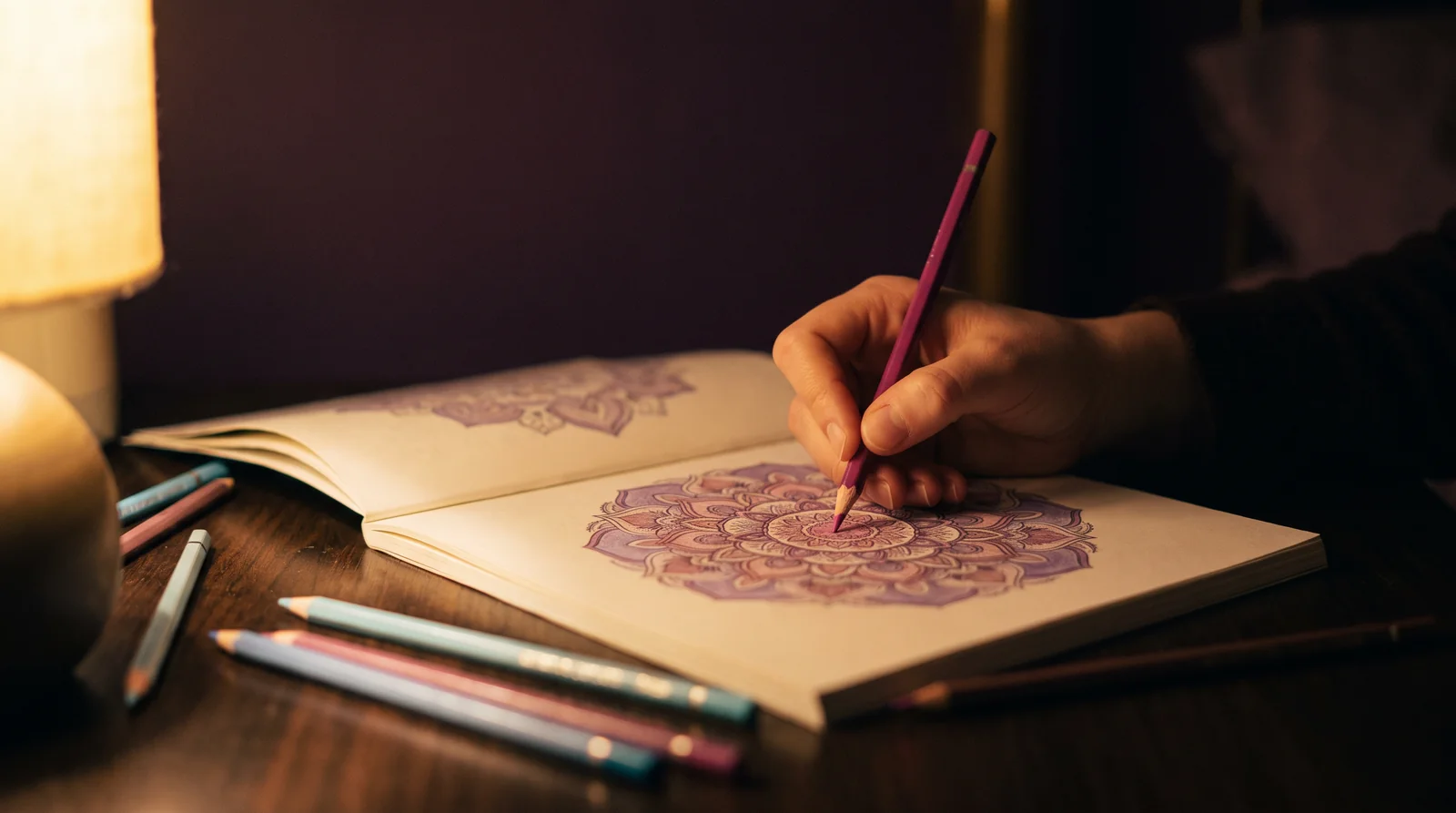
Around the middle of the last decade, something odd happened in the bookshops. Colouring books, that staple of the children's shelf, migrated to the front tables, acquired subtitles about calm and mindfulness, and began outselling novels. Adults bought them in their millions, along with tins of pencils they had not owned since school, and for a season or two the whole phenomenon was treated as a charming eccentricity of the overwhelmed. The fashion cooled, as fashions do. The practice, quietly, did not. People kept colouring, mostly in the evenings, mostly without telling anyone, for the excellent reason that it worked.
It is worth taking seriously why. Colouring occupies a curious position in the family of calming practices: it is visual, like gazing at a candle or a landscape painting; it is manual, like calligraphy or kneading dough; and it is bounded, in the most literal sense, by lines somebody else has already drawn. That last quality turns out to matter a great deal, and it is where the story of colouring and anxiety properly begins.
What the research actually found
The study that anchors this field is small, elegant and older than the craze it eventually helped to launch. Researchers first made a group of university students anxious, then set them colouring for twenty minutes: some were given a mandala, a symmetrical circular pattern, some a plaid design, and some a blank page to colour freely. Anxiety fell substantially in the mandala and plaid groups, but not in the free-colouring group (Curry and Kasser, 2005, Art Therapy). The surprise is instructive. The blank page, offering total freedom, soothed nobody. The benefit belonged to the groups given structure: a pattern with edges, repetition and no decisions worth agonising over.
Structure, it seems, is the active ingredient. A complex symmetrical pattern makes every choice small and every consequence reversible in spirit: the worst that can happen is a leaf coloured teal instead of green. For an anxious mind, which spends its days rehearsing choices with genuinely uncertain outcomes, twenty minutes among decisions that cannot go meaningfully wrong is a holiday with the texture of work. Psychologists would say the task absorbs attentional resources that worry would otherwise commandeer. A person with a pencil would say it more plainly: you cannot fret properly while staying inside the lines.
You cannot fret properly while staying inside the lines.
An old practice in a paper costume
The mandala detail is not incidental. Circular, radially symmetric designs have been drawn as contemplative objects for a very long time: in Tibetan monasteries, where monks build them from coloured sand over days and then sweep them away; in the rose windows of Gothic cathedrals; in the rangoli patterns drawn at Indian thresholds each morning. Carl Jung, who painted a small circular design in his notebook most days, regarded the form as something like a self-portrait of the psyche seeking order. One need not follow him all the way to notice what these traditions share: a bounded circle, a repeating geometry, and a person moving through it slowly with their hands, one small region at a time.
Seen against that lineage, the adult colouring book is less a fad than a translation. It takes the old contemplative geometry, prints it on decent paper, and hands it to people who would never sit cross-legged in a shrine room but will happily spend an evening with pencils. The vocabulary changed; the transaction, attention exchanged for quiet, did not. This is a pattern worth noticing across the whole territory of calm: practices survive by putting on plainer clothes.
Colouring as a visual meditation
Most people colour in front of the television, and there is no harm in that. But the same twenty minutes, taken with a little intention, becomes something closer to formal practice. The differences are small and entirely unmystical.
- Choose structure over freedom. Pick a pattern with clear edges and plenty of repetition, a mandala, a tile design, a geometric border, rather than an open scene. The research favours it, and so will your evening.
- Let the pencil set your breath. Long, slow strokes tend to draw breathing out to their own length. Fill each region with unhurried parallel lines rather than quick scribble, and let the rhythm settle where it likes.
- Work from the outside in. With a circular design, begin at the rim and move gradually towards the centre. The journey inward gives the session a shape, and arriving at the middle makes a natural end.
- When the mind wanders, change colour. Rather than scolding your attention, mark its return with a small ritual: choose the next pencil, notice the new colour against the old, begin again. A wandering mind is not a failed session; it is the exercise.
The lines are the kindness
What the colouring book understands, and what its gentle reputation obscures, is that an anxious mind is not usually starved of freedom. It is starved of edges. The blank page and the open evening are precisely the conditions in which worry does its best work; the printed pattern, like the raked gravel of a dry garden or the fixed sequence of a tea ritual, offers the opposite: somewhere for attention to live that has walls. The same principle animates the slow textures the Feelsy team builds for tired eyes: a screen where colour moves within soft boundaries, asking nothing, deciding nothing, while the watcher's shoulders quietly descend. On nights when even a pencil feels like too much agency, I let one of those textures drift instead, or follow the app's 4-7-8 breathing exercise until the day's edges soften.
But on the good evenings it is the tin of pencils, the lamp, and a circle waiting to be filled. Begin at the rim. Move slowly towards the centre. Stay inside the lines, and notice, somewhere past the halfway mark, that the lines have been holding you in return.
Feelsy is a wellness product, not medical advice. If stress, anxiety or sleep problems persist, please speak with a qualified professional.
References
- Curry, N. A., & Kasser, T. (2005). Can coloring mandalas reduce anxiety? Art Therapy: Journal of the American Art Therapy Association, 22(2), 81–85.
Frequently Asked Questions
Why does colouring help with anxiety?
Colouring is visual like gazing at a landscape, manual like calligraphy, and bounded by lines someone else has already drawn, and that boundedness turns out to matter most. Structure makes every choice small and reversible, absorbing attentional resources that worry would otherwise take over.
What did the mandala colouring study actually find?
Researchers made university students anxious and then had them colour for twenty minutes, some given a mandala, some a plaid design, and some a blank page. Anxiety fell substantially in the mandala and plaid groups but not in the free-colouring group, showing that structure, not freedom, was the active ingredient.
Why does colouring a mandala work better than colouring freely?
A blank page offering total freedom soothed nobody in the study, while a complex symmetrical pattern with edges and repetition made every decision low-stakes, since the worst outcome might be a leaf coloured the wrong shade. This gives an anxious mind a holiday with the texture of work, since the task absorbs attention that worry would otherwise commandeer.
Is the mandala shape itself significant?
Yes, circular, radially symmetric designs have long been used as contemplative objects, from Tibetan sand mandalas to cathedral rose windows to Indian rangoli patterns. Carl Jung regarded the circular form as something like a self-portrait of the psyche seeking order, and adult colouring books are best understood as a modern translation of this older contemplative geometry.
How can you colour more meditatively?
Choose a pattern with clear edges and plenty of repetition rather than an open scene, and let long, slow pencil strokes draw your breathing out to match their length. Work from the outside rim towards the centre for a natural sense of progression, and when your mind wanders, simply mark the return by choosing a new colour rather than scolding yourself.
About the author
Contributing writer
Eleonor writes about contemplative traditions, attention and the cultural history of calm. She has spent two decades collecting the rituals humans use to slow down, from zazen halls to hammams, and translating them for modern, screen-lit lives.
Feel it for yourself.
Feelsy turns reading about calm into practising it. Two minutes of a slow texture is often the whole difference.


Related reading
 Ancient Wisdom
Sand Mandalas and the Art of Letting Go
Tibetan monks spend days building an intricate sand mandala, then sweep it away. What the ritual teaches about impermanence, process and why watching can be meditation.
 Visual Meditation
Calming Colours: What Actually Soothes the Eye, and Why
What are the most calming colors? What research says about blue, green and lavender, why saturation matters more than hue, and how to use colour to unwind.
 Visual Meditation
Guided Imagery: Meditation for Minds That Think in Pictures
Learn how guided imagery meditation works: why picturing a peaceful scene calms the body, what research shows, and how to practise it in ten minutes.
 Visual MeditationNew
Highway Hypnosis: Why You Can't Remember the Last Ten Miles
You arrive at your exit with no memory of driving there. Highway hypnosis is real and common: here's the science of the road trance and how to use it safely.
 Visual Meditation
Why the Northern Lights Mesmerise Us: Aurora Watching as Visual Meditation
What causes the northern lights, why the aurora feels so calming to watch, and how to turn sky watching into a simple visual meditation practice.
 Visual Meditation
Blue Mind: Why Being Near Water Calms the Brain
What blue mind theory says about why oceans, lakes and rivers soothe us: the research on blue space, water's pull on the eye, and how to use it daily.