Kintsugi: The Japanese Art of Golden Repair
The meaning of kintsugi, how the Japanese craft of mending broken pottery with gold became a philosophy of resilience, and how to practise its lessons daily.
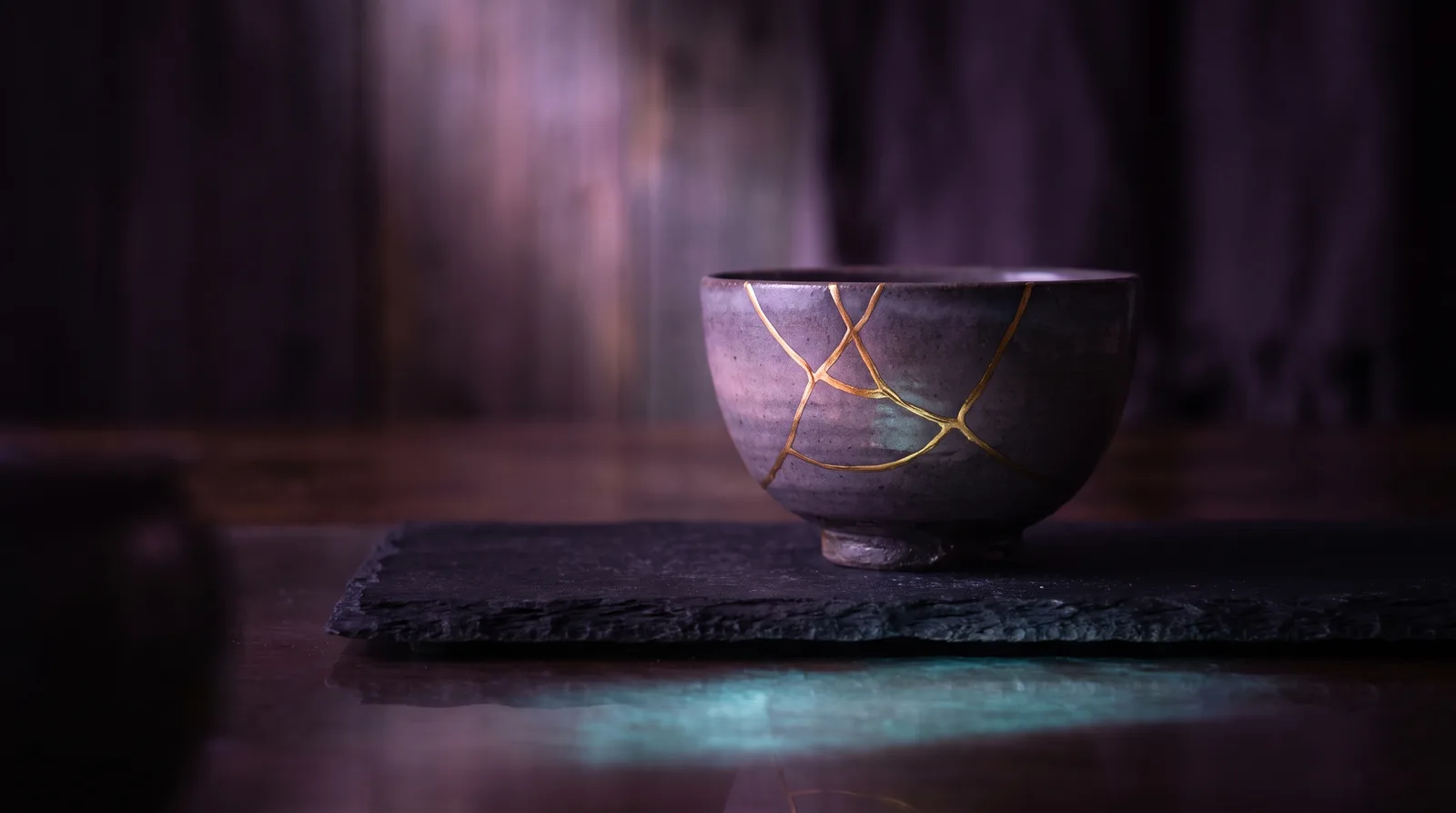
Somewhere in a Japanese workshop, a craftsperson is spending several months on a bowl that a fast economy would have binned in a heartbeat. The bowl arrived broken. It will leave more valuable than it was before it fell, its fracture lines traced in lacquer and dusted with gold, made not merely visible but luminous. This is kintsugi, 'golden joinery', sometimes called kintsukuroi, 'golden repair': the Japanese craft of mending broken ceramics so that the damage becomes the most beautiful thing about the object. It is a technique, and it is also, quietly, one of the most useful philosophies of imperfection ever to come out of a workshop.
A bowl, a shogun, and an ugly repair
The story most often told about kintsugi's origin concerns Ashikaga Yoshimasa, a fifteenth-century shogun who sent a favourite Chinese tea bowl back to China for repair. It returned mended in the era's standard fashion: ugly metal staples crimped across the crack, functional and charmless, like surgical stitches on porcelain. Legend has it that Japanese craftsmen, invited to do better, developed a repair that treated the break as part of the bowl's story rather than an embarrassment to be minimised. Whatever the precise truth of the tale, the technique flourished in the world of the Japanese tea ceremony, where a repaired bowl's golden seams came to be prized, and where, it is said, some tea masters admired the mended vessels more than flawless ones. The broken bowl did not survive its accident; it was completed by it.
The craft: slower than the break by design
A shattering takes a second. A kintsugi repair traditionally takes weeks or months. The mender cleans and reassembles the shards with urushi, a lacquer drawn from the sap of the lacquer tree, which cures slowly in humid air. Missing fragments are rebuilt with lacquer pastes; joins are refined layer by patient layer, each one dried and smoothed before the next. Only at the end is the final coat of lacquer dusted with powdered gold, silver or platinum, turning every fracture into a bright river across the glaze. The materials matter less than the tempo. The repair cannot be rushed, because the lacquer will not be rushed, and so the craft imposes on its practitioner exactly what the philosophy preaches: repair is a season, not an errand.
Kintsugi does not hide the break. It spends months making the break the most beautiful line in the bowl.
The philosophy inside the technique
Kintsugi belongs to the same aesthetic family as wabi-sabi, the Japanese sensibility that finds beauty in the imperfect, impermanent and incomplete. A wabi-sabi eye already prefers the weathered to the pristine; kintsugi extends the courtesy to the damaged. There are kindred threads, too, in mottainai, the reluctance to waste what still holds value, and in the Buddhist acceptance of impermanence that runs beneath so much Japanese art: things break because all things break, and pretending otherwise is the only real error. What kintsugi adds is the golden refusal at its centre. The repair does not camouflage the crack, as our instinct, and most of our glue advertisements, insist it should. It illuminates the crack. The bowl makes no claim to have never been dropped. It claims something better: that it was worth mending, and that the mending is now part of its beauty rather than a deduction from it.
Golden repair as a way of seeing a life
It is not difficult to see why kintsugi has escaped the pottery studio and become a favourite metaphor in conversations about resilience and recovery. We live in a culture with a strong preference for the unblemished: unlined faces, uninterrupted CVs, histories with no visible seams. Failures are to be concealed; setbacks are gaps to be explained away. Against this, kintsugi proposes a different accounting. The difficult chapter, honestly repaired, is not the part of the story that lowers your value. Often it is precisely where the gold went in: the compassion learned in a hard year, the friendship rebuilt after a rupture, the career that cracked and was rejoined along a truer line. The metaphor deserves gentle handling. A bowl does not feel pain, and no philosophy of pottery should be pressed on someone in real difficulty as a demand to perform gratitude for their wounds. Kintsugi speaks best after the mending has begun, as a way of carrying a repaired history: visibly, without apology, seams outward.
Practising golden repair, without the gold
Few of us will apprentice in urushi lacquer. The sensibility, though, can be practised with what is already in the house. Mend one thing this month, slowly, and let the repair show: the visible stitch on a beloved jumper, the glued handle, the darned elbow. Notice the speed of your own instinct to discard, objects, plans, versions of yourself, and let one of them be repaired instead. Keep something imperfect on display where the flaw can be seen, as a small daily argument against the pristine. And extend the practice inward: the habit of tracing a hard experience until you can name what it added, not only what it took, is kintsugi performed on memory. Repair of any kind asks for a settled nervous system, which is partly why the slow crafts feel so restorative; it is the same reason watching a pressed texture slowly return to wholeness in Feelsy is so disproportionately soothing. The eye loves to watch things come back together. Kintsugi simply insists we grant our own mended places the same affection.
The most beautiful line in the bowl
Kintsugi began as a solution to a practical problem: a valued bowl was broken, and staples were ugly. Five centuries later it endures because the solution turned out to contain a worldview. Things break. The breaking is ordinary. What is not ordinary is the choice made afterwards: to mend with such patience and such visible care that the object's history becomes its ornament. It is hard to think of a gentler ambition to carry into a scrolling, discarding age, or a better question to ask of our own cracked places: not how to hide the line, but what it might look like traced in gold.
Feelsy is a wellness product, not medical advice. If stress, anxiety or sleep problems persist, please speak with a qualified professional.
Frequently Asked Questions
What is kintsugi and what does it mean?
Kintsugi, meaning 'golden joinery' and sometimes called kintsukuroi or 'golden repair', is the Japanese craft of mending broken ceramics with lacquer that is finished in powdered gold, silver or platinum. Rather than hiding the damage, the technique makes the fracture lines luminous, so a repaired piece wears its history visibly and is often considered more beautiful than before it broke.
Where does kintsugi come from?
The origin story most often told involves Ashikaga Yoshimasa, a fifteenth-century Japanese shogun whose favourite Chinese tea bowl came back from repair held together with ugly metal staples. Japanese craftsmen, invited to do better, developed a lacquer repair finished in gold that treated the break as part of the bowl's story. The technique then flourished in the world of the Japanese tea ceremony, where golden seams came to be prized.
How is kintsugi actually done?
Traditional kintsugi uses urushi, a natural lacquer drawn from the sap of the lacquer tree, to rejoin the broken shards; missing fragments are rebuilt with lacquer pastes, and each layer must cure slowly in humid air before the next is applied. The final coat is dusted with powdered gold or another precious metal. A single repair traditionally takes weeks or months, and that slowness is considered part of the craft's meaning.
What is the philosophy behind kintsugi?
Kintsugi belongs to the same aesthetic family as wabi-sabi, the Japanese appreciation of imperfection and impermanence, and echoes mottainai, the reluctance to waste what still holds value. Its distinctive idea is that repair should be revealed rather than concealed: the mended crack becomes the most beautiful line in the object. As a metaphor, it suggests that a life's difficult chapters, honestly repaired, can add value rather than subtract it.
How can I apply kintsugi to everyday life?
Start with objects: mend one broken or worn thing slowly and let the repair remain visible, and keep something imperfect on display as a quiet argument against the pristine. Then extend the habit inward, by tracing a difficult experience until you can name what it added as well as what it took. The practice is best applied gently, as a way of carrying a repaired history without apology, not as pressure to feel grateful for pain.

About the author
Contributing writer
Eleonor writes about contemplative traditions, attention and the cultural history of calm. She has spent two decades collecting the rituals humans use to slow down, from zazen halls to hammams, and translating them for modern, screen-lit lives.
Feel it for yourself.
Feelsy turns reading about calm into practising it. Two minutes of a slow texture is often the whole difference.


Related reading
 Ancient Wisdom
Wabi-Sabi: The Japanese Art of Finding Calm in Imperfection
What wabi-sabi really means: the Japanese aesthetic of imperfect, impermanent beauty, and how its quiet philosophy softens perfectionism and stress.
 Ancient Wisdom
Sand Mandalas and the Art of Letting Go
Tibetan monks spend days building an intricate sand mandala, then sweep it away. What the ritual teaches about impermanence, process and why watching can be meditation.
 Ancient Wisdom
The Zen Garden: Why Raking Gravel Stills the Mind
What a zen garden is and why it calms: the history of karesansui, the perception science of Ryoan-ji, and a way to practise dry-garden attention at home.
 Ancient Wisdom
Döstädning: The Gentle Swedish Art of Death Cleaning
What Swedish death cleaning really means: the calm philosophy of döstädning, how it differs from ordinary decluttering, and how to begin at any age.
 Ancient Wisdom
How to Start a Gratitude Journal You Will Actually Keep
How to start a gratitude journal that actually helps: what the research found, why most lists go stale, and the very old art of counting blessings.
 Ancient Wisdom
Haiku as Meditation: Seventeen Syllables of Attention
How writing haiku trains attention: why the tiny form works like meditation, what noticing small moments does for wellbeing, and how to write your first.