Sand Mandalas and the Art of Letting Go
Tibetan monks spend days building an intricate sand mandala, then sweep it away. What the ritual teaches about impermanence, process and why watching can be meditation.
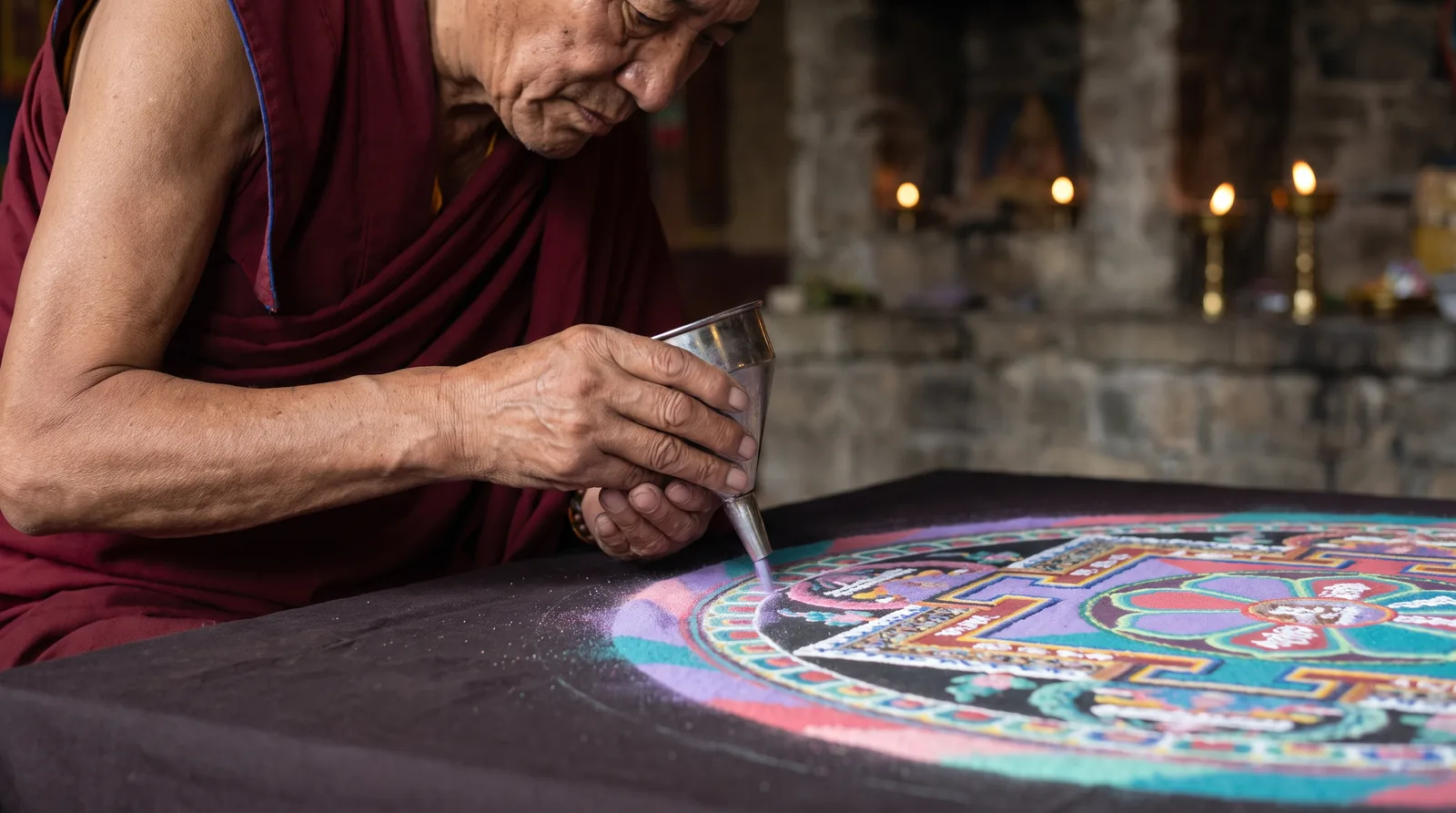
In Tibetan Buddhist monasteries, there is a ritual that looks, to modern eyes, like a beautiful act of self-sabotage. A team of monks spends days, sometimes weeks, building a mandala out of millions of grains of coloured sand. They work from the centre outward, tapping the sand through narrow metal funnels called chak-pur, a few grains at a time, into geometry so precise it looks printed. Crowds gather to watch. And when it is finished, after a ceremony, the monks sweep it away. The sand is gathered into a jar and poured into a river.
The destruction is not an afterthought. It is the point. The mandala is a teaching about impermanence you can watch with your own eyes: the most beautiful, painstaking thing in the room is let go of without grief, because letting go was always part of the design.
Process over product
Ask the monks and they will tell you the mandala's value was never the finished object. It is the making. Hours of steady hands, steady breath and complete absorption in a task measured in single grains of sand. In the vocabulary of modern psychology, mandala construction is a flow practice: clear task, immediate feedback, full engagement, self disappearing into the work. The finished pattern is simply what is left over when days of attention condense into one place.
This inversion, valuing the doing over the having, is one of the most useful ideas anywhere in contemplative culture, and one of the hardest for modern life to digest. Nearly everything around us is optimised for outcomes. The mandala says, calmly and in colour: the outcome was never the point, and to prove it, watch us sweep it away.
Watching as practice
Here is the detail most retellings skip: for every monk building the mandala, there are dozens of people simply watching, sometimes for hours. Nobody considers this wasted time. Watching careful, repetitive, beautiful work is itself treated as practice. The eye follows the funnel, the sand falls, the pattern grows a millimetre at a time, and the watcher's mind slows to the speed of the work. If you have ever lost twenty minutes to someone icing a cake, throwing a pot or raking a zen garden, you already know the state. Attention borrows the rhythm of what it rests on.
Attention borrows the rhythm of what it rests on.
The reset button
There is a small, honest echo of the sand mandala in every Feelsy session. You stretch and fold and swirl a texture into something, and none of it persists. You can reset the slime at any moment, and the reset is not a loss; it is an invitation to begin again. That low-stakes impermanence is precisely what makes the practice restful. Nothing you make can be ruined, so the making is free. The monks would recognise the principle, if perhaps not the slime.
Borrowing the lesson
- Do one thing this week purely for the doing, with no artifact at the end: a drawing you recycle, a sandcastle, dough kneaded and given away.
- When something you made or planned dissolves, try the monks' framing: its value was the attention it held, and that part is already banked.
- Let yourself watch. Slow, skilled, repetitive work, in person or on a screen, is a legitimate object of meditation, not a guilty pleasure.
Feelsy is a wellness product, not medical advice. If stress, anxiety or sleep problems persist, please speak with a qualified professional.
Frequently Asked Questions
What is a Tibetan sand mandala and why do monks destroy it?
Tibetan Buddhist monks spend days or weeks building a mandala out of millions of grains of coloured sand, tapping it through narrow funnels called chak-pur into precise geometry, and then sweep it away after a ceremony, pouring the sand into a river. The destruction is the point, not an afterthought, offering a visible teaching about impermanence since the most beautiful, painstaking thing in the room is let go of without grief.
What does 'process over product' mean in the sand mandala tradition?
The monks say the mandala's value was never the finished object but the making itself, hours of steady hands, steady breath, and complete absorption in a task measured in single grains of sand. In psychological terms this is described as a flow practice, and it stands against the modern habit of optimising everything for outcomes rather than the doing.
Can watching someone else work be a form of meditation?
Yes, for every monk building the mandala there are dozens of people simply watching, sometimes for hours, and this is treated as practice, not wasted time. The eye follows the funnel and the watcher's mind slows to the speed of the work, the same state you might recognise from watching someone ice a cake or throw a pot, since attention borrows the rhythm of what it rests on.
How does the sand mandala relate to using a slime or texture app?
There is a small, honest echo of the sand mandala in stretching, folding and swirling a texture into something that does not persist, since you can reset it at any moment and the reset is not a loss but an invitation to begin again. That low-stakes impermanence is what makes the practice restful, because nothing you make can be ruined, so the making is free.

About the author
Contributing writer
Eleonor writes about contemplative traditions, attention and the cultural history of calm. She has spent two decades collecting the rituals humans use to slow down, from zazen halls to hammams, and translating them for modern, screen-lit lives.
Feel it for yourself.
Feelsy turns reading about calm into practising it. Two minutes of a slow texture is often the whole difference.


Related reading
 Ancient Wisdom
Ancient Practices for Modern Calm: A World Tour
Humans have engineered calm for thousands of years. A tour through Zen, pranayama, hammam culture, forest bathing and the ancestors of visual meditation.
 ASMR
ASMRWhy Slime Videos Are So Satisfying
There is a real reason your shoulders drop when you watch slime being folded and poked. A look at ASMR, soft fascination and the design of satisfying motion.
 Ancient Wisdom
Trataka: The Original Visual Meditation
Centuries before screens, yogis rested their gaze on a single candle flame. How trataka works, how to practise it safely, and what it teaches modern visual meditation.
 Ancient Wisdom
Döstädning: The Gentle Swedish Art of Death Cleaning
What Swedish death cleaning really means: the calm philosophy of döstädning, how it differs from ordinary decluttering, and how to begin at any age.
 Ancient Wisdom
How to Start a Gratitude Journal You Will Actually Keep
How to start a gratitude journal that actually helps: what the research found, why most lists go stale, and the very old art of counting blessings.
 Ancient Wisdom
Haiku as Meditation: Seventeen Syllables of Attention
How writing haiku trains attention: why the tiny form works like meditation, what noticing small moments does for wellbeing, and how to write your first.