Psithurism: Why the Sound of Wind in the Trees Calms the Mind
Psithurism is the whispering sound of wind through leaves. Here is why this natural broadband sound soothes the nervous system, and what research says about it.

English keeps a small shelf of words so seldom used they feel like secrets, and psithurism sits near the end of it. From the Greek psithuros, meaning whispering, it names the sound of wind moving through the leaves of trees: that dry, oceanic hush that rises and falls over a wood, or over a single plane tree on an ordinary street, whenever the air decides to travel. Most of us have been stopped by it at some point, mid-walk, mid-worry, and felt something in the chest come down half a notch. The word is obscure; the experience is nearly universal. It is worth asking why a rustle should be so reliably kind to the nervous system.
A whisper the size of a forest
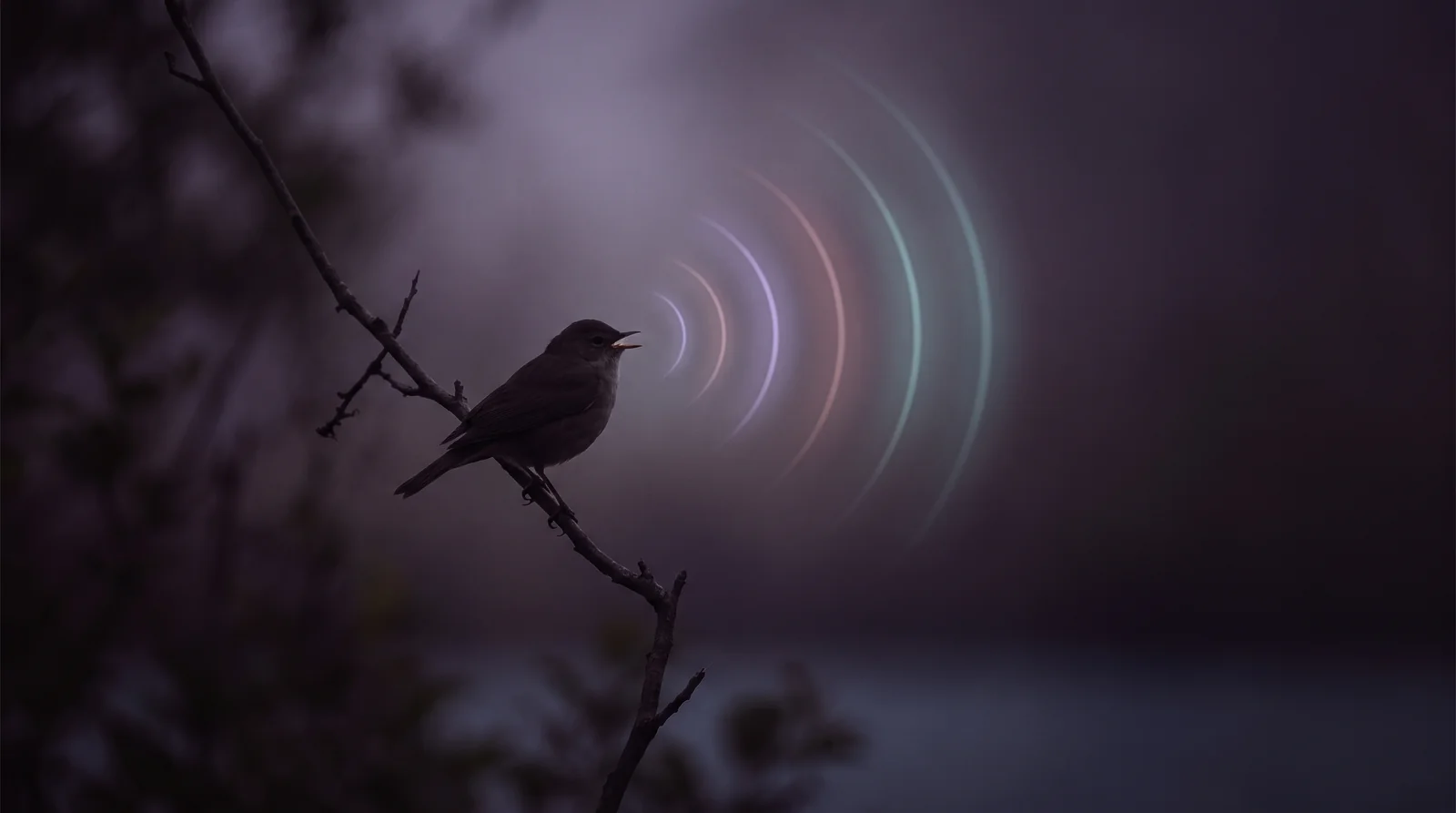
Acoustically, psithurism is a curious object. Each individual leaf produces a tiny, chaotic flutter; a tree in wind is millions of these at once, blended by distance into a single broadband wash. The result sits close to what sound engineers would call natural noise: energy smeared across many frequencies, with no sharp edges, no sudden onsets, nothing for the startle system to seize upon. In this it belongs to the same family as rainfall and surf, the sounds humans have always found easiest to sleep beside. But unlike a white noise machine, the sound of leaves is alive. It swells and subsides with each gust, close to the breath in its phrasing, and the ear, which evolved outdoors, seems to recognise the phrasing as home. Poets have always heard this kinship; Tennyson has a murmuring of innumerable bees, but it is the innumerable leaves, surely, that taught the ear what murmuring means.
There is an older logic underneath the acoustics. For most of our species' history, the steady sound of wind in vegetation carried a specific meaning: nothing is wrong. Predators and storms announce themselves as interruptions of that texture, cracks and silences and sudden stillness. A continuous, even rustle was the audible signature of an environment behaving normally, and a brain that could half-listen to it was a brain permitted to stand down. When the leaves outside your window loosen your shoulders, you are hearing, at several thousand years' remove, the all-clear.
What the research finds
The modern evidence sits comfortably alongside the old logic. In a large 2021 synthesis published in the Proceedings of the National Academy of Sciences, Rachel Buxton and colleagues reviewed dozens of studies on natural sound and found that exposure to sounds such as wind, water and birdsong was associated with reduced stress and annoyance and improved mood and health outcomes across the literature (Buxton et al., 2021, PNAS). Wind and water sounds, the broadband end of nature's repertoire, showed some of the most consistent calming associations.
Laboratory work points the same way. In an experiment at Stockholm University, participants were put through a stressful mental task and then sat in recovery while listening either to nature sounds, including a gentle outdoor soundscape, or to various forms of ordinary environmental noise. Measured by skin conductance, an index of bodily arousal, the nature sound group's stress systems recovered faster (Alvarsson, Wiens and Nilsson, 2010, International Journal of Environmental Research and Public Health). The effect sizes in this field are modest and the mechanisms still debated, but the direction is steady: the body seems to stand down more willingly in the company of natural sound than in silence's engineered cousins.
A continuous, even rustle was the audible signature of a world behaving normally. The leaves are still broadcasting the all-clear.
Listening as a practice
Because psithurism is everywhere trees and weather coexist, it makes an unusually democratic meditation object. The practice is simple: on a breezy day, stop near a tree and give the sound your full attention for two or three minutes. Notice the shape of each gust, the way the sound approaches from one side of the canopy and leaves by the other, the grain of it, different in an oak than in a birch, papery in autumn, softer in June. When thought intrudes, return to the rustle as you would return to the breath. It is astonishing how quickly this becomes absorbing once you consent to it; the sound is never the same twice, which is precisely what the attention likes.
Indoors, the same family of sound still serves. An open window in wind is the cheapest sound bath there is. And on still nights, or in flats that face traffic rather than trees, recorded and layered soundscapes do respectable work: many people fall asleep faster to leafy, breathy, broadband textures than to flat electronic noise, precisely because of that living rise and fall. This is much of why Feelsy pairs its slow visual textures with soft ambient sound rather than sterile tones; eyes and ears are calmed by the same grammar, drift without event, and a few autoplay minutes of it before bed makes a gentler off-ramp than the last scroll of the day.
The oldest lullaby
It pleases me that the word for this sound comes from whispering, because a whisper is speech turned intimate, urgency taken out of language. That is rather what a windy tree does to the world: it takes the day's noise and translates it into something with no message at all beyond continuance. Long before lullabies had words, this one was playing over every human settlement with a tree in it. It plays still, free of charge, most days of the week. The practice is only to stop underneath it and listen like an animal again: half-alert, wholly reassured.
Feelsy is a wellness product, not medical advice. If stress, anxiety or sleep problems persist, please speak with a qualified professional.
References
- Buxton, R. T., Pearson, A. L., Allou, C., Fristrup, K., & Wittemyer, G. (2021). A synthesis of health benefits of natural sounds and their distribution in national parks. Proceedings of the National Academy of Sciences, 118(14), e2013097118.
- Alvarsson, J. J., Wiens, S., & Nilsson, M. E. (2010). Stress recovery during exposure to nature sound and environmental noise. International Journal of Environmental Research and Public Health, 7(3), 1036-1046.
Frequently Asked Questions
What does psithurism mean?
Psithurism is the sound of wind moving through the leaves of trees, that soft, oceanic rustle a canopy makes in a breeze. The word comes from the Greek psithuros, meaning whispering, and though the term is obscure, the calming experience it names is nearly universal.
Why is the sound of wind in trees so relaxing?
A tree in wind blends millions of tiny leaf flutters into a smooth broadband wash, with no sharp edges for the brain's startle system to seize on, similar to rain or surf. There is also an evolutionary logic: a continuous, even rustle has always signalled an environment behaving normally, so the brain treats it as an all-clear and stands down.
Is there scientific evidence that nature sounds reduce stress?
Yes. A 2021 synthesis in PNAS by Buxton and colleagues found exposure to natural sounds such as wind and water was associated with reduced stress and annoyance and improved mood across dozens of studies. A Stockholm University experiment also found people's stress systems, measured by skin conductance, recovered faster after a stressor when listening to nature sounds than to environmental noise.
How can I use wind sounds to relax or sleep?
On a breezy day, simply stand near a tree and give the rustle your full attention for two or three minutes, returning to it whenever thought intrudes, exactly as you would return to the breath in meditation. Indoors, an open window in wind works, and many people fall asleep faster to leafy, breathy recorded soundscapes than to flat electronic noise, because of their living rise and fall.

About the author
Contributing writer
Eleonor writes about contemplative traditions, attention and the cultural history of calm. She has spent two decades collecting the rituals humans use to slow down, from zazen halls to hammams, and translating them for modern, screen-lit lives.
Feel it for yourself.
Feelsy turns reading about calm into practising it. Two minutes of a slow texture is often the whole difference.


Related reading
 ASMR
ASMRWhy the Sound of Rain Is So Calming (and So Good for Sleep)
Why rain sounds help you sleep: the acoustics of rainfall, what research says about natural sound and stress, and how to use rain well at bedtime.
 ASMR
ASMRWhy Birdsong Calms the Mind
Why birdsong calms an anxious mind: the science of soft fascination, what bird sounds do for attention and mood, and how to bring the dawn chorus indoors.
 ASMR
ASMRPetrichor: Why Rain Smells So Good, and Why That Scent Settles the Mind
Petrichor is the earthy scent of rain on dry ground. Here is where the word comes from, the chemistry behind the smell, and why it feels like relief itself.
 ASMR
ASMRVisual ASMR: Why Some People Get Tingles With the Sound Off
Slow hands, slime folds, drifting light: visual ASMR calms some people with no audio at all. Here's what research says about watching your way to relaxed.
 ASMR
ASMRIs It Bad to Sleep With Headphones On?
Is it bad to sleep with headphones on? What's actually risky, what isn't, safe volume rules, and comfier ways to keep calming sound going all night.
 ASMR
ASMRWhy Ambient Music Calms the Mind: Sound You Can Live Inside
Ambient music was designed to be ignorable and interesting at once. Here is where it came from, why beatless sound settles the body, and how to listen well.