Is It Bad to Sleep With the TV On?
Falling asleep to the TV feels cozy, but light and sound keep working on you all night. What the research shows, and how to keep the comfort without the cost.
By Kurt Woleret
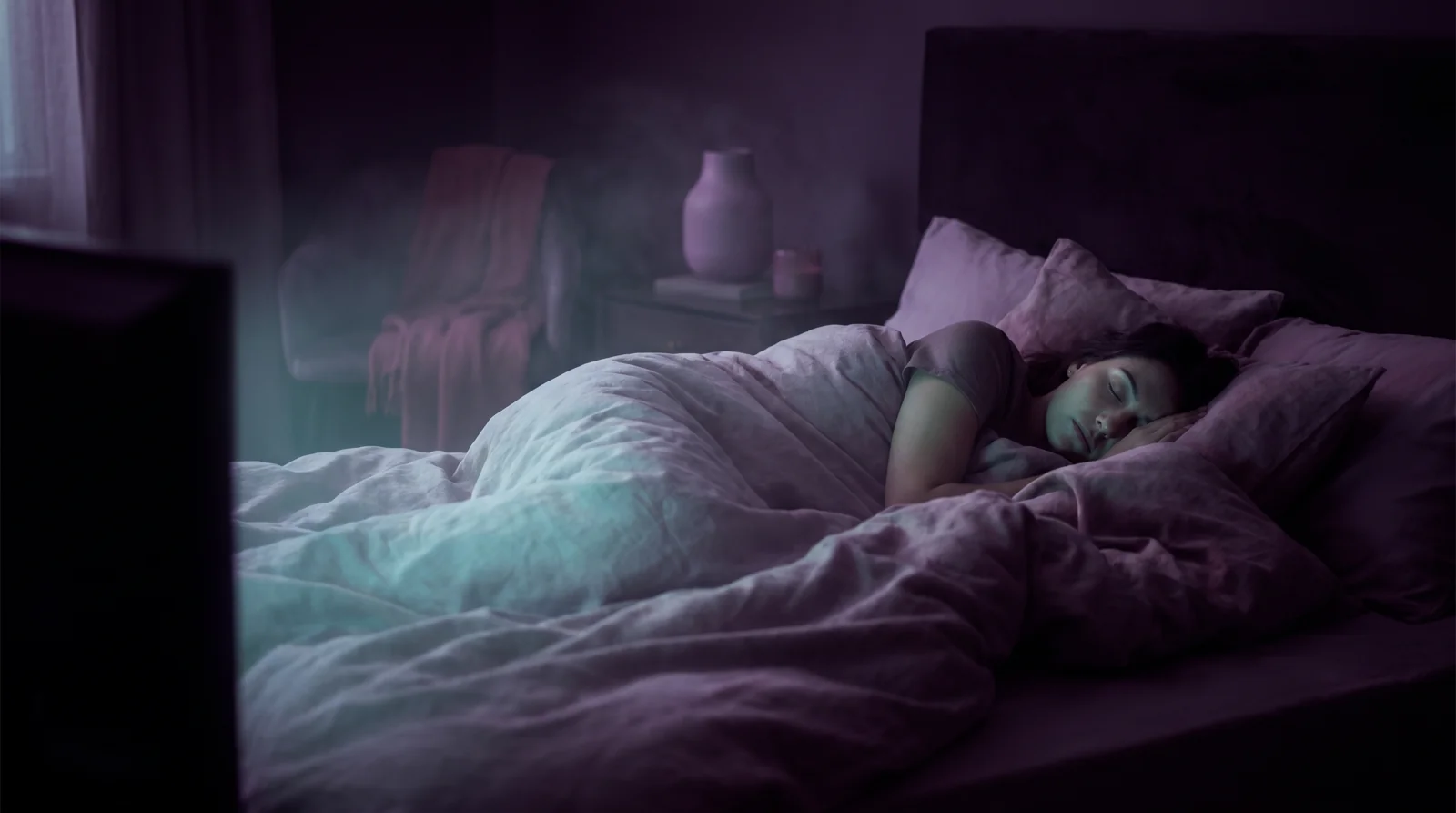
I know a guy, fine, it's me, who fell asleep to the same sitcom every night for two years. Same episodes, same laugh track, same blue flicker on the ceiling of a studio apartment in Queens. It worked, in the sense that I lost consciousness. Whether it worked in the sense of actual sleep is a different question, and the research has an answer I didn't love hearing. Let's go through it like adults, and then figure out how to keep the comfort without paying the full price.
Why the TV works, sort of
People don't fall asleep to television because they're undisciplined. They do it because a silent bedroom is where the brain schedules its worry meetings. Familiar voices give your attention something soft to hold onto, something that isn't tomorrow's inbox or that thing you said in 2019. A show you've seen ten times is perfect: engaging enough to crowd out rumination, predictable enough that you don't need to stay awake for the ending. That need is legitimate. The delivery mechanism is the problem.
What the light does after you're out
Your eyelids are not blackout curtains. Light gets through them, and your brain keeps registering it all night. In a 2022 study in PNAS, researchers at Northwestern led by Ivy Mason and Phyllis Zee had healthy adults sleep one night in dim light and one night under moderate room light, about the level of a lit screen in a dark room. One night was enough to measure a difference: under the brighter condition, sleepers' heart rates stayed higher through the night, and they showed increased insulin resistance the next morning. Their bodies spent the night slightly on duty, as if the environment couldn't be trusted. The participants, asked afterward, mostly couldn't tell the difference. That's the unsettling part: the cost doesn't announce itself.
Your eyes close. The meter keeps running.
Sleep is not one thing all night
A detail that makes the whole picture worse: sleep gets lighter as the night goes on. The deep, hard-to-disturb stages are front-loaded into the first few hours; the back half of the night is dominated by lighter stages and REM, when you're far easier to pull toward the surface. The TV you fell asleep to at 11:30 was competing with your most defended sleep. The TV still running at 4 a.m. is working against your flimsiest, and that's precisely when the lights and laugh tracks are still going. The arrangement is exactly backwards.
What the sound does
TV audio is designed to be dynamic, which is exactly what sleeping humans don't want. Dialogue drops to a murmur, then a score swells, then an ad arrives at twice the volume with opinions about car insurance. Unpredictable shifts in sound are what pull sleepers toward waking, even when you don't remember it; steady, unchanging noise is far kinder, which is why a fan is a sleep aid and an action movie is not. Then there's the autoplay cliff. You drift off during a gentle episode and at 3 a.m. the algorithm has marched three episodes ahead into a shouting match, at full brightness, forever. Nobody designed that pipeline with your sleep in mind, because they were paid to design it the other way.
There's a conditioning cost, too. Fall asleep to the TV long enough and the TV becomes part of the falling-asleep machinery, which you discover the first night you try to sleep without it: a hotel room, a partner with opinions, a power outage. The silence feels wrong, almost loud. That's not a character flaw either; it's just an association you trained. The good news is associations retrain. The habit that got built in a few weeks can be rebuilt in a few weeks, pointed at something gentler.
And yes, the phone propped on the pillow is the same deal in a smaller font. Closer to your face, brighter per inch, and autoplay with even fewer manners. If anything it's worse, because the feed is interactive: the TV at least doesn't expect you to participate. Everything below applies to both screens.
The harm-reduction version
If the TV is the only thing that quiets your head, I'm not going to pretend you'll quit tonight. Rank these from easiest to most effective and climb as far as you can:
- Set a sleep timer so the TV shuts off 30 to 60 minutes in, instead of narrating your entire night.
- Drop the brightness as low as it goes and use the warmest picture setting; the light hitting your closed eyes is the dose that matters.
- Keep the volume just above a whisper, and pick slow, familiar shows over anything with explosions or laugh-track spikes.
- Switch to audio only: screen off, a quiet boring podcast or sleep story doing the company-keeping.
- Replace the plot with steady sound and gentle visuals that are built to fade out rather than escalate.
Replacing the ritual without losing the comfort
The deeper fix is giving your brain the same off-ramp with none of the ad breaks. Steady noise covers the silence. A dull podcast covers the company. And if what you actually crave is something to rest your eyes on, that's the one need a TV meets worst, because it's engineered to escalate. This is the gap Feelsy was built for: slow textures and soft sound with an autoplay mode that winds down instead of up, no cliffhangers, no one selling you insurance at 3 a.m. Screen dim, volume low, timer on. The ritual survives; the all-night light bath doesn't.
Two years of sitcom sleep taught me the comfort was real but the delivery was dumb. Keep the comfort. Fire the delivery mechanism.
Feelsy is a wellness product, not medical advice. If stress, anxiety or sleep problems persist, please speak with a qualified professional.
References
- Mason, I. C., Grimaldi, D., Reid, K. J., Warlick, C. D., Malkani, R. G., Abbott, S. M., & Zee, P. C. (2022). Light exposure during sleep impairs cardiometabolic function. Proceedings of the National Academy of Sciences, 119(12).
Frequently Asked Questions
Is it bad to fall asleep with the TV on?
It's not ideal. Research found that even one night of moderate light during sleep kept sleepers' heart rates higher overnight and increased insulin resistance the next morning, and TV audio's unpredictable volume shifts can fragment sleep without you remembering it. If you can't quit, a sleep timer, minimum brightness, and low volume remove most of the damage.
Why do I fall asleep faster with the TV on?
A silent bedroom gives your brain room to ruminate, and familiar voices crowd that out. A show you've seen many times is engaging enough to hold your attention but predictable enough to release it, which is a decent recipe for drifting off. The problem isn't falling asleep; it's what the light and shifting sound do during the hours after.
Does TV light affect you even with your eyes closed?
Yes. Eyelids only filter light, they don't block it, and your brain keeps registering brightness all night. In the 2022 Northwestern study, people sleeping under moderate room light showed measurable overnight effects on heart rate and next-morning insulin resistance, and most couldn't subjectively tell the difference. The dose is invisible, which is why it's easy to dismiss.
What should I fall asleep to instead of TV?
Match the need. If silence is the problem, use steady unchanging noise, which doesn't spike the way TV audio does. If you want company, a quiet, boring podcast or sleep story with the screen off works. If you want something for your eyes, choose slow visuals designed to dim and fade out rather than escalate, with a timer so nothing runs all night.

About the author
Contributing writer
Kurt is a New York based writer covering the practical science of stress, sleep and focus. He is the resident sceptic of the Journal: if a technique cannot survive a crowded subway commute and a deadline week, he is not interested in it.
Feel it for yourself.
Feelsy turns reading about calm into practising it. Two minutes of a slow texture is often the whole difference.


Related reading
 Sleep
Does Screen Time Before Bed Really Wreck Your Sleep?
Phones before bed: sleep villain or overblown? What the research on screens, blue light and melatonin actually shows, and what to do that isn't 'never look at a screen.'
 ASMR
Why Podcasts Put You to Sleep Faster Than Silence
Press play, someone starts talking, you're out in ten minutes. Why podcasts knock you out faster than silence, and how to set them up so they help your sleep.
 Sleep
White Noise for Sleep: What Works and What Does Not
White, pink and brown noise all promise better sleep. Here is what the evidence actually supports, how to choose, and how to set up sound for a quieter night.
 Sleep
Falling Back: A Survival Guide for the End of Daylight Saving Time
Clocks fall back this weekend, and the free hour is slightly fake. What the end of daylight saving time really does to your sleep, and how to land it well.
 Sleep
The Best Alarm Sound to Wake Up To, According to Research
Harsh beeping may be making your mornings worse. What research says about the best alarm sound to wake up to, and how to choose one your brain won't fight.
 Sleep
Can You Learn While You Sleep? What the Science Actually Says
Sleep learning is an old dream and mostly a myth, but not entirely. What research really shows about learning, memory and your sleeping brain.