What Is a Mandala? Meaning, History and How to Meditate with One
Mandala means circle, but the circle is only the beginning. Here is what mandalas represent, where they come from, and how to use one to settle the mind.
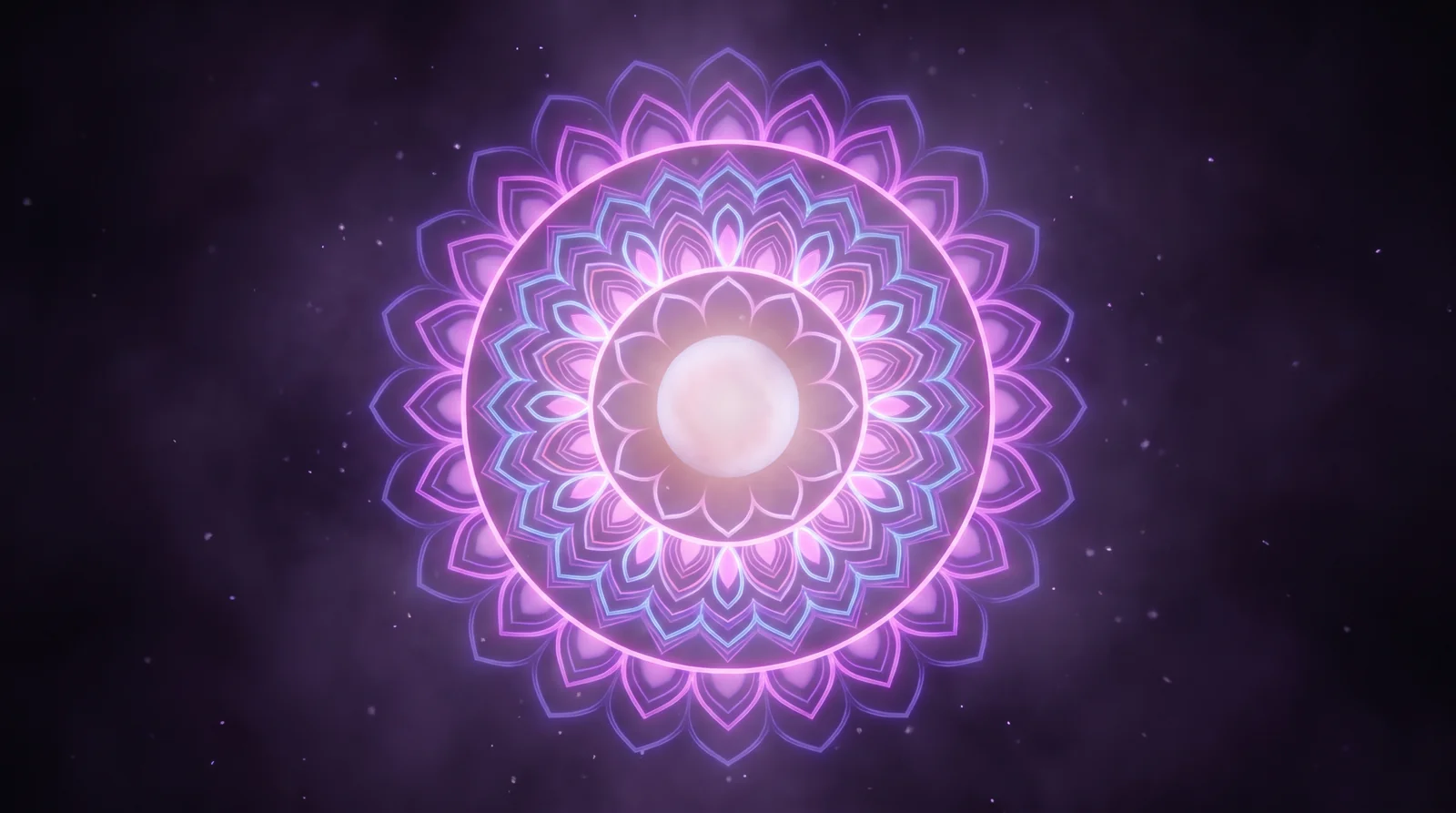
Somewhere in your life there is probably a mandala you have not noticed. The rose window of a cathedral. The pattern on a grandmother's plate. The circular diagrams that appear, unbidden, in the margins of a bored student's notebook. The form keeps arriving because it answers something in the way we see: a centre, a boundary, and everything between arranged in patient, radiating order.
The word itself is Sanskrit, and it means, simply, circle. But in the contemplative traditions that developed it, a mandala was never merely a shape. It was a device: a picture built to be entered with the eyes, so that attention travels inward along its geometry and arrives, eventually, at the still point in the middle.
The meaning of the word
In its oldest usage, mandala described any sacred circle: the round of a ritual space, a division of the Rig Veda, the circuit of a king's territory. Over time the meaning concentrated into the one we recognise now, a symmetrical, usually circular design organised around a centre, often enclosing squares, gates, petals and rings of pattern.
The organising idea is containment. A mandala draws a boundary around a small, ordered world, and in doing so proposes something quietly radical: that wholeness can be pictured, and that looking at the picture long enough changes the looker. The circle holds; the centre anchors; the symmetry reassures. You do not need to know a single word of Sanskrit for that grammar to work on you.
A short history across traditions
Mandalas flowered most elaborately in Hindu and Buddhist practice. Hindu traditions developed the yantra, a compact geometric mandala of interlocking triangles and petals used as a support for meditation and ritual. Tibetan Buddhism built perhaps the most famous expression of the form: vast sand mandalas, constructed grain by grain over days by teams of monks, then ritually swept away upon completion, a deliberate lesson in impermanence that we have written about separately.
But the circle with a centre is not the property of any one lineage. Christian Europe set rose windows into its cathedrals and traced labyrinths into their floors. Islamic art raised radial geometry to extraordinary refinement. In the twentieth century, the psychiatrist Carl Jung became fascinated by the circular drawings his patients produced and made the mandala a cornerstone of his thinking, reading it as an image of the psyche's search for order and wholeness. Jung's theories are not science, and it is fair to hold them loosely, but his core observation rings true to anyone who has doodled a circle in a difficult meeting: when the mind feels scattered, the hand reaches for the centre.
A mandala is a picture built to be entered with the eyes: the gaze travels the pattern, and the pattern leads it home to the centre.
Why circles hold the attention
Look closely at what a mandala asks of the eye and you can see why the form became a meditation device. Radial symmetry gives the gaze a track to run on: wherever you land, the pattern curves you onward, and every path bends towards the middle. There are no dead ends and no surprises, only variation inside order. The design is rich enough to stay interesting and predictable enough never to startle.
That combination, gentle interest without demand, is the signature of what psychologists call soft fascination, the restful mode of attention we also give to clouds, water and firelight. A mandala is soft fascination made deliberate: a portable, human-made object that invites the same effortless watching. In that sense it belongs to the same family as every slow, symmetrical thing we find ourselves staring at, from kaleidoscopes to ripples on a pond.
What research says about mandalas and anxiety
The best studied modern use of the mandala is humble: colouring one in. In a frequently cited experiment, students who coloured a mandala after a brief anxiety induction showed significantly reduced anxiety compared with students who coloured freely on blank paper (Curry and Kasser, 2005, Art Therapy). A replication some years later again found that mandala colouring reduced anxiety more than free-form colouring (van der Vennet and Serice, 2012, Art Therapy). The structure itself seems to matter: it is not just the crayons, it is the circle.
These are small laboratory studies of one specific activity, so the right conclusion is modest. But it matches what the traditions claimed all along: that ordered, symmetrical pattern gives a restless mind somewhere safe to settle, and that working slowly within a boundary is itself a kind of relief.
How to meditate with a mandala
You can practise with a printed mandala, a colouring book, an image on a screen, or one you draw yourself; none of these is superior. What matters is how you look.
- Choose one mandala and place it comfortably in view, about arm's length away.
- Soften your gaze. Let your eyes rest on the outer rim without gripping any detail.
- Follow the pattern slowly inward, ring by ring, as if walking a path. There is no pace to keep.
- When you reach the centre, rest there. When attention wanders, begin again at the rim without commentary.
- After a few minutes, close your eyes and notice the afterimage, the quiet, and your breath.
Five minutes is plenty to begin. The practice is not about seeing the whole design but about letting the design decide the route, which is precisely the relief: for a few minutes, your attention has a shape to live in that is not your to-do list.
Mandalas without paper
The mandala's logic, a centre, a symmetry, a slow route inward, does not require ink. Watching a kaleidoscope turn is watching a mandala in motion. The same is true of the slow radial textures in Feelsy: particles drifting around a centre, fluid folding symmetrically back on itself, patterns that bloom and settle while your gaze rides along. If colouring feels fussy at the end of a long day, letting a moving mandala do the drawing for you is a perfectly honourable substitute, and the screen version asks even less of you than the crayon ever did.
However you come to it, on paper, in sand, in glass or in light, the mandala makes one patient promise: there is a centre, and you can get there from here. Some evenings, that is the only direction a mind needs.
Feelsy is a wellness product, not medical advice. If stress, anxiety or sleep problems persist, please speak with a qualified professional.
References
- Curry, N. A., & Kasser, T. (2005). Can coloring mandalas reduce anxiety? Art Therapy: Journal of the American Art Therapy Association, 22(2), 81–85.
- van der Vennet, R., & Serice, S. (2012). Can coloring mandalas reduce anxiety? A replication study. Art Therapy: Journal of the American Art Therapy Association, 29(2), 87–92.
Frequently Asked Questions
What is a mandala in simple terms?
A mandala is a symmetrical design, usually circular, organised around a centre and often enclosing rings of pattern, petals and gates. The word is Sanskrit for circle. In contemplative traditions it is more than decoration: it is a picture built to be entered with the eyes, so that attention travels inward along the pattern and comes to rest at the still point in the middle.
What do mandalas symbolise?
The organising idea is containment and wholeness: a mandala draws a boundary around a small, ordered world with a clear centre, which traditions have read as an image of the cosmos, of sacred space, or of the self brought into order. Carl Jung saw the circular drawings his patients made as the psyche's search for wholeness. You do not need to adopt any one interpretation for the calming effect of the form to work.
Do mandalas really help with anxiety?
Small studies suggest the structure genuinely helps. In a 2005 experiment, students who coloured a mandala after an anxiety induction showed significantly reduced anxiety compared with students who coloured freely on blank paper, and a 2012 replication found the same advantage for mandala colouring. The ordered, symmetrical pattern seems to give a restless mind somewhere safe to settle.
How do you meditate with a mandala?
Place one mandala comfortably in view, soften your gaze on the outer rim, and follow the pattern slowly inward, ring by ring, as if walking a path. When you reach the centre, rest there, and when attention wanders, simply begin again at the rim. Five minutes is plenty to start, and a printed mandala, a colouring page, a screen image or one you draw yourself all work equally well.
Are Tibetan sand mandalas the same thing?
They are the most famous expression of the form: vast, intricate mandalas built grain by grain over days by teams of monks, then ritually swept away upon completion as a deliberate lesson in impermanence. The design principles are the same, a centre, symmetry and enclosing rings, but the sand version adds the teaching that even the most beautiful order is temporary.

About the author
Contributing writer
Eleonor writes about contemplative traditions, attention and the cultural history of calm. She has spent two decades collecting the rituals humans use to slow down, from zazen halls to hammams, and translating them for modern, screen-lit lives.
Feel it for yourself.
Feelsy turns reading about calm into practising it. Two minutes of a slow texture is often the whole difference.


Related reading
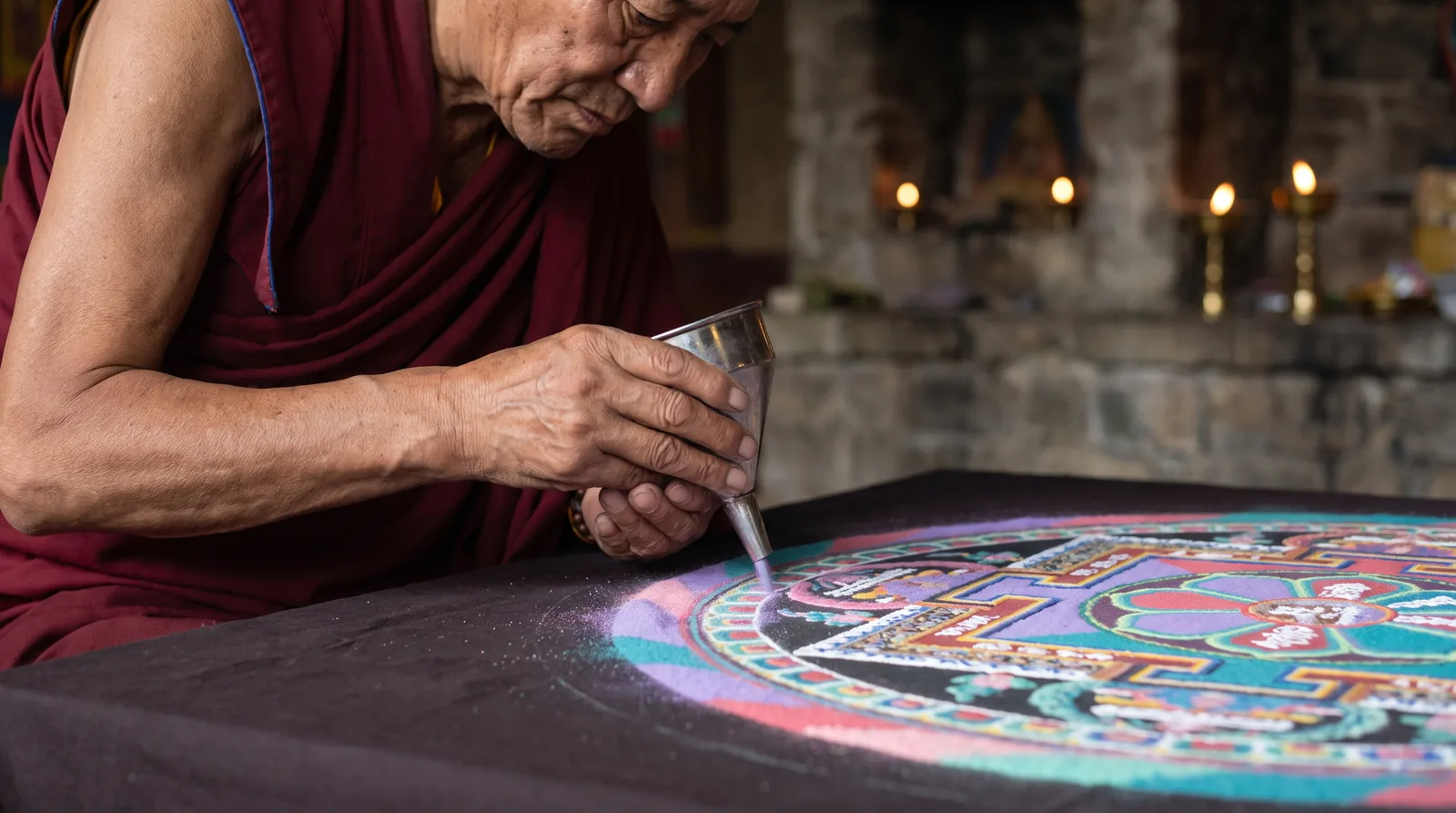 Ancient Wisdom
Sand Mandalas and the Art of Letting Go
Tibetan monks spend days building an intricate sand mandala, then sweep it away. What the ritual teaches about impermanence, process and why watching can be meditation.
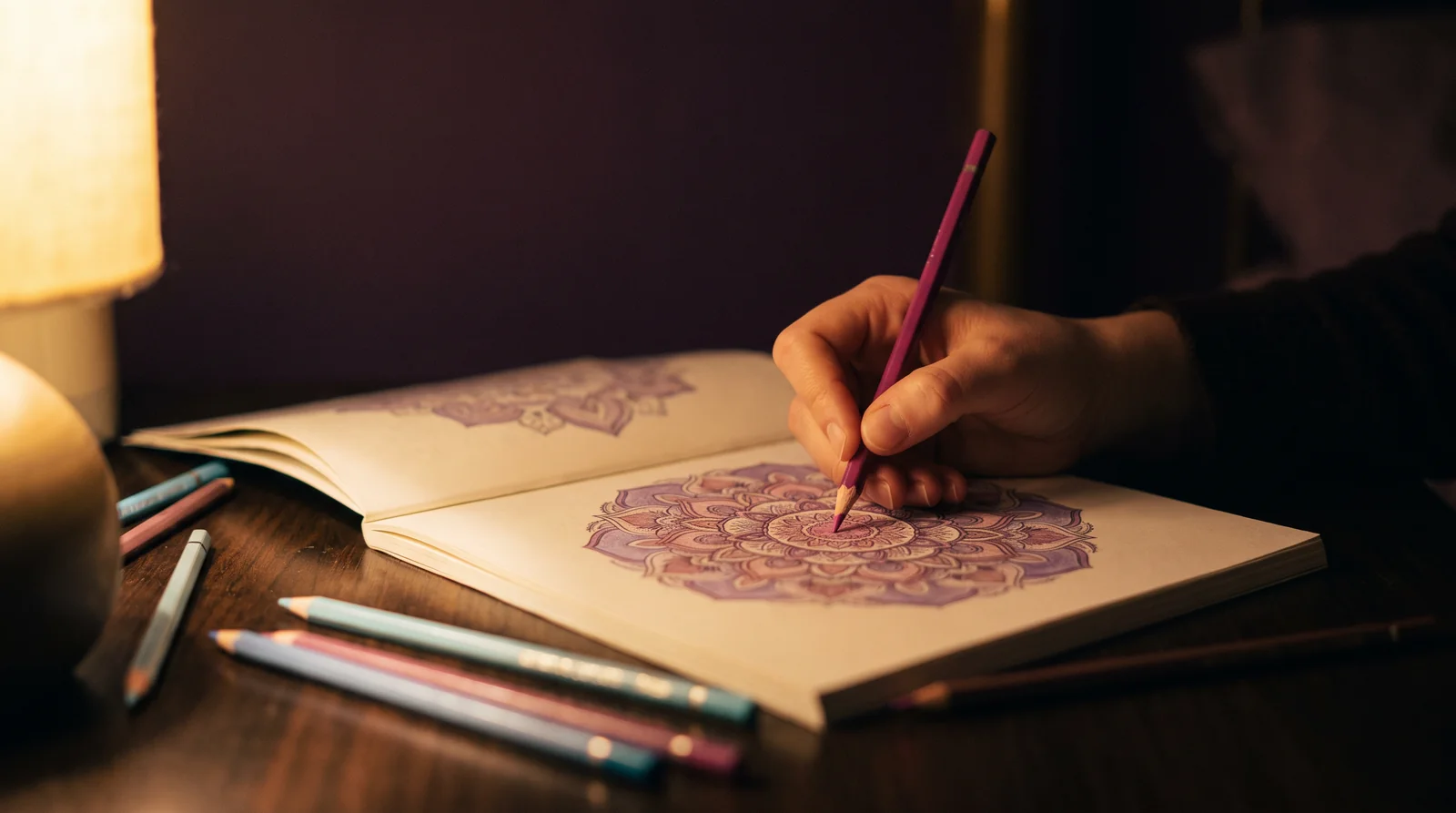 Visual Meditation
Colouring In: Why Adult Colouring Books Quiet an Anxious Mind
Why colouring calms adult minds: what research on mandala colouring and anxiety found, and how to turn ten minutes with pencils into a visual meditation.
 Visual Meditation
Ensō: The Zen Circle You Draw in One Breath
The ensō, Zen's hand-drawn circle, is a one-breath meditation in ink. Its meaning, its history, and how drawing one imperfect circle steadies the mind.
 Visual MeditationNew
Apricity: The Forgotten Pleasure of Winter Sun
Apricity is a forgotten English word for the warmth of the sun in winter. Here is why a few minutes of low winter sunlight can soften the darkest months.
 Visual MeditationNew
Momijigari: The Japanese Art of Autumn Leaf Viewing
Momijigari is the old Japanese tradition of travelling to see autumn leaves. Here is why fiery foliage calms the mind, and how to practise it anywhere.
 Visual MeditationNew
Why Libraries Feel So Calming
Step into a library and your shoulders drop. Here is the psychology of hush, tall shelves and shared silence, and how to borrow that feeling for your rooms.