Blooming Tea: Watching a Flower Open in Glass
Blooming tea turns hot water into a slow performance: a hand-sewn bundle unfurling into a flower. What it is, how to brew it, and how to watch it well.
By Mei Lin
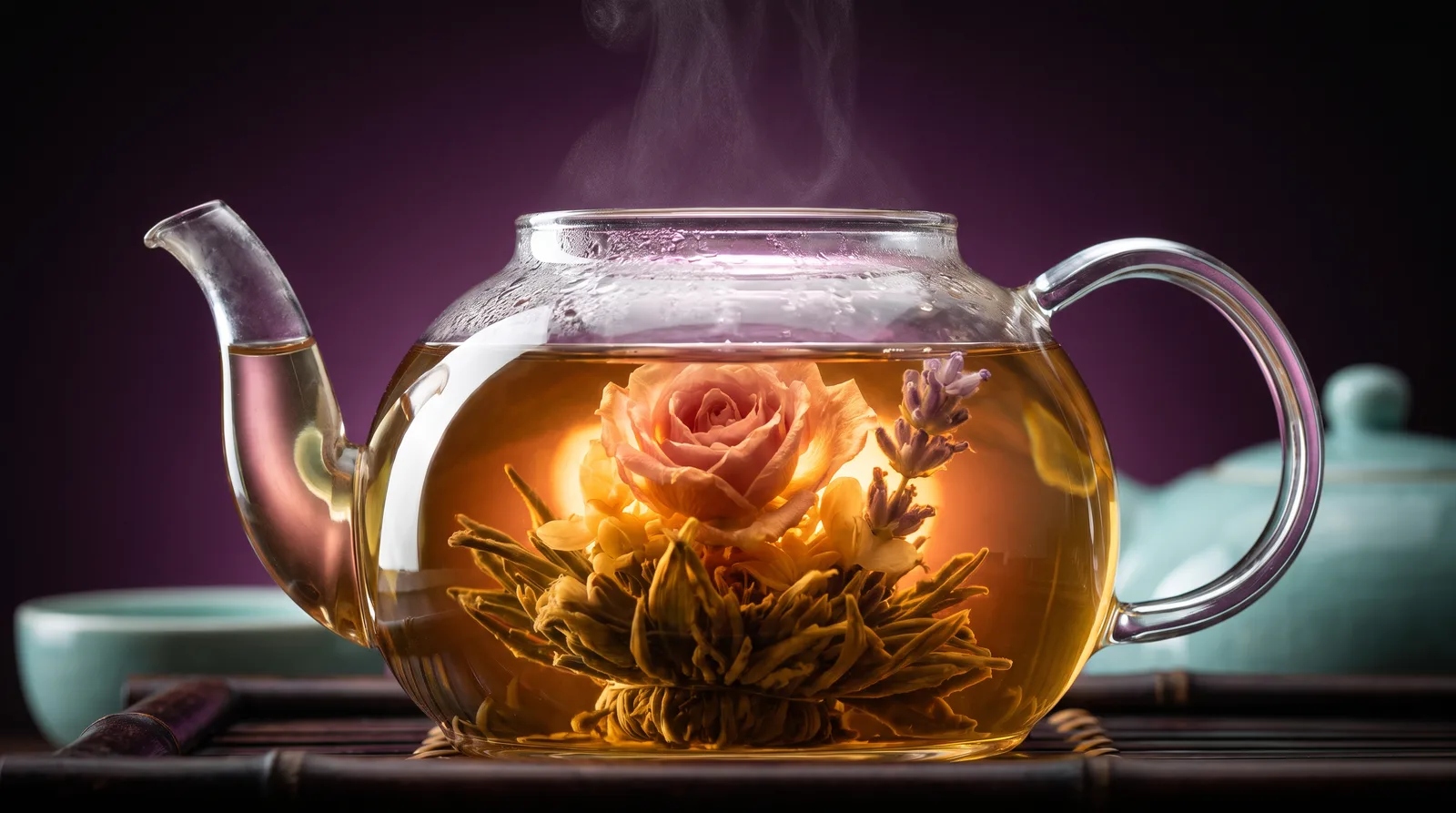
The first blooming tea I ever saw was a gift my grandmother received and refused to drink for a week. It looked like a rough little acorn, dry and unpromising, and she kept it in its box the way you keep something too good to use. Then one afternoon she set a glass pot on the table, slipped the bundle in, and poured hot water over it. The acorn sank, hesitated, and began to open. Leaves unfolded like slow wings. A thread of jasmine rose through the amber. At the center, a flower none of us knew was there lifted itself upright and bloomed. Nobody at the table spoke for three minutes. That silence, I understood later, is the real product.
What blooming tea actually is
Blooming tea, also sold as flowering tea or craft tea, is a small sculpture made of leaves. Artisans, many of them in China's Fujian province, take young green tea or silver needle leaves and sew them by hand with cotton thread around one or more dried flowers: jasmine, globe amaranth, lily, osmanthus, marigold, chrysanthemum. The bundle is shaped and dried into a tight bulb about the size of a walnut. It keeps its secret until hot water relaxes the thread, the leaves open outward, and the hidden flower rises on its stem.
Tea sellers disagree about how old the art is. Display teas appear in stories reaching back centuries, while the tight, hand-sewn bulbs sold today are largely a modern craft, refined for the glass teapots that let you see them. The argument matters less than the intention, which has not changed: this is tea made to be watched first and drunk second.
A performance in three acts
A good bloom unfolds like slow theater. First the sinking: the bulb drops, turns, and settles, trailing a ribbon of early color. Then the unfurling: over two or three minutes the outer leaves peel back one by one, each release sending a soft pulse through the water. Last, the rising: the flower, freed, floats upward on its thread of stem and opens at the top like a lantern being lit. The whole performance takes between three and ten minutes, and it cannot be skipped ahead. The water decides the pace. You attend.
Most tea asks you to wait. Blooming tea makes the waiting the performance.
How to brew and watch one
You need glass; a bloom in a ceramic pot is a concert behind a wall. Beyond that, the method is forgiving:
- Use a glass teapot or a tall heatproof glass, large enough for the flower to stand upright.
- Heat water to just off the boil, around 185 to 195 degrees Fahrenheit, so the delicate leaves do not scald.
- Place the bulb in first, then pour the water gently down the side of the glass, not onto the bloom.
- Do not stir. Sit where the light passes through, and watch until the flower has fully opened.
- Drink while warm; the same bloom will take two or three refills, each a little gentler than the last.
- When the tea is finished, move the flower to a bowl of cold water, where it will keep as a small display for a day or two.
Choosing a bloom worth watching
Not every bulb earns its theater. A good bloom is sewn from whole young leaves, not fragments, and it smells like tea and flowers rather than perfume; heavy artificial scenting is the most common shortcut. Buy from a seller who names the tea base and the flowers used, and check that the flowers are food grade, since the whole point is that you drink what you watch. Stored airtight, away from light and the spice shelf, the bulbs keep for a year or more. They are also, I should say, the easiest gift in the tea world: small, inexpensive, and guaranteed to make the recipient call you the afternoon they finally brew one.
What is actually in the cup
Underneath the theater, this is green tea: light caffeine, a floral nose, and L-theanine, the amino acid that gives tea its characteristic calm alertness. In a randomized controlled trial published in 2019, Hidese and colleagues found that four weeks of L-theanine lowered stress-related symptoms and improved aspects of sleep and cognitive performance in healthy adults. An honest footnote: that trial used supplement doses larger than what one cup delivers, so a single bloom is not a clinical intervention. But then, the ritual was never only about the chemistry. The slow pour, the waiting, the watching: the cup is doing half the work before you take the first sip.
Watching as a practice
Treat one brew as a complete meditation. Phone in another room, the glass at eye level, your only task to see the whole opening: every leaf's release, the last slow lift of the stem. When your mind wanders to the afternoon's errands, come back to the flower. It will not be hurried, and this is the lesson smuggled inside the gift. My grandmother put it more plainly: the flower opens at its own speed to teach you yours.
On days when there is no teapot within reach, I keep a slower substitute in my pocket: Feelsy's unfurling, ink-like textures with the sound of poured water turned low. Set autoplay mode and one bloom follows another. It is not tea. But it trains the same muscle: staying with something that opens slowly and refuses to be rushed.
The flower you cannot hurry
Blooming tea is slightly impractical, mildly theatrical, and easy to dismiss as a novelty. Keep one anyway. There are few objects that so reliably stop a table of adults mid-sentence, and fewer still that do it with nothing but leaves, thread, and hot water. The bulb waits in its box like a folded letter. Some slow afternoon, you will want something worth watching, and it will be there, holding its flower, keeping its secret.
Feelsy is a wellness product, not medical advice. If stress, anxiety or sleep problems persist, please speak with a qualified professional.
References
- Hidese, S., Ogawa, S., Ota, M., Ishida, I., Yasukawa, Z., Ozeki, M., & Kunugi, H. (2019). Effects of L-theanine administration on stress-related symptoms and cognitive functions in healthy adults: A randomized controlled trial. Nutrients, 11(10), 2362.
Frequently Asked Questions
What is blooming tea?
Blooming tea, also called flowering tea, is a hand-sewn bundle of green tea or silver needle leaves wrapped around one or more dried flowers such as jasmine, lily, or globe amaranth. When steeped in hot water, the bundle slowly opens and the hidden flower rises and blooms, turning the brew into a short visual performance.
How do you brew blooming tea?
Use a glass teapot or tall heatproof glass so you can watch. Place the bulb in first, pour water heated to just off the boil, around 185 to 195 degrees Fahrenheit, gently down the side, and do not stir. The flower takes roughly three to ten minutes to open fully, and the same bloom handles two or three refills.
Can you reuse a blooming tea flower?
Yes, twice over. The same bloom will take two or three steeps, each a little lighter than the last. Once the tea is finished, move the opened flower to a bowl of cold water and it will keep as a small table display for a day or two.
Does blooming tea have caffeine?
Yes, a light amount. The base is green tea, so a bloom delivers gentle caffeine along with L-theanine, the amino acid associated with tea's calm alertness. It is considerably lighter than coffee, but if you are sensitive to caffeine, treat it as an afternoon rather than a late-evening ritual.
About the author
Contributing writer
Mei grew up in Shanghai around tea that could not be hurried and grandmothers who considered stillness a skill. She writes about slow hands and sensory ritual: tea, calligraphy, qigong, and the quiet crafts that taught the world how to pay attention.
Feel it for yourself.
Feelsy turns reading about calm into practising it. Two minutes of a slow texture is often the whole difference.


Related reading
 Ancient Wisdom
Tea Meditation: The Slow Ritual of Gongfu Cha
How to turn tea into meditation: the Chinese gongfu tea ritual, why warm slow ritual calms the nervous system, and a ten-minute practice for any mug.
 Ancient Wisdom
Why Chinese Grandmothers Prescribe Hot Water for Everything
In China, plain hot water is comfort, care and daily ritual in a single cup. The story of he re shui, thermos culture, and what a warm slow sip can teach.
 Visual Meditation
Why Ink Blooming in Water Is So Mesmerizing
A drop of ink unfurls underwater like slow smoke, and you cannot look away. The science and the old floating-ink arts behind one of the calmest sights there is.
 Visual MeditationNew
Apricity: The Forgotten Pleasure of Winter Sun
Apricity is a forgotten English word for the warmth of the sun in winter. Here is why a few minutes of low winter sunlight can soften the darkest months.
 Visual MeditationNew
Momijigari: The Japanese Art of Autumn Leaf Viewing
Momijigari is the old Japanese tradition of travelling to see autumn leaves. Here is why fiery foliage calms the mind, and how to practise it anywhere.
 Visual MeditationNew
Why Libraries Feel So Calming
Step into a library and your shoulders drop. Here is the psychology of hush, tall shelves and shared silence, and how to borrow that feeling for your rooms.