Why Ink Blooming in Water Is So Mesmerizing
A drop of ink unfurls underwater like slow smoke, and you cannot look away. The science and the old floating-ink arts behind one of the calmest sights there is.
By Mei Lin
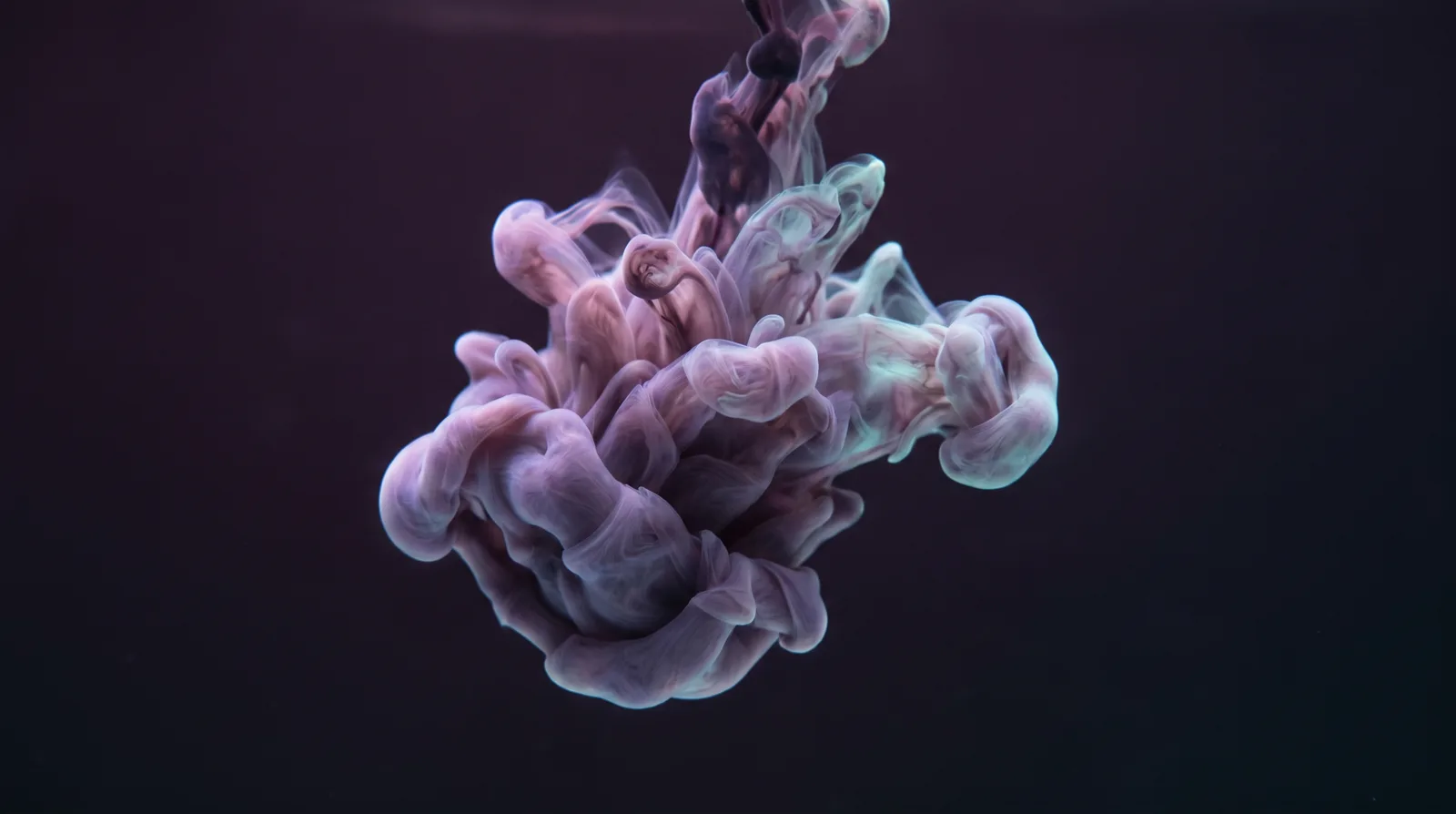
The best part of my grandmother's calligraphy practice came after the writing was finished. She would rinse her brush in a jar of clean water, one unhurried swirl, and I would kneel with my chin on the table to watch the ink leave the bristles: first a dark breath, then a slow gray storm cloud turning in the jar, then long tendrils reaching down like the roots of a tree that existed for thirty seconds and never again. She never hurried the rinse. Some evenings she gave the jar a second, slower stir, purely, I now believe, for the audience at the table's edge. I understood, without being told, that this too was part of the practice: the characters were for the paper, and the ink cloud was for us, a small gray theater whose only play was dispersal, performed nightly to a full house of two.
The slowest firework
Drop ink into still water and you get an event that behaves like a firework with all the violence removed. The drop punches gently through the surface and blooms into a ring; the ring sprouts tendrils; each tendril blooms again into smaller rings, and so on downward, a chandelier assembling itself out of smoke. What you are watching is heavy pigment sinking through lighter water, curling into tiny vortices as the two fluids negotiate, and diffusion slowly blurring every sharp edge into haze. No two blooms are alike, because the negotiation is never the same twice. But every bloom follows the same grammar: burst, branch, soften, disperse. The eye seems to know this grammar in advance, which is part of why the watching feels less like attention and more like recognition.
Branches, and why your eyes trust them
There is a name for that recognition. The ink cloud's shape, large branches splitting into smaller and similar ones, is a fractal pattern, the same architecture as tree limbs, river deltas, lightning, and the veins of a leaf. Human vision is deeply fluent in this kind of structure, and the fluency appears to be soothing: research measuring physiological responses found that viewing fractal patterns of moderate complexity, the range where nature tends to live, reduced markers of stress in observers (Taylor, 2006, Leonardo). An ink bloom is that geometry, drawn slowly, in soft gray, right in front of you. It asks for the kind of loose, effortless attention that restores rather than drains: nothing to decode, nothing to win, just a familiar shape unfolding at a speed the eye can rest on.
Every bloom ends the same way: the water settles into a single quiet gray, and that, too, is part of the lesson.
The old arts of floating ink
None of this is a modern discovery. In Japan, the art of suminagashi, floating ink, is nearly a thousand years old: a drop of sumi ink is rested on the surface of still water, coaxed into rings and ripples with a breath or a single hair's touch, and then lifted off onto paper, so the sheet keeps a portrait of one moment of moving water. In the Chinese tradition I grew up beside, ink and water are the entire orchestra; a painter of shan shui landscapes controls mist and mountain by controlling how far ink is allowed to travel through wet paper. Watching ink meet water was never merely preparation for these arts. It was the tuition. You learn what water does by watching it do it, and the watching itself turns out to be the calmest lesson in the curriculum.
The materials were part of the meditation long before the first drop fell. In the scholar's studio, ink was not squeezed from a tube; it was ground, an ink stick drawn in slow circles against a wet stone until the water thickened and darkened, a preparation that could take longer than the painting it served. Grinding ink was understood as grinding the mind: by the time the ink was ready, so was the painter. The rinse jar at the end and the ink stone at the beginning bracket the work with the same instruction, which is that nothing here will be hurried.
How to watch an ink bloom
- Fill a clear glass or jar with water and let it stand until it is perfectly still; stillness is the canvas.
- Add one drop of ink, or strong tea, from a finger's height above the surface, and then touch nothing.
- Choose a single tendril and follow only that one, at its own speed, letting your exhale run a little longer than your inhale.
- Stay until the water has gone an even gray, and notice the moment when there is nothing left to follow.
A bloom before bed
The whole ceremony costs one drop of ink and perhaps three minutes, which makes it one of the most affordable meditations I know. And its logic carries even when there is no jar at hand. Several of the slow textures in Feelsy move by exactly these rules, pigment-like clouds drifting, branching, and softening in the same aubergine dark, and letting one of them play in autoplay mode at the end of the day is the same practice by other means: one bloom, followed gently, instead of one more bright and hurried scroll. My grandmother would have found an app an absurd place to keep water and ink. But she would have recognized the posture immediately: chin down, eyes soft, breath long, watching something patient finish becoming nothing in particular.
Feelsy is a wellness product, not medical advice. If stress, anxiety or sleep problems persist, please speak with a qualified professional.
References
- Taylor, R. P. (2006). Reduction of physiological stress using fractal art and architecture. Leonardo, 39(3), 245-251.
Frequently Asked Questions
Why is ink in water so satisfying to watch?
An ink drop blooms through predictable stages, burst, branch, soften, disperse, and its branching shape is a fractal pattern, the same architecture as tree limbs and river deltas. Human vision is fluent in that structure, and research has found that viewing fractal patterns of moderate complexity reduced physiological markers of stress in observers.
What actually happens when ink drops into water?
Heavier pigment sinks through lighter water, curling into small vortices as the two fluids interact, while diffusion slowly blurs every sharp edge into haze. The drop blooms into a ring, the ring sprouts tendrils, and each tendril blooms again into smaller rings, until everything settles into an even gray.
What is suminagashi?
Suminagashi, Japanese for floating ink, is a marbling art nearly a thousand years old. A drop of sumi ink is rested on the surface of still water, shaped into rings and ripples with a breath or a fine touch, and then lifted onto paper, so the sheet preserves one moment of moving water.
How do I use ink in water as a meditation?
Fill a clear glass with water and let it go perfectly still, add a single drop of ink or strong tea, then follow one tendril at its own pace while letting your exhale run longer than your inhale. Stay until the water turns an even gray; noticing that ending is part of the practice.
Can I get the same effect from a screen?
The watching posture matters more than the medium: soft eyes, long breath, one slow thing followed gently. Fluid, ink-like drifting textures, such as those in Feelsy's autoplay mode, move by the same rules of blooming and softening, and make a quieter end to the day than a bright, fast feed.

About the author
Contributing writer
Mei grew up in Shanghai around tea that could not be hurried and grandmothers who considered stillness a skill. She writes about slow hands and sensory ritual: tea, calligraphy, qigong, and the quiet crafts that taught the world how to pay attention.
Feel it for yourself.
Feelsy turns reading about calm into practising it. Two minutes of a slow texture is often the whole difference.


Related reading
 Visual Meditation
Why Fractals Calm the Mind: The Quiet Mathematics of Ferns and Coastlines
Ferns, clouds and coastlines share a repeating geometry called fractals. Here is why nature's self-similar patterns soothe the eye, and how to use them.
 Visual Meditation
Shan Shui: Why Misty Mountain Paintings Quiet the Mind
Why Chinese landscape painting calms the mind: what shan shui is, the psychology of mist and negative space, and how to look at a painting as meditation.
 ASMR
ASMRWhy Paint Mixing Videos Are So Satisfying
Why paint mixing videos feel so satisfying: the slow science of swirls and folds, what ASMR research suggests, and how to watch them as a mini meditation.
 Visual Meditation
Highway Hypnosis: Why You Can't Remember the Last Ten Miles
You arrive at your exit with no memory of driving there. Highway hypnosis is real and common: here's the science of the road trance and how to use it safely.
 Visual Meditation
Why the Northern Lights Mesmerise Us: Aurora Watching as Visual Meditation
What causes the northern lights, why the aurora feels so calming to watch, and how to turn sky watching into a simple visual meditation practice.
 Visual Meditation
Blue Mind: Why Being Near Water Calms the Brain
What blue mind theory says about why oceans, lakes and rivers soothe us: the research on blue space, water's pull on the eye, and how to use it daily.