What Is Rangoli? The Ephemeral Art of the Threshold
Rangoli is the Indian practice of drawing bright, temporary patterns at the doorstep. Here is its history, its regional cousins, and why impermanent art calms.
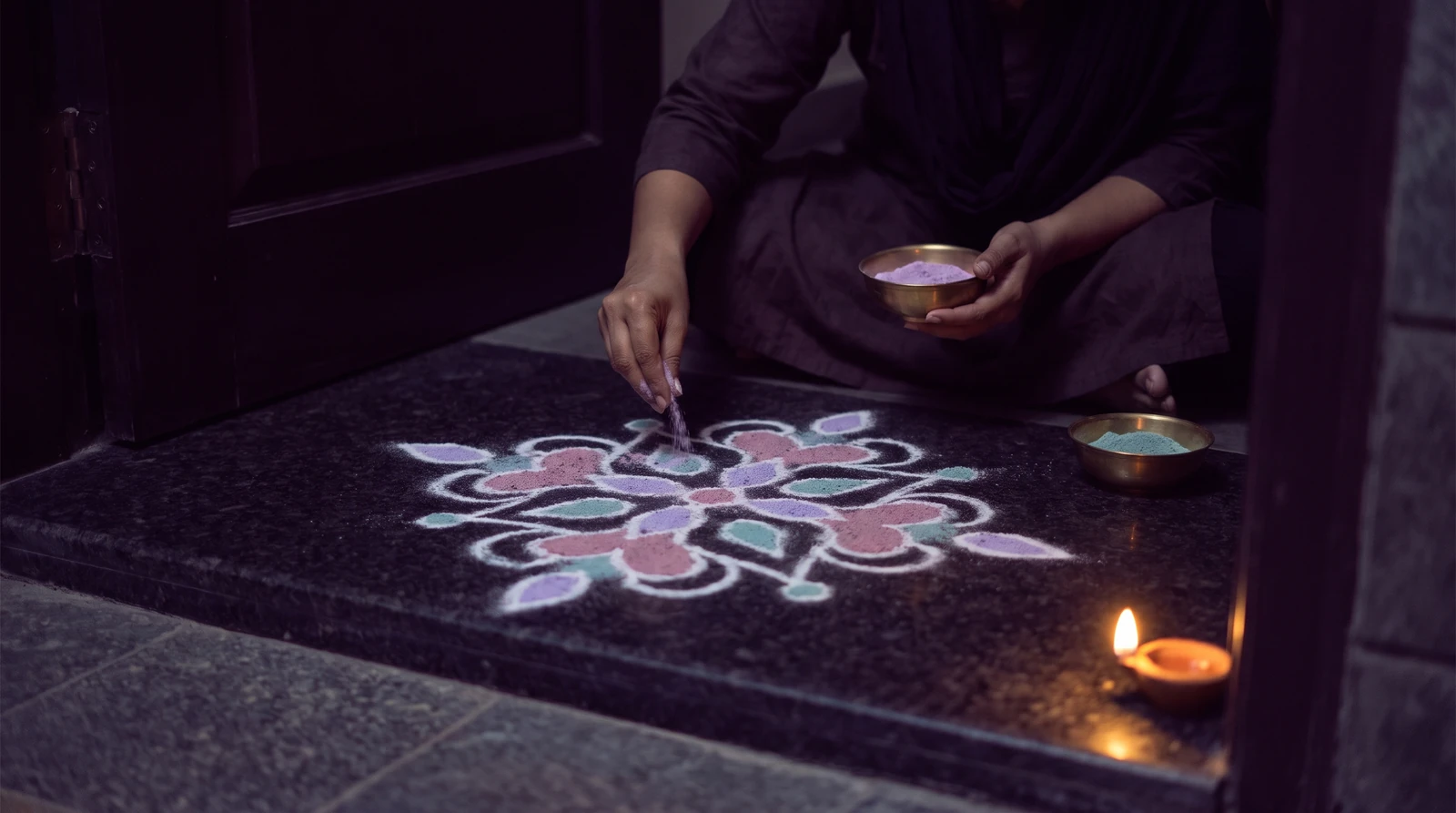
Before the sun is properly up, across much of India, a quiet art form is being made and unmade. A woman steps out to the threshold of her home with a small bowl of rice flour or coloured powder. She bends, lets a pinch of it run between her fingers, and begins to draw: dots first, then loops and lattices that bind the dots together, until the doorstep carries a symmetrical pattern that was not there ten minutes ago. By tomorrow it will be gone, walked over, blown away, nibbled by birds, and she will draw another.
This is rangoli, one of the oldest living traditions of ephemeral art in the world, and if you watched the festival of Diwali light up homes earlier this month, you saw it at its most elaborate. But the festival version is only the famous cousin of something far more interesting: a daily, domestic, meditative practice that has been handed down, mostly from mother to daughter, for many centuries.
One art, many names
Rangoli is the general term, from a Sanskrit root connected to colour, but the practice wears a different name in almost every region. In Tamil Nadu it is kolam, drawn in white rice flour as a grid of dots joined by continuous looping lines. In Andhra Pradesh and Telangana it is muggu. In Bengal it is alpana, painted in rice paste; in Rajasthan, mandana, drawn on ochre walls and floors; in Bihar, aripana. The materials shift with the region: rice flour, chalk powder, coloured sands, flower petals, turmeric and vermilion.
The grammar, however, is remarkably consistent. The designs are symmetrical, usually built outward from a centre or threaded through a lattice of dots. They sit at thresholds and courtyards, the border between home and world. And they are deliberately temporary.
A drawing that feeds the ants
The traditional kolam is drawn in edible rice flour, and that choice is not an accident. As the day passes, ants, birds and insects eat the drawing. The art form has generosity built into its material: the household begins each day by making something beautiful that is also, quietly, an offering to the smallest neighbours. Hospitality is extended before the first guest arrives, to creatures that will never say thank you.
There is a lesson folded in here that has nothing to do with decoration. The drawing is not for keeping. It is for making.
The kolam is not for keeping. It is for making, and that is precisely why it calms.
Why impermanent art soothes the maker
Rangoli belongs to a small family of practices, with Tibetan sand mandalas as its most famous relative, in which the destruction of the work is part of the work. A sand mandala may take monks days of intense, precise labour, and it ends with the sand swept together and poured into a river. The kolam is the domestic, daily version of the same gesture: effort, beauty, release, repeat.
For the person drawing, this does something subtle and kind. Because the work will be gone by evening, there is no portfolio, no comparison, no pressure for the pattern to be the best one ever drawn. The stakes drop, and when stakes drop, attention relaxes into the task itself: the feel of the flour, the steadiness of the wrist, the slow emergence of symmetry. It is the same release many people find in wabi-sabi, the Japanese aesthetic of imperfection, or in raking a zen garden that the wind will redraw by morning.
The geometry of a quiet mind
A kolam is also a small feat of applied mathematics. Many designs are single continuous lines that weave around every dot in the grid and return to their starting point, never crossing the same path twice in the same way. Drawing one demands exactly the kind of attention that meditation teachers try to cultivate: present, light, continuous. Lose focus and the line wanders; grip too hard and the curve stiffens. Computer scientists have studied kolam designs as formal languages, but the grandmothers drawing them at dawn need no notation. The knowledge lives in the hand.
In that sense the morning kolam is a moving meditation disguised as housekeeping, the way the tea ceremony is meditation disguised as hospitality. The practice begins the day with ten minutes of symmetry, breath and bent-kneed quiet before the household wakes.
Borrowing the spirit of the threshold
You do not need a courtyard in Chennai to borrow what rangoli teaches. The ingredients are a small, repeatable act of making; materials that do not matter; symmetry to guide the hand; and permission for the result to vanish.
- Doodle one symmetrical pattern on scrap paper with your morning tea, then recycle the page without photographing it.
- Arrange a few leaves, petals or pebbles into a pattern on a windowsill and let the week undo it.
- Trace slow spirals in the condensation of a window or the foam of a coffee, art with a lifespan of seconds.
- If your mornings have no slack at all, watch pattern instead: a kaleidoscope or mandala texture in Feelsy unfolds the same symmetry on screen, and letting one loop run for two minutes is a threshold ritual of its own.
However you borrow it, keep the last rule intact: the thing you make is allowed to disappear. That is not the sad part of the practice. That is the practice.
Feelsy is a wellness product, not medical advice. If stress, anxiety or sleep problems persist, please speak with a qualified professional.
Frequently Asked Questions
What is rangoli?
Rangoli is the Indian practice of drawing temporary, usually symmetrical patterns at thresholds and courtyards using materials like rice flour, coloured powders, sand or flower petals. It is most visible during Diwali, when designs become large and elaborate, but in many households it is a daily dawn ritual handed down through generations, with the drawing made fresh each morning and allowed to vanish by evening.
What is the difference between rangoli and kolam?
Rangoli is the general term, while kolam is the Tamil form of the practice, drawn in white rice flour as a grid of dots joined by continuous looping lines. Other regional cousins include muggu in Andhra Pradesh and Telangana, alpana in Bengal, mandana in Rajasthan and aripana in Bihar. The names and materials vary, but the grammar of symmetry, thresholds and impermanence stays consistent.
Why is rangoli drawn in rice flour?
Traditional kolam is drawn in edible rice flour partly so that ants, birds and insects can eat the drawing over the course of the day. Generosity is built into the material: the household begins each morning by making something beautiful that doubles as an offering to its smallest neighbours.
Why is making temporary art calming?
Because the work is gone by evening, there is no portfolio and no pressure for the pattern to be the best one ever drawn. With the stakes lowered, attention relaxes into the task itself: the feel of the materials, the steadiness of the hand, the slow emergence of symmetry. Rangoli shares this logic with Tibetan sand mandalas, which are ritually swept away after days of precise work.

About the author
Contributing writer
Eleonor writes about contemplative traditions, attention and the cultural history of calm. She has spent two decades collecting the rituals humans use to slow down, from zazen halls to hammams, and translating them for modern, screen-lit lives.
Feel it for yourself.
Feelsy turns reading about calm into practising it. Two minutes of a slow texture is often the whole difference.


Related reading
 Ancient Wisdom
Ancient Practices for Modern Calm: A World Tour
Humans have engineered calm for thousands of years. A tour through Zen, pranayama, hammam culture, forest bathing and the ancestors of visual meditation.
 Visual Meditation
What Is Visual Meditation? The Complete Guide
Visual meditation rests your attention on slow, pleasing motion so calm happens almost on its own. Here is how it works, what the research says, and how to practise it in three minutes.
 Visual Meditation
Meditation for People Who Can't Meditate
If sitting still with your eyes closed feels impossible, you are not broken. Here is a gentler on-ramp built around senses, movement and very small doses.
 Ancient Wisdom
Gua Sha as an Evening Ritual: Stone, Oil and Attention
Gua sha has become a skincare trend, but at heart it is a slow ritual: warm oil, a smooth stone, unhurried strokes. How to treat it as five minutes of calm.
 Ancient Wisdom
The View from Above: A Stoic Exercise in Perspective
The view from above is a Stoic visualisation that shrinks your worries by widening the frame. Here is where it comes from and how to practise it in five minutes.
 Ancient Wisdom
Ataraxia: The Ancient Greek Art of an Untroubled Mind
Ataraxia is the ancient Greek word for an untroubled mind, prized by Epicureans, Stoics and Sceptics alike. Here is what it means and how they reached it.