The View from Above: A Stoic Exercise in Perspective
The view from above is a Stoic visualisation that shrinks your worries by widening the frame. Here is where it comes from and how to practise it in five minutes.

Somewhere in a military camp on the Danube frontier, nearly two thousand years ago, the most powerful man in the Western world sat down at night and deliberately made himself small. In his private notebooks, Marcus Aurelius returns again and again to the same mental movement: rise above the earth in imagination, look down, and watch human affairs shrink to their true size. Armies become ant columns. Cities become lamplight. The quarrel that consumed his morning becomes invisible.
He was not being morbid, and he was not escaping. He was practising a specific, repeatable exercise that the Stoics and their contemporaries used the way we might use a breathing technique. The French scholar Pierre Hadot, who spent his career studying these texts, gave the exercise its modern name: the view from above.
What the exercise actually is
The view from above is a guided act of imagination. You picture yourself rising: above your room, your street, your city, your country, until you are looking down at the whole slow-turning earth. From that height you locate yourself, one small warm point among billions, and you look at your current troubles from there. Then, and this part matters, you come back down and carry on with your day.
The exercise is not an argument. It does not tell you that your problems are unimportant. It changes the frame around them, and frames do a surprising amount of the work in how heavy a problem feels. A deadline viewed from inside your own chest at midnight is enormous. The same deadline viewed from low orbit is one lit window in one building on one coast of one continent.
An old practice with a long lineage
Versions of this meditation appear across the ancient world. Plato has Socrates imagine the soul looking down on the earth. The Stoics made it a regular discipline: Seneca and Marcus Aurelius both use the downward gaze to loosen the grip of status, anger and fear. In Cicero's Dream of Scipio, a Roman general is lifted into the heavens and shown how small Rome looks from the stars, and how brief a lifetime is against the slow wheel of the cosmos.
What unites these texts is tenderness rather than coldness. The point of seeing the earth small was never that nothing matters. It was that the things which do matter, a steady character, honest work, the people in the room with you, become easier to see once the noise shrinks.
The exercise does not argue with your worries. It changes the frame around them, and frames carry most of the weight.
Why zooming out works
Modern psychology has arrived at a strikingly similar tool from a different direction. Researchers studying rumination distinguish between a self-immersed perspective, replaying a painful event through your own eyes, and a self-distanced perspective, observing it as though from the outside. Work by Özlem Ayduk and Ethan Kross found that people who spontaneously adopted a distanced, observer-like perspective when reflecting on difficult experiences showed lower emotional reactivity and less intrusive rumination over time (Ayduk & Kross, 2010, Journal of Personality and Social Psychology).
The view from above is self-distancing with the scale dial turned all the way up. Instead of stepping one metre outside yourself, you step a thousand kilometres up. The mechanism appears to be the same: distance lets you see the shape of a situation instead of drowning in its texture.
How to practise it in five minutes
- Sit somewhere quiet and let your breath slow for a few cycles. Name, in one plain sentence, the thing that is weighing on you.
- Close your eyes and picture the room from the ceiling: you, the furniture, the light. Hold it for a few breaths.
- Rise. See your building from above, then your street with its moving cars, then the whole city as a glowing map at night.
- Keep going: the country's coastline, then the curve of the earth, cloud systems drifting, the line between day and night.
- Find yourself. Somewhere under that cloud is the room you are sitting in. Look at your named trouble from here, without arguing with it.
- Descend slowly, back through city, street and ceiling. Open your eyes, and notice what size the problem is now.
The whole circuit takes about five minutes. Some people find the imagery arrives easily; others prefer to support it with a slow visual. A drifting field of particles or stars, of the kind Feelsy's calmer textures provide, gives the eyes something to rest on while the imagination climbs, and the autoplay mode means nothing interrupts the ascent.
When to reach for it
The view from above is best for problems of proportion: a harsh email that has colonised your whole afternoon, a social worry that keeps replaying, the sense that today's setback is the whole story of your life. It is less suited to grief or acute distress, which deserve warmth and company rather than altitude. And if you simply cannot summon the imagery today, that is not failure. Marcus Aurelius needed to write the exercise down repeatedly precisely because it does not stick on the first attempt.
Practised gently, once a day or whenever the walls close in, it becomes a small hinge in the mind: the learned ability to step back one scale, then another, until the thing in front of you fits inside a life rather than filling it.
Feelsy is a wellness product, not medical advice. If stress, anxiety or sleep problems persist, please speak with a qualified professional.
References
- Ayduk, Ö., & Kross, E. (2010). From a distance: Implications of spontaneous self-distancing for adaptive self-reflection. Journal of Personality and Social Psychology, 98(5), 809–829.
Frequently Asked Questions
What is the view from above in Stoicism?
The view from above is a Stoic visualisation exercise in which you imagine rising high above your room, your city and eventually the whole earth, then look at your current troubles from that height. Marcus Aurelius used it repeatedly in his notebooks, and the scholar Pierre Hadot gave the exercise its modern name. The aim is not to dismiss your problems but to change the frame around them so they return to their true size.
Is the view from above meant to make my problems feel meaningless?
No. In the ancient texts the point of seeing the earth small was never that nothing matters, but that the things which do matter, such as steady character, honest work and the people around you, become easier to see once the noise shrinks. The exercise ends with a deliberate descent back into your ordinary day.
Does psychology support this kind of zooming out?
Research on self-distancing points the same way. Work by Ayduk and Kross published in 2010 found that people who reflected on difficult experiences from a distanced, observer-like perspective showed lower emotional reactivity and less intrusive rumination over time than those who replayed events through their own eyes. The view from above is essentially self-distancing with the scale turned up.
How do I practise the view from above?
Sit quietly, name the thing that is weighing on you, then imagine rising in stages: the room seen from the ceiling, your street, your city as a glowing map, the coastline, and finally the curved earth with its drifting clouds. Locate yourself under that cloud, look at your trouble from there without arguing with it, then descend slowly and open your eyes. The whole circuit takes about five minutes, and a slow drifting visual can support the imagery if it does not arrive easily.

About the author
Contributing writer
Eleonor writes about contemplative traditions, attention and the cultural history of calm. She has spent two decades collecting the rituals humans use to slow down, from zazen halls to hammams, and translating them for modern, screen-lit lives.
Feel it for yourself.
Feelsy turns reading about calm into practising it. Two minutes of a slow texture is often the whole difference.


Related reading
 Ancient Wisdom
Ancient Practices for Modern Calm: A World Tour
Humans have engineered calm for thousands of years. A tour through Zen, pranayama, hammam culture, forest bathing and the ancestors of visual meditation.
 Visual Meditation
What Is Visual Meditation? The Complete Guide
Visual meditation rests your attention on slow, pleasing motion so calm happens almost on its own. Here is how it works, what the research says, and how to practise it in three minutes.
 Breath & Body
Breathing Exercises for Anxiety: From Pranayama to 4-7-8
Breath is the remote control of your nervous system. Here is what slow breathing does, three techniques with steps, and when not to force it.
 Ancient Wisdom
Gua Sha as an Evening Ritual: Stone, Oil and Attention
Gua sha has become a skincare trend, but at heart it is a slow ritual: warm oil, a smooth stone, unhurried strokes. How to treat it as five minutes of calm.
 Ancient Wisdom
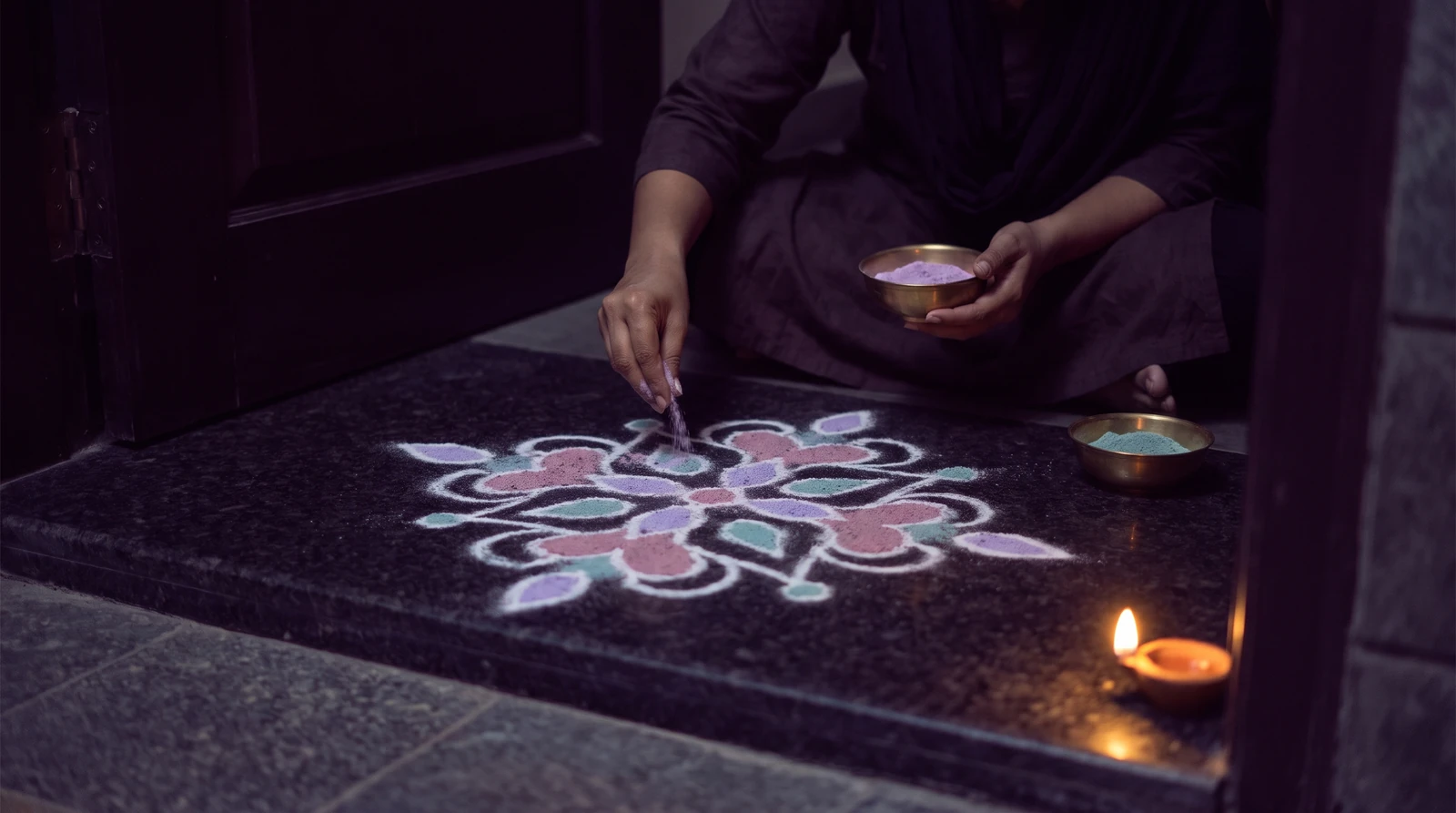
What Is Rangoli? The Ephemeral Art of the Threshold
Rangoli is the Indian practice of drawing bright, temporary patterns at the doorstep. Here is its history, its regional cousins, and why impermanent art calms.
 Ancient Wisdom
Ataraxia: The Ancient Greek Art of an Untroubled Mind
Ataraxia is the ancient Greek word for an untroubled mind, prized by Epicureans, Stoics and Sceptics alike. Here is what it means and how they reached it.