Why Cozy Games Calm You Down: The Science of Digital Comfort
Low stakes, soft loops, nothing to lose: why cozy games relax the nervous system, what the studies actually found, and how to play without losing your night.
By Kurt Woleret
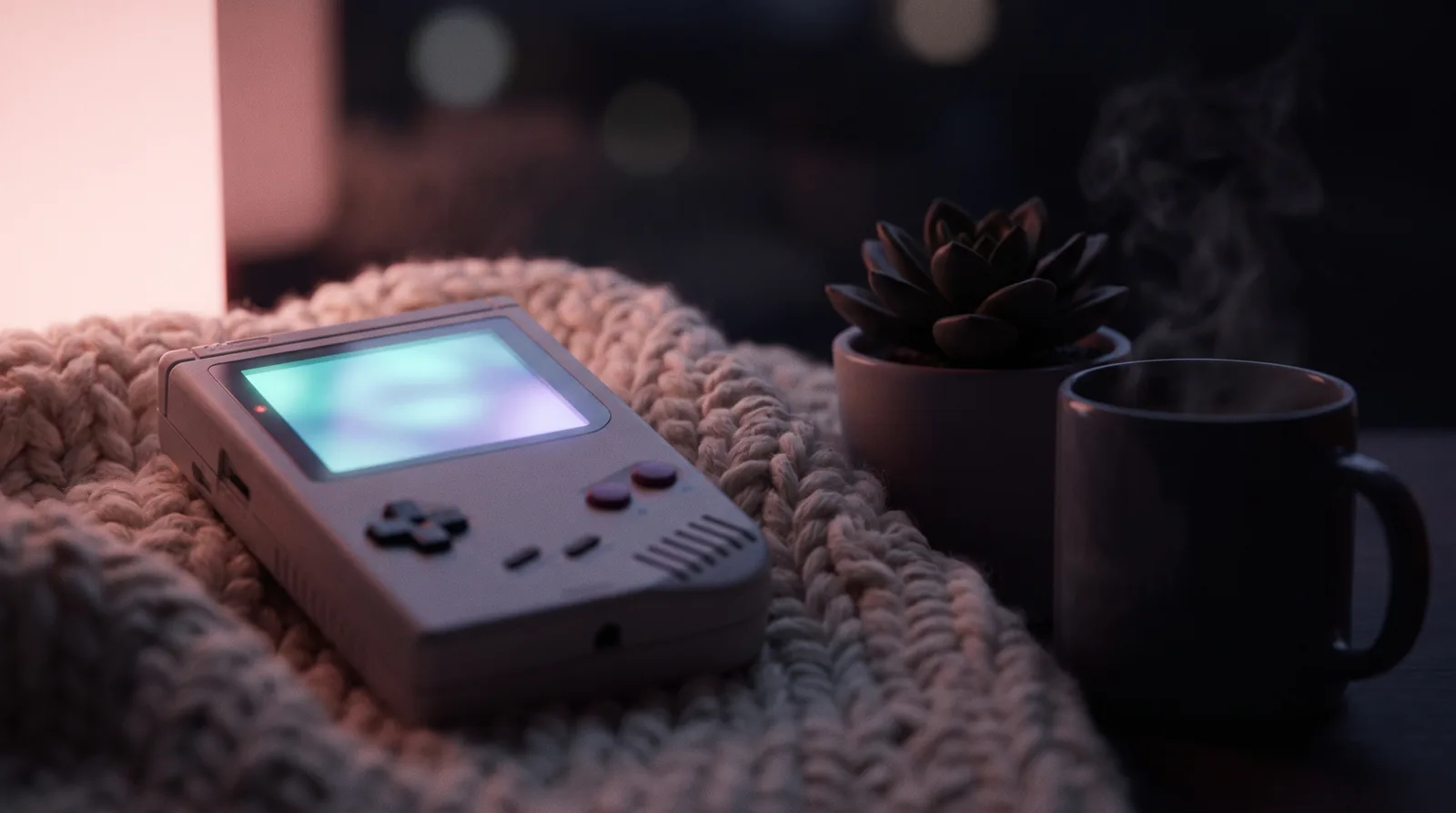
At some point in the last few years, a strange thing happened to video games: a huge audience quietly stopped wanting to win. The best sellers in this corner have no death screens, no leaderboards, and often no way to fail at all. You water crops. You arrange furniture. You fish, badly, and the fish forgive you. Cozy games went from niche to industry pillar, and the usual explanation is a shrug: comfort food, but pixels. I think the shrug undersells it. There's an actual nervous-system story here, and even some data. Let me make the case that watering fake turnips is doing something real.
What makes a game 'cozy' in the first place
Strip the aesthetics and cozy games share a mechanical signature. Stakes are low or absent: nothing you love can be taken from you. Progress is gentle and mostly guaranteed: the crops grow whether or not you're skilled. Loops are short, repetitive, and legible: plant, water, harvest, repeat. Time pressure is minimal or cosmetic. And the sensory layer is engineered for softness: round shapes, muted palettes, little chimes, rain on leaves. In other words: a cozy game is an activity with clear goals, immediate feedback, and a challenge level pinned safely below your skill. It's absorption with the danger removed. The genre discovered, by market forces, roughly what contemplative traditions discovered by practice: gentle repetitive activity with visible results is a reliable way to settle a mind.
The evidence that play calms
Now the data, with honest labels on the jars. The most direct evidence comes from Carmen Russoniello's lab at East Carolina University, which in 2009 ran randomized controlled studies on casual games, the cozy genre's simpler ancestor: think Bejeweled, not battle royale. In one study published in the Journal of CyberTherapy and Rehabilitation, participants who played casual games showed improved mood and reduced stress compared to controls, with the companion study recording changes in EEG and heart rate variability consistent with relaxation. Small studies, industry-adjacent funding, worth knowing both. But it's measured physiology, not vibes: brains and hearts of people playing gentle games drifted toward calm.
The second jar is bigger and newer. In 2021, Johannes, Vuorre and Przybylski published a study in Royal Society Open Science with an unusual asset: actual play-time data from Nintendo and EA servers, for Animal Crossing: New Horizons and Plants vs. Zombies, linked to surveys of over three thousand players. The mildly scandalous finding: time spent playing was positively associated with well-being. Not the doom the screen-time discourse predicted; the players logging real hours in the world's coziest game reported feeling slightly better, not worse. It's correlational, one moment in time, two games. The authors said so plainly. But as a data point against 'games are stress with graphics,' it's a good one.
A cozy game is absorption with the danger removed. The genre found by market forces what contemplative traditions found by practice.
Why your nervous system buys it
Put the mechanics and the data together and the story writes itself. An anxious evening brain is a threat-detection system with nothing to detect, so it invents things: replaying the meeting, drafting tomorrow's disasters. A cozy game hands that system a small, complete, benign world where every loop closes. You act, the world responds, nothing bites. That's occupation without activation: enough gentle task to keep the threat-scanner busy, zero actual threat to keep it fed. It's the same trick as knitting, jigsaw puzzles, and raking tiny zen gardens, wearing a nicer sweater.
The failure mode is equally predictable, and I say this as someone whose tiny apartment has hosted several 1 a.m. turnip emergencies: the same soft loops that soothe are excellent at chewing through a bedtime. Cozy is not the same as sleepy. A game, however gentle, still asks you to decide things, and deciding is arousal. So use the genre for the evening downshift, the post-work decompression, the anxious Sunday; and give it a hard off-ramp before bed. My own sequence on rough nights goes: game off around eleven, screen swapped for something that demands literally nothing. Usually that's Feelsy running its autoplay: slime textures drifting on their own, no loops to close, no turnips to check, the interactivity dialed from 'low' to 'none.' Cozy games are the methadone for a racing mind; a zero-decision texture is the actual off switch.
Permission to water the turnips
There's a lingering embarrassment around this genre, the sense that a grown adult unwinding in a cartoon village owes someone an apology. The data says otherwise, and so does the logic: humans have always used small, orderly, repetitive worlds to calm down, from gardens to needlepoint to model trains. The cartoon village is just the newest one, and it's cheaper than a train set. So if twenty minutes of digital gardening downshifts your evening, that's not a guilty pleasure. That's a relaxation practice with a soundtrack. Keep the sessions bounded, keep bedtime sacred, and water the turnips in peace.
Feelsy is a wellness product, not medical advice. If stress, anxiety or sleep problems persist, please speak with a qualified professional.
References
- Russoniello, C. V., O'Brien, K., & Parks, J. M. (2009). The effectiveness of casual video games in improving mood and decreasing stress. Journal of CyberTherapy and Rehabilitation, 2(1), 53-66.
- Russoniello, C. V., O'Brien, K., & Parks, J. M. (2009). EEG, HRV and Psychological Correlates while Playing Bejeweled II: A Randomized Controlled Study. Annual Review of CyberTherapy and Telemedicine, 7, 189-192.
- Johannes, N., Vuorre, M., & Przybylski, A. K. (2021). Video game play is positively correlated with well-being. Royal Society Open Science, 8(2), 202049.
Frequently Asked Questions
Why are cozy games so relaxing?
They combine gentle, repetitive loops with low or zero stakes: you act, the world responds, and nothing can be lost. That gives an anxious mind a small benign world to occupy without activating any real threat response, the same mechanism behind knitting or tending a garden. The soft visuals and sounds are engineered to support the effect.
Is there scientific evidence that video games reduce stress?
Some, with honest caveats. Randomized studies from 2009 found casual game players showed improved mood, reduced stress, and physiological changes consistent with relaxation, including in EEG and heart rate variability. A 2021 study using real Nintendo server data found Animal Crossing playtime was positively associated with well-being, though that finding is correlational.
Are cozy games good before bed?
For the evening wind-down, yes; right before sleep, be careful. Even the gentlest game asks you to make decisions, and deciding keeps your arousal up, so soft loops can quietly chew through a bedtime. Set a firm cutoff, then switch to something that demands nothing at all: no goals, no choices, just something slow to watch or hear.
What counts as a cozy game?
The signature is mechanical, not just visual: low or absent stakes, progress that's gentle and mostly guaranteed, short legible loops like plant-water-harvest, minimal time pressure, and a soft sensory palette. Farming sims, village-life games, and tidy puzzle games fit the pattern. If nothing you love can be taken from you, it's probably cozy.
Is it okay for adults to relax with cozy games?
Yes, and the embarrassment is misplaced. Humans have always calmed down inside small, orderly, repetitive worlds, from gardens to jigsaw puzzles to model trains; a cartoon village is simply the newest version. Research on players of cozy games found time played was associated with slightly better well-being, not worse. Keep sessions bounded and bedtime protected.

About the author
Contributing writer
Kurt is a New York based writer covering the practical science of stress, sleep and focus. He is the resident sceptic of the Journal: if a technique cannot survive a crowded subway commute and a deadline week, he is not interested in it.
Feel it for yourself.
Feelsy turns reading about calm into practising it. Two minutes of a slow texture is often the whole difference.


Related reading
 ASMR
ASMRWhy Slime Videos Are So Satisfying
There is a real reason your shoulders drop when you watch slime being folded and poked. A look at ASMR, soft fascination and the design of satisfying motion.
 ASMR
ASMRThe Quiet Pleasure of Oddly Satisfying Videos
Why are oddly satisfying videos so satisfying? The psychology of perfect fits, clean sweeps and slow swirls, and how to turn watching into meditation.
 Visual Meditation
Why Cleaning Videos Are So Satisfying, According to Science
Power washing, carpet scraping, soap cutting: why does watching other people clean feel this good? The psychology of cleaning videos as a visual reset.
 Visual MeditationNew
Highway Hypnosis: Why You Can't Remember the Last Ten Miles
You arrive at your exit with no memory of driving there. Highway hypnosis is real and common: here's the science of the road trance and how to use it safely.
 Visual Meditation
Why the Northern Lights Mesmerise Us: Aurora Watching as Visual Meditation
What causes the northern lights, why the aurora feels so calming to watch, and how to turn sky watching into a simple visual meditation practice.
 Visual Meditation
Blue Mind: Why Being Near Water Calms the Brain
What blue mind theory says about why oceans, lakes and rivers soothe us: the research on blue space, water's pull on the eye, and how to use it daily.