Why Houseplants Calm You Down: The Quiet Ritual of Tending Green
Do houseplants reduce stress? What research says about indoor plants and the nervous system, and why the ritual of tending them matters more than the decor.
By Mei Lin
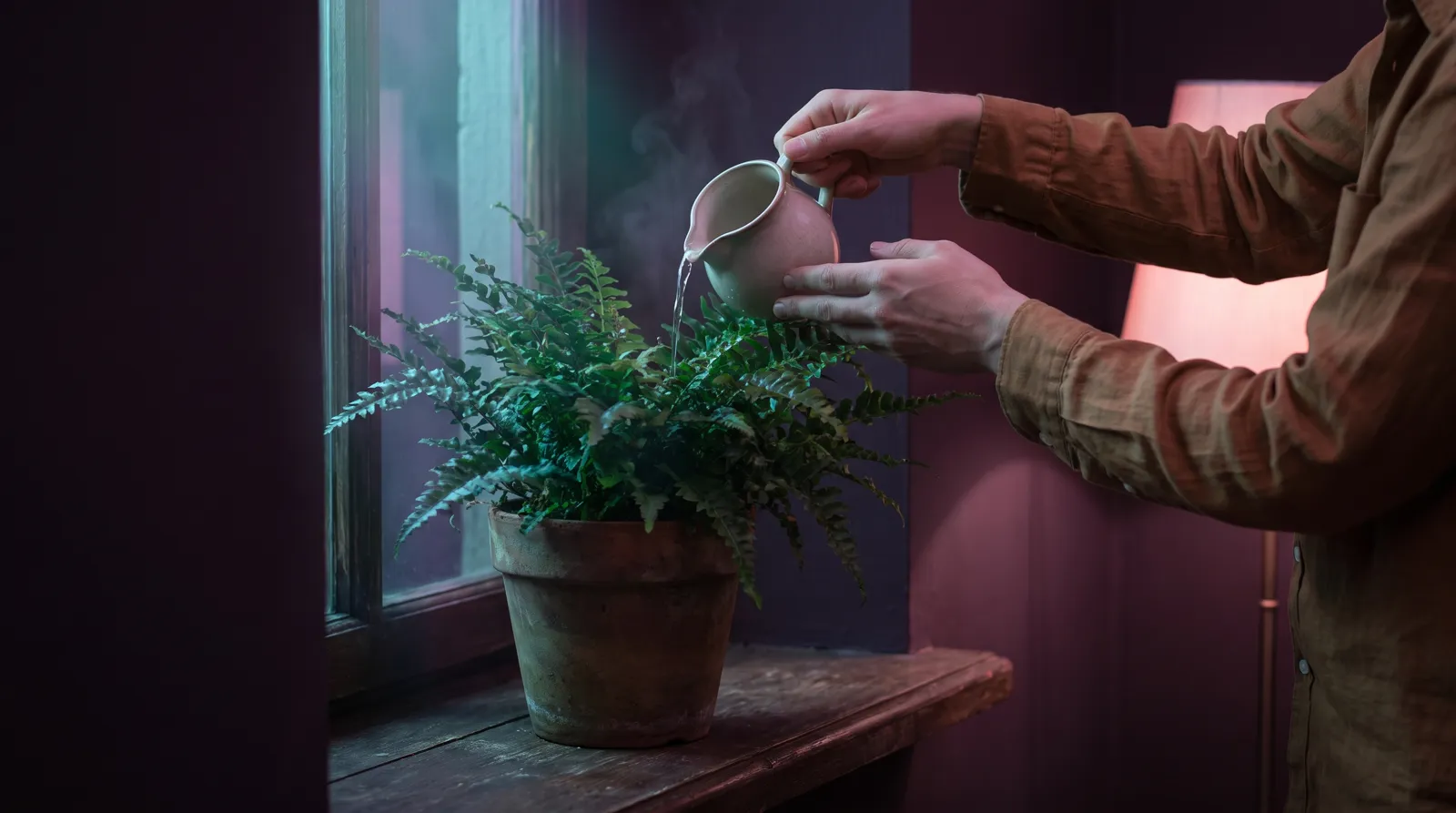
My grandmother's apartment in Shanghai had one window that mattered. It faced south, over a courtyard of bicycles, and along its sill stood her small green republic: a jasmine she talked to, a pot of chives for dumplings, an orchid that bloomed once a year as if paying rent. Every morning before tea she walked the row with a small watering can, touching a leaf here, turning a pot there so no plant grew crooked toward the light. It took four minutes. I understood only much later that those four minutes were not chores before her day. They were the hinge on which the whole day quietly turned.
What the research actually shows
The feeling my grandmother knew by instinct has since been walked into a laboratory. In a randomized crossover study published in the Journal of Physiological Anthropology, researchers had young adults perform two tasks: transplanting a small indoor plant, and working on a computer. After the plant task, participants reported feeling more comfortable and soothed, and their bodies agreed: diastolic blood pressure was lower and sympathetic nervous system activity, the body's accelerator pedal, was measurably suppressed compared with the computer task (Lee et al., 2015). The authors' conclusion was modest and lovely: active interaction with indoor plants can reduce physiological and psychological stress. Not looking at plants on a screen saver. Interaction. Hands in soil.
This detail matters, because the popular version of this idea stops at decor. Buy the monstera, place it in the corner, absorb the calm. Greenery in a room does seem to soften it, and no one should be talked out of a beautiful corner. But the study's stress-lowering effect came from tending, from the transplanting itself. The calm is not only in the plant. It is in the reaching toward it.
Why tending works when relaxing does not
Care is a posture the body knows how to fall into. When you water a plant, wipe dust from a leaf, or press a finger into the soil to feel for dryness, you are doing something slow, gentle, and entirely absorbing at a low temperature. The hands are occupied but not hurried. The attention is outward but not vigilant. This is the same territory as kneading dough or pouring tea: tasks with a beginning, a middle, and an end, done at the speed of the body rather than the speed of the feed. A plant will not be rushed. Water poured too fast runs straight through the pot and out the bottom, a small lesson delivered without judgment, every time.
A plant will not be rushed. Water poured too fast runs straight through the pot, a small lesson delivered without judgment.
There is also the matter of timescale. A plant lives on a calendar of weeks and seasons, and tending one enrolls you, a few minutes a day, in that slower clock. The new leaf that took twelve days to unfurl is an argument, made quietly and in green, that not everything important moves at the pace of a notification. My grandmother's orchid bloomed once a year. She never once complained that it was buffering. And because the plant's clock is indifferent to yours, tending it is one of the few daily acts that cannot be optimized, batched, or done faster tomorrow. The four minutes are simply the four minutes. In a schedule where everything else is negotiable, that fixed, gentle demand becomes a kind of shelter.
A four-minute practice
If you want the calm and not just the corner, borrow her ritual. Keep it to a few minutes, at the same seam of the day, morning tea or the return home. Walk your plants in order, even if there are only two. Touch the soil of each before deciding anything; let the finger, not the schedule, say who needs water. Pour slowly, and watch the water darken the soil, which is its own small satisfaction, the dry made damp. Turn each pot a quarter turn so the growth stays even. Prune what is yellow without ceremony; plants are not sentimental, and there is relief in their honesty. Then stop. The ritual ends, the day begins, and something in the nervous system has already been told, in the oldest language, that there is enough time.
For the plantless, or for the hours when you are far from your windowsill, the texture of the experience travels surprisingly well. Part of why I like Feelsy's slower green and botanical textures is that they move at plant speed, drift and settle, nothing demanding to be answered; a few minutes of them on autoplay over lunch does something adjacent to the watering can. And pairing any tending ritual, real or on screen, with a few slow breaths, or the guided 4-7-8 exercise if counting helps you, deepens the same downshift the transplanting study measured.
The republic on the sill
I keep my own row of pots now, in a city far from that courtyard: a pothos that forgives me everything, a jasmine that forgives me nothing, chives, out of loyalty. Some mornings I am too rushed to do it properly, and I notice the difference in my shoulders by noon. The plants survive my neglect; I am the one who wilts slightly. That, in the end, is the honest direction of the arrangement. We say we are looking after the plants. Mostly, four minutes at a time, they are looking after us.
Feelsy is a wellness product, not medical advice. If stress, anxiety or sleep problems persist, please speak with a qualified professional.
References
- Lee, M. S., Lee, J., Park, B. J., & Miyazaki, Y. (2015). Interaction with indoor plants may reduce psychological and physiological stress by suppressing autonomic nervous system activity in young adults: a randomized crossover study. Journal of Physiological Anthropology, 34, 21.
Frequently Asked Questions
Do houseplants actually reduce stress?
There is real evidence that interacting with them does. In a randomized crossover study, young adults who transplanted a small indoor plant felt more comfortable and soothed than after a computer task, with lower diastolic blood pressure and suppressed sympathetic nervous system activity (Lee et al., 2015, Journal of Physiological Anthropology). The key was active tending, not just having a plant in the room.
Is it the plant or the act of caring for it that calms you?
The research points to the caring. The stress-lowering effect in the 2015 study came from the transplanting task itself: hands in soil, slow gentle movements, attention that is outward but not vigilant. Greenery does soften a room, but the measurable downshift came from interaction, the same territory as kneading dough or pouring tea.
How do I build a calming plant care routine?
Keep it to a few minutes at the same seam of the day, such as with morning tea. Walk your plants in order, touch the soil of each before deciding who needs water, pour slowly, turn each pot a quarter turn so growth stays even, and prune what is yellow without ceremony. The point is a small, complete ritual done at the speed of the body.
Which houseplants are best for beginners?
Choose plants that forgive an imperfect schedule. A pothos tolerates missed waterings and low light, and herbs like chives add usefulness to the ritual. The calm comes from the tending rather than from any particular species, so the best plant is one whose care you will actually keep doing a few minutes a day.

About the author
Contributing writer
Mei grew up in Shanghai around tea that could not be hurried and grandmothers who considered stillness a skill. She writes about slow hands and sensory ritual: tea, calligraphy, qigong, and the quiet crafts that taught the world how to pay attention.
Feel it for yourself.
Feelsy turns reading about calm into practising it. Two minutes of a slow texture is often the whole difference.


Related reading
 Breath & Body
Why Gardening Is Good for Your Mind
Why gardening reduces stress and lifts mood: what a research meta-analysis found, and how soil, water, and tending living things quiet anxious thoughts.
 Ancient Wisdom
Bonsai and Penjing: The Slow Art of Growing Patience
Bonsai began as Chinese penjing: a landscape grown in a tray over decades. Why tending a miniature tree calms the mind, and how to begin without owning one.
 Ancient Wisdom
Shinrin-Yoku: Why Forests Calm the Human Mind
Japan turned a walk in the woods into preventive medicine. The research behind forest bathing, what it does to stress physiology, and how to practise it without a forest.
 Breath & Body
How to Lower Cortisol: What Actually Works
Cortisol isn't the enemy, chronic elevation is. Here's what research says actually lowers stress hormones, and which viral cortisol fixes you can skip.
 Breath & Body
Popcorn Brain: Why Your Attention Keeps Popping to the Next Thing
Popcorn brain is what constant scrolling trains your attention to do: pop, jump, repeat. Here's the research on shrinking focus and how to retrain yours.
 Breath & Body
Embroidery as Meditation: The Quiet Work of Needle and Thread
Embroidery slows the hands and settles the mind one stitch at a time. Why needlework is so calming, what research on craft found, and how to begin.