Why Anxiety Feels Worse at Night (and What Actually Helps)
Why is anxiety worse at night? How hormones, darkness and an undistracted mind amplify worry after dark, and the gentle evening practices that help.
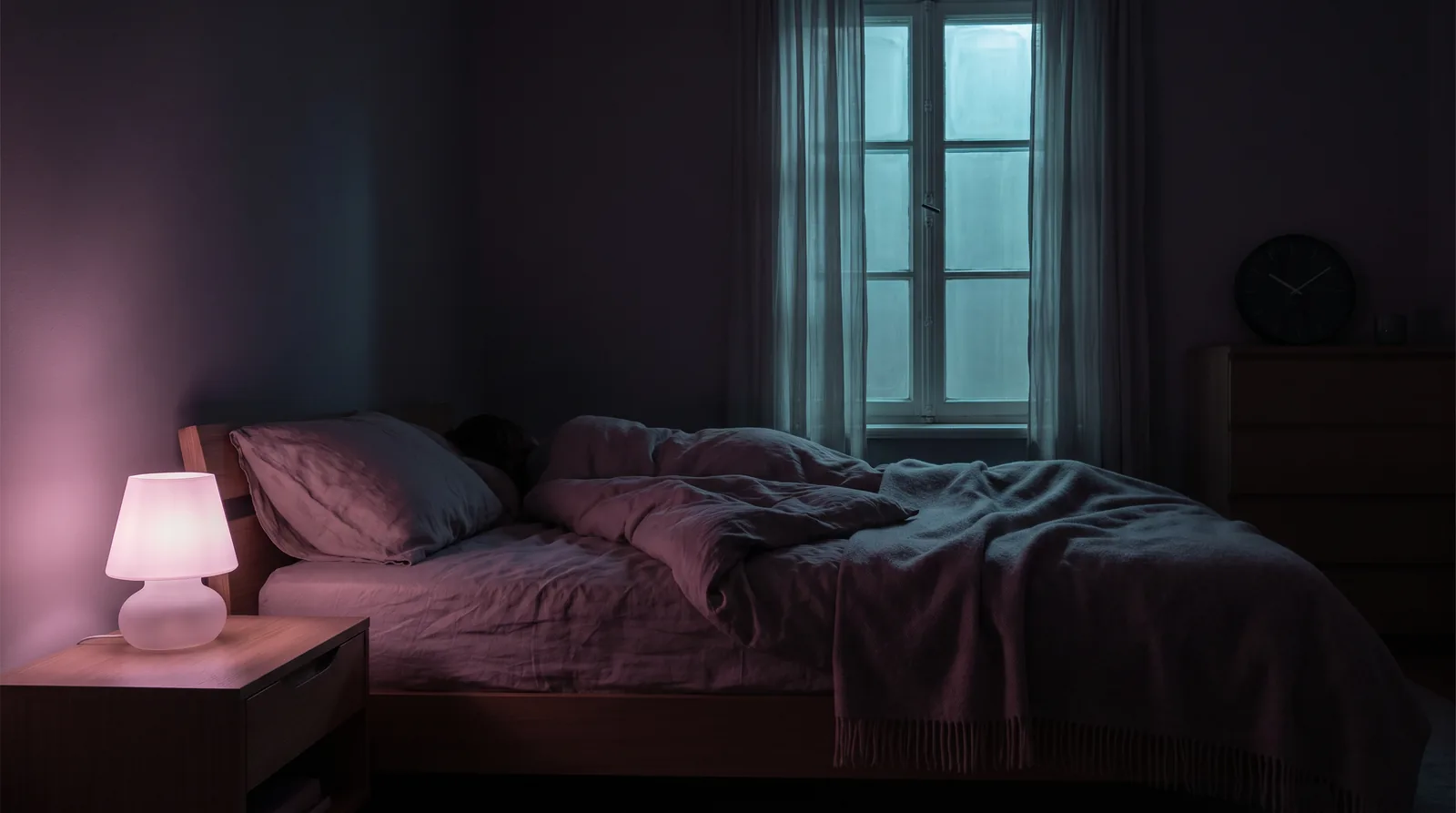
It is one of the small cruelties of human design that worry keeps office hours no clock would sanction. A concern that seemed manageable at four in the afternoon, a passing cloud, returns at midnight as weather. The email you meant to send, the twinge in your side, the finances, the friendship: at night each one arrives with an entourage. If you have ever lain in the dark wondering why your own mind treats you so much more harshly after ten o'clock, the first thing to know is that the experience is nearly universal, and the second is that it has explanations. Good ones, with mechanisms. And where there are mechanisms, there are handles.
The chemistry of the small hours
Part of the answer is hormonal housekeeping. Cortisol, the body's principal mobilising hormone, follows a daily arc: high in the morning to get you out the door, declining through the afternoon, reaching its low in the hours around midnight. This is as it should be. But it means the night mind is running on a different chemistry from the day mind: less mobilised, less crisply executive, more porous. The prefrontal machinery that spends all day putting worries in proportion is, by late evening, frankly tired. Problems are not larger at night. The department that resizes them has gone home.
The relationship between this daily rhythm and anxiety appears to run deep. One long-running study followed young adults for six years and found that the shape of their morning cortisol response predicted who would go on to develop anxiety disorders (Adam et al., 2014, Psychoneuroendocrinology). The details are for the endocrinologists, but the lay lesson is worth keeping: the anxious mind and the body's stress rhythms are in constant conversation, around the clock. Night is simply the hour when we finally sit still enough to overhear them.
An empty room amplifies
The rest of the answer is simpler and older than hormones: at night, the competition falls silent. All day long your attention is spoken for by meetings, errands, screens and other people. Worry has to shout over the traffic. Then the lights go out, the house quietens, sensory input drops to nearly nothing, and a vigilance system that evolved to scan the dark for trouble finds itself with an empty channel and no programming. So it makes some. In the absence of real information, the threat system rehearses hypotheticals, and in the dark there is nothing to check them against. Every clinician who works with sleep knows this shape: not more danger at night, just less evidence.
Problems are not larger at night. The department that resizes them has gone home.
What actually helps
The good news is that nighttime anxiety responds well to being treated as a predictable visitor rather than an ambush. The strategy has two halves: give the worries a better appointment, and give the night mind gentler company. Some practices that repay the effort:
- Hold a worry appointment earlier in the evening. Ten minutes, pen and paper, two columns: what is worrying you, and the single next step for each. You are not solving anything; you are filing it where the night mind can see it has been logged.
- Slow the breath before you need it slow. A round or two of 4-7-8 breathing, which Feelsy will pace for you on screen so there is no counting to do, tilts the nervous system towards rest before the lights go out rather than after the worrying starts.
- Dim the world an hour early. Low, warm light tells the circadian system the day is genuinely ending, and the mind reads the room.
- Give the eyes and ears something soft. A slow visual texture or a quiet soundscape occupies the vacant sensory channel that worry would otherwise colonise. A few minutes of watching cream fold or foam settle in Feelsy, screen dimmed, is the modern equivalent of watching a fire burn down.
- Keep the bed for sleeping. If you have been awake and anxious for what feels like twenty minutes, get up, sit somewhere dim and unexciting, and return only when sleep is close. The bed should not become the place where worrying happens.
If you wake at three
The 3am waking deserves its own paragraph, because it is where night anxiety does its finest work. You surface between sleep cycles, which is normal and universal, but this time a thought is waiting, and within a minute the heart is tapping and the ceiling has become a screen for a documentary about your failures. The single most useful move is to stop trying to fall asleep, which is a striving state, and aim instead for mere rest, which is not. Rest is achievable on demand; sleep arrives only when it is not being watched. Lie warm, let the body be heavy, give attention one soft anchor, the breath, an imagined place, a remembered walk, and let sleep decide its own schedule. It usually decides sooner when it is not being petitioned.
The longer view
None of this makes anxiety disappear, and that is not the aim. The aim is to change your relationship with the night shift: to know, even at midnight, that the mind's midnight arithmetic is unreliable, that the catastrophe on the ceiling is a rerun and not a bulletin, and that the morning self will read the same facts differently, and more accurately. People who practise an evening wind-down for a few weeks tend to report not that the worries vanished but that the volume came down: the visitor still calls, but it no longer lets itself in. That is a workable peace, and on most nights it is enough.
Feelsy is a wellness product, not medical advice. If stress, anxiety or sleep problems persist, please speak with a qualified professional.
References
- Adam, E. K., Vrshek-Schallhorn, S., Kendall, A. D., Mineka, S., Zinbarg, R. E., & Craske, M. G. (2014). Prospective associations between the cortisol awakening response and first onsets of anxiety disorders over a six-year follow-up. Psychoneuroendocrinology, 44, 47-59.
Frequently Asked Questions
Why does anxiety feel worse at night?
Cortisol, the body's main mobilising hormone, follows a daily arc that's high in the morning and reaches its low around midnight, meaning the prefrontal machinery that normally puts worries in proportion is more tired and less crisp at night. At the same time, the daytime competition for attention, meetings, errands, screens, falls silent, leaving a vigilance system evolved to scan the dark with an empty channel that it fills with rehearsed worries.
Is nighttime anxiety a sign of a bigger problem?
Not necessarily. A long-running study found that the shape of someone's morning cortisol response predicted who would go on to develop anxiety disorders, showing the anxious mind and the body's stress rhythms are in constant conversation. But night is simply the hour when there's less noise to drown out that conversation, not evidence that danger is actually greater.
What can you do to reduce anxiety before bed?
The article suggests holding a 'worry appointment' earlier in the evening to write down concerns and next steps, slowing your breath with something like 4-7-8 breathing before you need it, dimming the world an hour early, and giving your eyes and ears something soft like a quiet soundscape or slow visual texture. Keeping the bed reserved only for sleep, rather than for lying awake worrying, also matters.
What should you do if you wake up anxious at 3am?
The most useful move is to stop trying to fall asleep, which is a striving state, and aim instead for mere rest, which is achievable on demand. Lie warm, let the body feel heavy, and give attention one soft anchor like the breath or an imagined place, letting sleep arrive on its own schedule rather than being petitioned for.

About the author
Contributing writer
Eleonor writes about contemplative traditions, attention and the cultural history of calm. She has spent two decades collecting the rituals humans use to slow down, from zazen halls to hammams, and translating them for modern, screen-lit lives.
Feel it for yourself.
Feelsy turns reading about calm into practising it. Two minutes of a slow texture is often the whole difference.


Related reading
 Sleep
SleepHow to Stop Racing Thoughts at Night
Racing thoughts at night are a habit the brain can unlearn. Here is why minds speed up at bedtime and the techniques that quiet them, step by step.
 Breath & Body
The 4-7-8 Breathing Technique, Step by Step
A focused walkthrough of the 4-7-8 breath: what it is, how to do it, why the long exhale calms you, and when to use it during the day and before sleep.
 Sleep
SleepDoes Screen Time Before Bed Really Wreck Your Sleep?
Phones before bed: sleep villain or overblown? What the research on screens, blue light and melatonin actually shows, and what to do that isn't 'never look at a screen.'
 SleepNew
Night Owl vs Early Bird: The Science of Chronotypes
Night owl or early bird isn't a personality flaw or a virtue. It's a chronotype. Here's what the science says about your body clock and how to work with it.
 SleepNew
How to Wake Up Early (Without Hating Your Life)
Want to become a morning person? Here's how to wake up early using light, timing and consistency, based on what circadian science actually shows.
 Sleep
SleepCan't Sleep? Why Getting Out of Bed Is the Counterintuitive Fix
Lying awake trying harder is the one thing that makes insomnia worse. Here's the 20-minute rule, the science of stimulus control, and how to use it.