Why Lava Lamps Are So Mesmerizing: The Science of Watching Wax
Why staring at a lava lamp feels so calming: slow unpredictable motion, soft fascination, and what a 1963 novelty knew about soothing a busy brain.
By Kurt Woleret
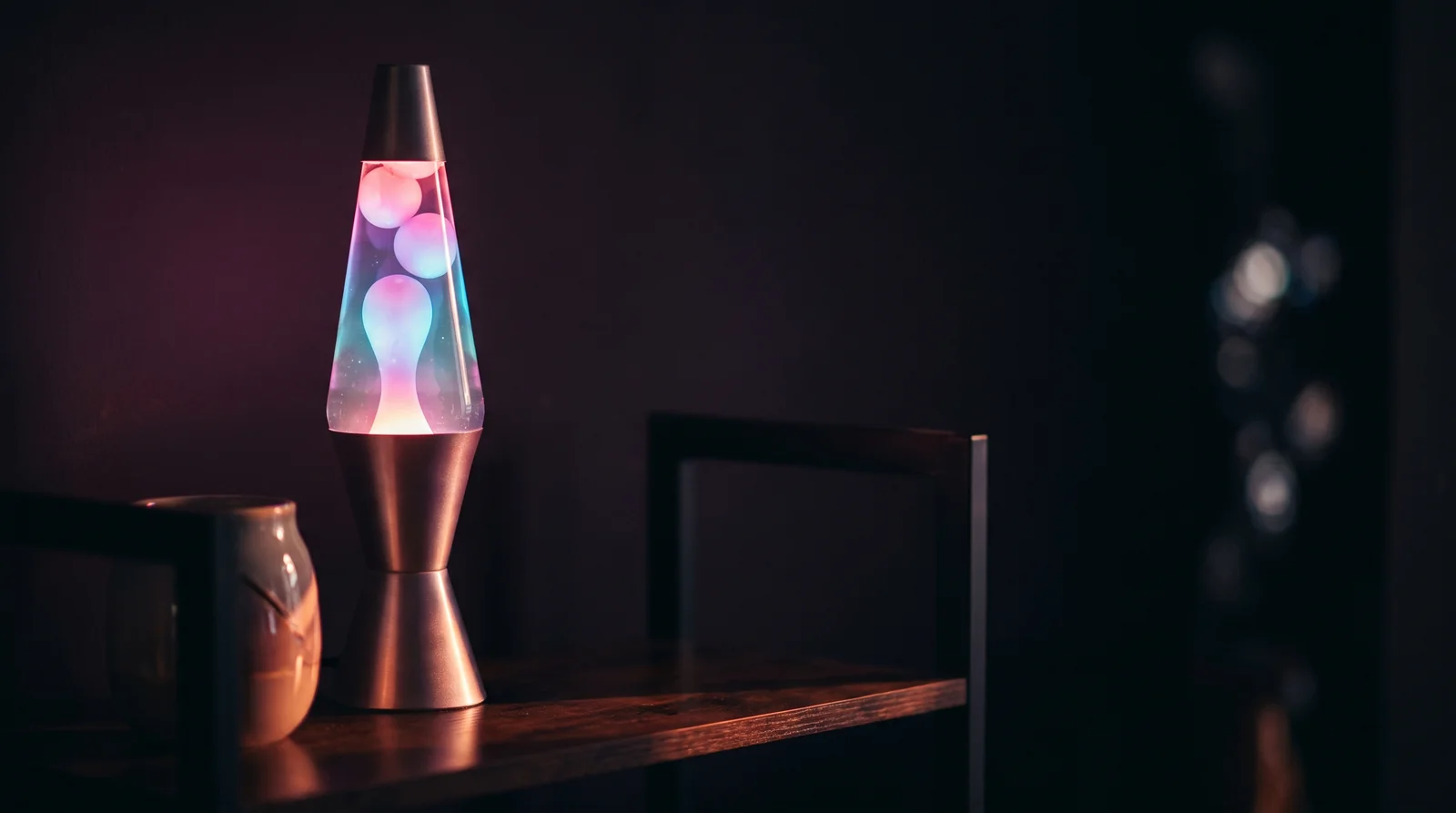
In 1963, a British accountant named Edward Craven Walker watched a homemade egg timer made of oil and water bubbling on a pub stove, as the story goes, and decided the world needed a lamp that did that. The world agreed, tens of millions of times over. My first New York apartment had one, inherited from the previous tenant along with a wobbly bookshelf, and I remember being annoyed by how often I caught myself staring at it. I was a person with deadlines. The lamp did not care. Sixty years on, the lava lamp is still the most honest piece of relaxation technology ever sold, and it's worth understanding why a bottle of warm wax beats most things on your phone at calming you down.
The physics of slow
The mechanism is beautifully dumb. A blob of wax sits in liquid, and a bulb below heats the base. Warm wax expands, becomes slightly less dense than the liquid around it, and rises. At the top, away from the heat, it cools, contracts, becomes denser, and sinks. Repeat forever. It's a convection loop with stage lighting. The part that matters for your nervous system is what this loop produces: motion that is slow, continuous, and never exactly the same twice. The blobs merge, split, stretch, and hesitate in ways that depend on tiny differences in temperature, so the lamp never repeats itself. But it also never does anything sudden. Nothing pops. Nothing startles. The next moment is always a gentle variation on this one.
Soft fascination, actual science
There's a name for what that kind of motion does to attention. In 1995, psychologist Stephen Kaplan published the framework known as attention restoration theory in the Journal of Environmental Psychology. The short version: the focused, effortful attention you use for spreadsheets and subway transfers is a depletable resource, and it recovers in environments that hold your attention effortlessly. Kaplan called that quality soft fascination: things like leaves moving, water, clouds. They're interesting enough to occupy the mind, undemanding enough that nothing is required of you, and they leave room for thoughts to settle in the background. Kaplan was writing about nature, but the description fits a lava lamp with almost suspicious precision. Slow, endless, low-stakes variation is the active ingredient; the tulip-shaped glass is packaging.
- Slow: nothing in the lamp moves faster than your attention can follow without effort.
- Continuous: there are no cuts, no scene changes, no resets to process.
- Non-repeating: mild novelty keeps the mind engaged without ever demanding a reaction.
- Low-stakes: nothing in a lava lamp can go wrong, and your brain quietly knows it.
Random at the right speed
That non-repeating quality isn't decorative; it's the point. The blobs are genuinely unpredictable: the flow inside a lava lamp is chaotic enough that one company famously keeps a wall of them on camera and uses the footage to help seed encryption keys. Your brain, a prediction machine by trade, gets something rare from that combination: it can keep making tiny, pleasant, always-slightly-wrong predictions with zero cost for being wrong. That's the same contract offered by waves, fire, falling snow, and fish tanks. Compare that to a TV show, which is also motion on a glowing rectangle but arrives with plot, cuts, dialogue, and stakes. The lava lamp asks for nothing back. It never repeats itself and it never surprises you, and that's the entire trick.
The lava lamp never repeats itself and never surprises you. That's the entire trick.
Using it on purpose
If you own one, use it deliberately instead of decoratively. Evening is its natural habitat: a dim, warm point of light in an otherwise dark room is much friendlier to a winding-down brain than a ceiling fixture at full blast. Put it where your eyes land when you're doing nothing, give it the requisite warm-up time (the wax takes a while to get moving, which is its own little lesson in patience), and let it be the last thing you watch instead of a feed. And if you don't own one, you already carry its descendant. A phone screen showing drifting, non-repeating, low-stakes motion is the same contract in a new bottle: Feelsy's fluid textures on autoplay are, functionally, a lava lamp that fits in your pocket, never needs an hour to warm up, and comes with sound. The 1963 technology and the current one are selling the identical active ingredient: slow variation with nothing at stake.
In defense of the gimmick
The lava lamp gets filed under kitsch, next to bead curtains and blacklight posters, and I get it. But sixty years of continuous production is not what a fad looks like; it's what a tool looks like. Craven Walker stumbled onto a formula that psychology took decades to articulate: give the eyes something slow, warm, endless, and consequence-free, and the rest of the person follows it down. That's soft fascination in a glass bottle, ninety-nine percent packaging, one percent physics, and the physics was right all along.
Feelsy is a wellness product, not medical advice. If stress, anxiety or sleep problems persist, please speak with a qualified professional.
References
- Kaplan, S. (1995). The restorative benefits of nature: Toward an integrative framework. Journal of Environmental Psychology, 15(3), 169-182.
Frequently Asked Questions
Why are lava lamps so relaxing to watch?
Their motion has four calming properties at once: it's slow, continuous, non-repeating, and completely low-stakes. That combination produces what psychologists call soft fascination, attention that is held effortlessly, which lets the focused, effortful kind of attention you use all day recover.
Is a lava lamp good to watch before bed?
It suits the wind-down hour well: a dim, warm point of light in a dark room is friendlier to a settling brain than bright overhead lighting, and the slow motion gives your eyes something undemanding to rest on. Treat it as the last thing you watch rather than a backdrop to scrolling.
Is a lava lamp's motion really random?
Effectively, yes. The convection flow inside is chaotic, so the wax never repeats an exact pattern; the blobs merge and split based on tiny temperature differences. The motion is unpredictable in detail but never sudden, which is precisely the mix that holds attention without demanding anything.
How is watching a lava lamp different from watching TV?
Both are motion on a glowing surface, but television arrives with cuts, dialogue, plot, and stakes, all of which recruit effortful attention. A lava lamp offers variation with no information to process and no consequences for looking away, so the mind can rest while the eyes stay gently occupied.

About the author
Contributing writer
Kurt is a New York based writer covering the practical science of stress, sleep and focus. He is the resident sceptic of the Journal: if a technique cannot survive a crowded subway commute and a deadline week, he is not interested in it.
Feel it for yourself.
Feelsy turns reading about calm into practising it. Two minutes of a slow texture is often the whole difference.


Related reading
 Visual Meditation
Why Watching Fire Is So Calming
Why is watching fire so relaxing? The science of flames, flicker and fireside calm, and how to borrow the campfire effect from a screen on an ordinary night.
 Visual Meditation
Why Aquariums Are So Calming: The Science of Watching Fish
Why watching fish lowers stress: what aquarium research found about heart rate, blood pressure and mood, and how to use water and drift as visual meditation.
 ASMR
ASMRWhy Slime Videos Are So Satisfying
There is a real reason your shoulders drop when you watch slime being folded and poked. A look at ASMR, soft fascination and the design of satisfying motion.
 Visual MeditationNew
Highway Hypnosis: Why You Can't Remember the Last Ten Miles
You arrive at your exit with no memory of driving there. Highway hypnosis is real and common: here's the science of the road trance and how to use it safely.
 Visual Meditation
Why the Northern Lights Mesmerise Us: Aurora Watching as Visual Meditation
What causes the northern lights, why the aurora feels so calming to watch, and how to turn sky watching into a simple visual meditation practice.
 Visual Meditation
Blue Mind: Why Being Near Water Calms the Brain
What blue mind theory says about why oceans, lakes and rivers soothe us: the research on blue space, water's pull on the eye, and how to use it daily.