Why Stargazing Calms the Mind: The Science of Awe
Why looking at the night sky quiets an anxious mind: the research on awe and the small self, and how to practise stargazing without a telescope.
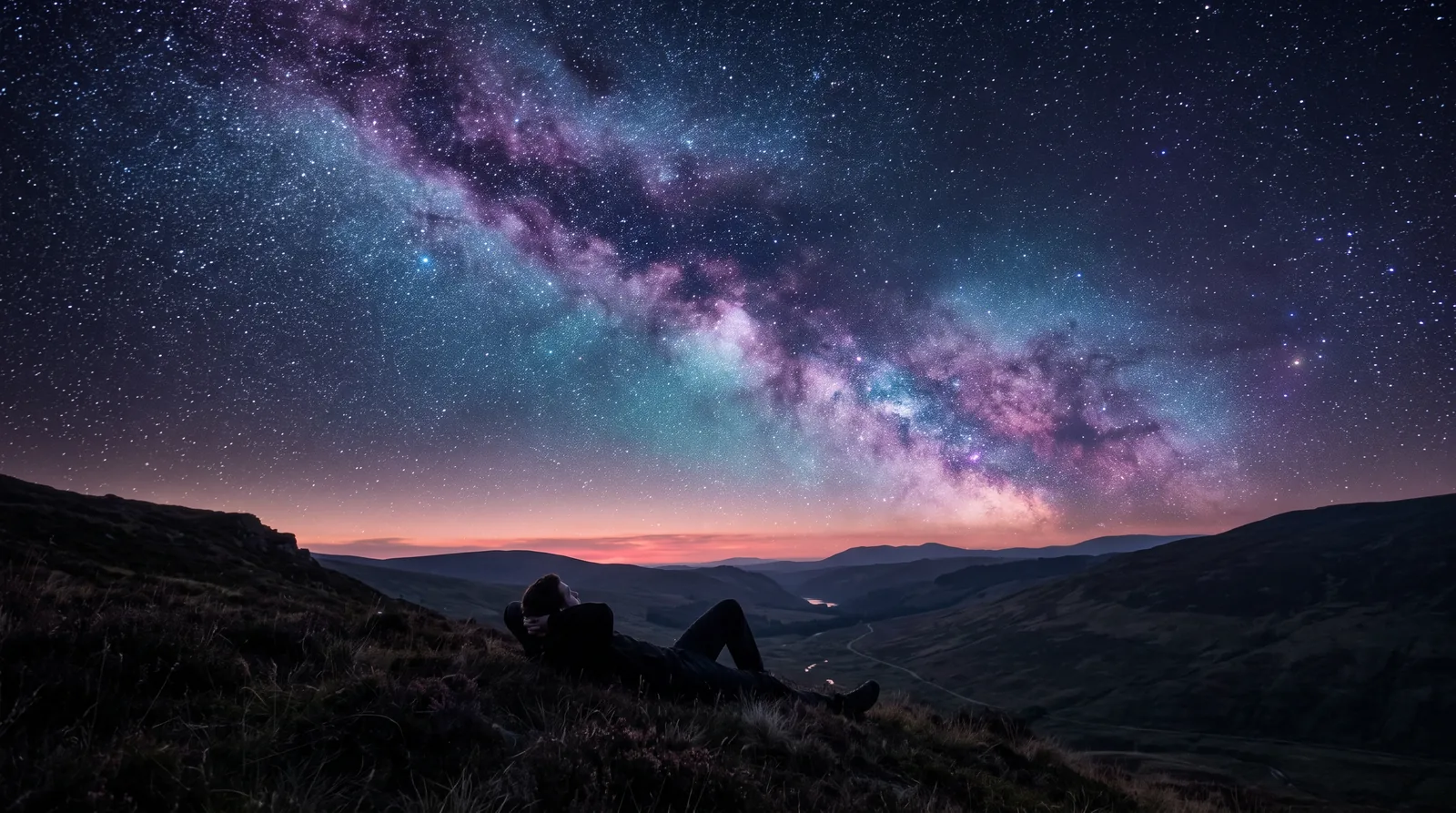
On a clear night, far enough from town, the sky does something to conversation: it lowers voices. People who were chatting in the car speak in half-sentences once they are standing under the full arch of stars, and then, quite often, they stop speaking at all. This hush is so reliable that it must be telling us something, and in the past two decades psychology has finally given it a name and a literature. The feeling is awe, and it turns out to be one of the most quietly therapeutic emotions we have, with the night sky as its cheapest and most punctual supplier.
Awe, the understudied emotion
Researchers define awe with two ingredients. First, perceived vastness: an encounter with something far larger than yourself, whether physically, like a mountain wall or a sky full of stars, or conceptually, like deep time. Second, what psychologists call a need for accommodation: the vast thing does not fit your existing mental furniture, and the mind must stretch to take it in. For most of psychology's history this emotion went unmeasured, filed somewhere between wonder and religion. That changed as laboratories, notably Dacher Keltner's group at Berkeley, began treating awe as a distinct, studiable state with its own signature effects on thought, body and behaviour. The night sky is practically a laboratory stimulus in this respect: it is the largest thing a human being can see, and it is overhead every night, free of charge.
What the research found
The study worth knowing followed military veterans and young people from underserved communities on white-water rafting trips, measuring their emotions during the days outdoors and their wellbeing afterwards. The striking result was not that nature helped, which was expected, but which ingredient did the helping: of all the positive emotions measured, awe was the one that predicted reductions in stress symptoms and improvements in wellbeing a week later, over and above joy, contentment, gratitude and the rest (Anderson, Monroy & Keltner, 2018, Emotion). Awe, in other words, is not decorative; it appears to be an active ingredient. And while rafting requires a river, a permit and daylight, the emotion itself does not. A dark sky delivers vastness on the same scale, unbooked and nightly.
The stars do not solve your problems. They resize them.
The small self
The mechanism researchers keep returning to is called the small self. Awe reliably shrinks self-focus: under something vast, the concerns of the day are perceived, for a little while, at their true scale. This matters because so much mental distress is self-focus at high volume; rumination, the engine of anxious nights, is attention circling the self in ever-tighter loops. Awe interrupts the loop from outside, not by argument but by comparison. It is difficult to hold tomorrow's meeting at catastrophic size while looking at light that left its star before the meeting's building, city or language existed. The problems remain, of course. But perspective is not the removal of problems; it is the restoration of their actual dimensions, and the night sky performs that restoration wordlessly.
How to stargaze properly
No telescope is required; the practice is older than glass. What is required is patience with your own eyes. Full dark adaptation takes twenty to thirty minutes, during which faint stars surface gradually like a photograph developing, so give the sky at least that long and keep the phone away, since a single glance at a bright screen resets the adaptation and the practice with it. Lie down if you can: a deckchair, a blanket on grass, a car bonnet in a pinch. Let the eye wander without agenda, or follow one constellation you know and let it lead you to ones you do not. Moonless nights show the most stars, though the moon itself is a worthy subject and survives any city. Darker is deeper: astronomers grade night skies from urban glow to true wilderness dark, and every step away from streetlights admits another layer of stars, but the emotion does not wait for perfect conditions. Even a dozen stars over rooftops, attended to properly, is a vastness.
Make it an appointment rather than an accident. The sky keeps a calendar, and joining it gives the practice a rhythm that willpower never manages: the moon's phases come round monthly, the constellations shift with the seasons like slow scenery, and a handful of meteor showers return each year as punctually as birthdays. A weekly half-hour, weather permitting, is enough; the same evening, the same chair, the same patch of sky slowly becoming familiar. Regular stargazers report that the sky begins to feel less like a spectacle and more like an acquaintance, and that the calm arrives sooner with each visit, the way it does in any practised meditation. The stars have kept every appointment for the whole of human history. The only unreliable party is us.
When the sky is orange
Honesty requires admitting that many of us live under skies the colour of a streetlamp, and that cloud has opinions of its own. On such nights the practice can shrink gracefully: the moon and bright planets cut through almost any light pollution, and a west-facing window at dusk still offers Venus often enough to keep an appointment. Indoors, I will admit to a substitute: Feelsy's cosmic and particle textures drift at something like the sky's own pace, and one of them on autoplay, with the room lights low and the screen dimmed, makes a serviceable planetarium for a wet Tuesday, best enjoyed earlier in the evening rather than as the last thing before sleep. But treat these as rehearsals. The real practice waits above the weather, and it asks so little: a clear night, a patch of dark, half an hour, and the willingness to be made to feel small in the one way that enlarges.
Feelsy is a wellness product, not medical advice. If stress, anxiety or sleep problems persist, please speak with a qualified professional.
References
- Anderson, C. L., Monroy, M., & Keltner, D. (2018). Awe in nature heals: Evidence from military veterans, at-risk youth, and college students. Emotion, 18(8), 1195-1202.
Frequently Asked Questions
Why does stargazing make me feel calm?
The main mechanism appears to be awe: the emotion produced by encountering something vastly larger than yourself. Research following veterans and young people on outdoor trips found that awe, more than any other positive emotion measured, predicted lower stress and better wellbeing a week later (Anderson, Monroy & Keltner, 2018). The night sky is the most available source of that vastness, overhead nightly and free.
What is the small self effect?
Awe reliably shrinks self-focus, a phenomenon researchers call the small self. Under something vast like a star field, the day's concerns are perceived at truer scale, which interrupts rumination, the tight self-circling loop behind many anxious nights. The problems are not removed; they are restored to their actual dimensions.
Do I need a telescope to stargaze?
No. The practice is older than glass and works with the naked eye. What matters is dark adaptation: give your eyes twenty to thirty minutes away from bright screens and lights, and faint stars will surface gradually. Lying back on a blanket or deckchair helps you take in the whole sky rather than one patch.
How long does it take for eyes to adjust to the dark?
Full dark adaptation takes roughly twenty to thirty minutes, and it is fragile: a single glance at a bright phone screen resets it. Plan at least half an hour under the sky, keep the phone away, and let the fainter stars develop slowly like a photograph.
Can you stargaze in a city?
Meaningfully, yes. Light pollution hides faint stars, but the moon and bright planets cut through almost any urban glow, and even a dozen stars over rooftops can carry the practice if attended to properly. Every step away from streetlights admits more stars, but the calming effect of looking up does not wait for a wilderness sky.

About the author
Contributing writer
Eleonor writes about contemplative traditions, attention and the cultural history of calm. She has spent two decades collecting the rituals humans use to slow down, from zazen halls to hammams, and translating them for modern, screen-lit lives.
Feel it for yourself.
Feelsy turns reading about calm into practising it. Two minutes of a slow texture is often the whole difference.


Related reading
 Visual Meditation
Why Watching Fire Is So Calming
Why is watching fire so relaxing? The science of flames, flicker and fireside calm, and how to borrow the campfire effect from a screen on an ordinary night.
 Visual Meditation
Why Watching Ocean Waves Calms the Mind
Why the sea calms the mind: the science of wave rhythm, blue space and shoreline sound, and how to borrow the ocean's stillness far from any coast.
 Ancient Wisdom
Trataka: The Original Visual Meditation
Centuries before screens, yogis rested their gaze on a single candle flame. How trataka works, how to practise it safely, and what it teaches modern visual meditation.
 Visual MeditationNew
Highway Hypnosis: Why You Can't Remember the Last Ten Miles
You arrive at your exit with no memory of driving there. Highway hypnosis is real and common: here's the science of the road trance and how to use it safely.
 Visual Meditation
Why the Northern Lights Mesmerise Us: Aurora Watching as Visual Meditation
What causes the northern lights, why the aurora feels so calming to watch, and how to turn sky watching into a simple visual meditation practice.
 Visual Meditation
Blue Mind: Why Being Near Water Calms the Brain
What blue mind theory says about why oceans, lakes and rivers soothe us: the research on blue space, water's pull on the eye, and how to use it daily.