Phosphenes: Why You See Colours When You Close Your Eyes
Those drifting blobs of colour behind closed eyelids are called phosphenes. What causes them, when to pay attention, and how to watch them as meditation.
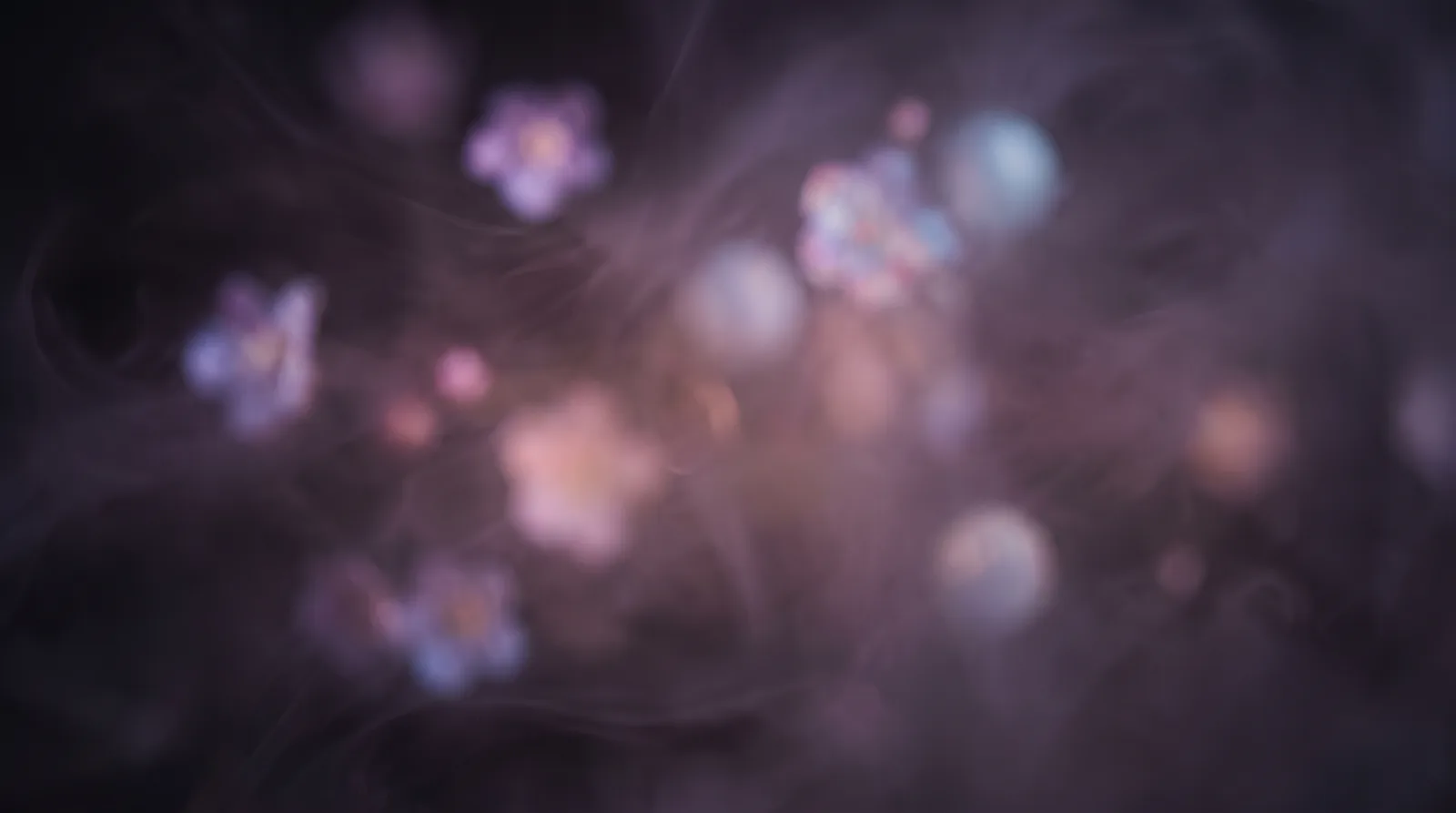
Close your eyes in a dark room and wait. For a moment there is nothing, a flat and obedient black. Then, if you keep watching, the black begins to misbehave. A wash of violet drifts in from one corner. A ring of dull gold blooms, thins, and fades. Tiny sparks cross the dark like distant traffic. Nobody taught us to expect this, and most of us have never mentioned it to another person, yet nearly everyone has seen it. The show has a name: phosphenes, from the Greek phos, light, and phainein, to show. It is the light your visual system makes when the world stops supplying any.
The light that needs no light
A phosphene is the experience of seeing light without light actually entering the eye. The most familiar kind arrives when you rub your closed eyes and the darkness erupts into geometry: chequerboards, spoked wheels, seams of colour that fold and scatter. Pressing on the eyeball stimulates the retina mechanically, and the retina, which speaks only one language, reports the pressure as light. These pressure phosphenes have been noticed for as long as people have had knuckles and curiosity; the ancient Greeks wrote about them, and the nineteenth-century physiologist Jan Purkinje spent years patiently cataloguing the patterns his own eyes produced.
But the gentler phosphenes, the ones that drift across the dark unbidden, need no pressure at all. The visual system is never silent. Cells in the retina and the visual cortex fire spontaneously, at random, all the time, the way a concert hall is never perfectly quiet even when the orchestra has gone home. In daylight this background chatter is drowned out by the flood of real signal. In darkness there is nothing to drown it, and the brain, a tireless interpreter that refuses to believe in meaningless input, renders the chatter as faint clouds and sparks of colour. What you are watching behind your eyelids is your own machinery idling.
The prisoner's cinema
Spend long enough in true darkness and the idling grows bolder. Miners trapped underground, polar explorers in the long night, and prisoners held in unlit cells have all reported luminous displays blooming out of nothing, a phenomenon sometimes called the prisoner's cinema. Deprived of input, the visual system begins to improvise more elaborately, and simple sparks can organise themselves into lattices, tunnels and spirals. These forms are thought to trace the architecture of the visual cortex itself; the geometry you see is, in a sense, a map of the tissue doing the seeing. There is something quietly moving about that. In the absence of a world to show you, the eye shows you yourself.
Phosphenes are the visual system talking to itself, and for once we are permitted to listen.
What the flicker experiments found
Researchers have learned to summon these experiences on demand. One approach, the ganzfeld, bathes the eyes in a perfectly uniform field so that the brain loses its grip on real input. Another, more potent one uses rhythmic flicker. In a large online study, participants watched ten minutes of alternating red and black flashes, a stimulus known as Ganzflicker, and most of them began to see things: shifting colours and shapes at minimum, and in many cases vivid, complex pseudo-hallucinations. Intriguingly, people with strong mental imagery saw richer and more elaborate scenes, while those with aphantasia, who cannot summon pictures in the mind's eye, saw little or nothing (Königsmark, Bergmann, & Reeder, 2021, Cortex). The dark theatre behind your eyelids, it turns out, is furnished differently in every head.
Watching as a practice
Most of us treat phosphenes as static to be ignored while we wait for sleep. They can be something better: an object of meditation that you carry everywhere and can never lose. The practice is simple. Lie down or sit in a dim room, close your eyes, and watch the dark the way you would watch a slow sky. Do not chase the colours or try to sharpen them; they retreat from effort the way faint stars vanish when you look at them directly. Simply notice what arrives, how it moves, how it dissolves. When your mind wanders into lists and rehearsals, let the next drift of colour call you back.
This is the same quality of attention that older traditions trained deliberately. In trataka, the yogic practice of candle gazing, the meditator stares softly at a flame and then closes the eyes to watch its afterimage bloom and fade, which is a guided tour of the same inner light. And it is the quality of attention we had in mind at Feelsy: the app's slow textures, drifting colour fields on a deep, dark ground, give the open eyes the same kind of aimless luminous weather that closed eyes make for themselves. Some people like to watch a texture for a few minutes with autoplay carrying them along, then close their eyes and let the afterimage hand them over to their own phosphenes. It is a gentle corridor from screen to sleep.
When the lights mean something
A word of sensible caution, because not all inner light is idle chatter. The soft drifting colours of a dark room are benign. But a sudden shower of bright flashes, especially off to one side, or flashes arriving with a swarm of new floaters or a shadow like a curtain across your vision, is a different matter; these can signal trouble at the retina and deserve prompt attention from an eye specialist. The distinction is usually easy to feel: phosphenes are quiet, slow and vague, while warning flashes are sharp, insistent and new. Trust the difference, and when in doubt, ask.
The cinema you carry
There is a small consolation hiding in all of this. You are never entirely in the dark. Switch off every lamp, close your eyes against the last of the glow, and the oldest cinema in the world opens for an audience of one. The projectionist is your own restless cortex; the programme is abstract, unrepeatable, and free. Watching it will not transform your life. But five unhurried minutes spent observing the colours your own mind makes is five minutes in which you are not arguing with the day, and for most of us, most evenings, that is exactly the kind of transformation worth having.
Feelsy is a wellness product, not medical advice. If stress, anxiety or sleep problems persist, please speak with a qualified professional.
References
- Königsmark, V. T., Bergmann, J., & Reeder, R. R. (2021). The Ganzflicker experience: High probability of seeing vivid and complex pseudo-hallucinations with imagery but not aphantasia. Cortex.
Frequently Asked Questions
Why do I see colours when I close my eyes?
You are seeing phosphenes, the visual system's own background activity rendered as light. Cells in the retina and visual cortex fire spontaneously even in darkness, and because the brain interprets all retinal signals as light, this idle activity appears as drifting clouds, sparks and blobs of colour behind your closed eyelids. It is normal and nearly universal.
What are phosphenes?
Phosphenes are sensations of light that occur without light entering the eye. They can be triggered mechanically, for example by rubbing or pressing the closed eyes, which stimulates the retina and produces geometric patterns, or they can arise spontaneously in darkness from the visual system's constant background firing.
Is it normal to see patterns when I rub my eyes?
Yes. Pressing or rubbing the closed eyes stimulates the retina mechanically, and the retina reports any stimulation as light. The result is pressure phosphenes: chequerboards, rings, spirals and scattering colours that fade within seconds. People have recorded the effect since antiquity, so you are in long company.
When should I worry about seeing flashes of light?
Ordinary phosphenes are slow, faint and vague. A sudden shower of sharp, bright flashes, particularly at the edge of vision, or flashes accompanied by many new floaters or a curtain-like shadow, can indicate a problem with the retina and should be assessed promptly by an eye specialist. New, insistent and sharp is the pattern to take seriously.
Can you meditate on phosphenes?
Yes, and they make a surprisingly good object of meditation because they are always available and impossible to control. Sit or lie in a dim room, close your eyes, and watch whatever colours arrive without trying to sharpen or chase them. When the mind wanders, let the next drift of colour bring you back. Five to ten minutes is plenty.

About the author
Contributing writer
Eleonor writes about contemplative traditions, attention and the cultural history of calm. She has spent two decades collecting the rituals humans use to slow down, from zazen halls to hammams, and translating them for modern, screen-lit lives.
Feel it for yourself.
Feelsy turns reading about calm into practising it. Two minutes of a slow texture is often the whole difference.


Related reading
 Ancient Wisdom
Trataka: The Original Visual Meditation
Centuries before screens, yogis rested their gaze on a single candle flame. How trataka works, how to practise it safely, and what it teaches modern visual meditation.
 Visual Meditation
Why Kaleidoscopes Are So Mesmerising: The Pleasure of Ordered Light
A cardboard tube and three mirrors can hold the eye for ages. Here is why kaleidoscopes are so mesmerising, from symmetry science to a slow looking practice.
 Visual Meditation
Why Fractals Calm the Mind: The Quiet Mathematics of Ferns and Coastlines
Ferns, clouds and coastlines share a repeating geometry called fractals. Here is why nature's self-similar patterns soothe the eye, and how to use them.
 Visual MeditationNew
Apricity: The Forgotten Pleasure of Winter Sun
Apricity is a forgotten English word for the warmth of the sun in winter. Here is why a few minutes of low winter sunlight can soften the darkest months.
 Visual MeditationNew
Momijigari: The Japanese Art of Autumn Leaf Viewing
Momijigari is the old Japanese tradition of travelling to see autumn leaves. Here is why fiery foliage calms the mind, and how to practise it anywhere.
 Visual MeditationNew
Why Libraries Feel So Calming
Step into a library and your shoulders drop. Here is the psychology of hush, tall shelves and shared silence, and how to borrow that feeling for your rooms.