Why Kaleidoscopes Are So Mesmerising: The Pleasure of Ordered Light
A cardboard tube and three mirrors can hold the eye for ages. Here is why kaleidoscopes are so mesmerising, from symmetry science to a slow looking practice.
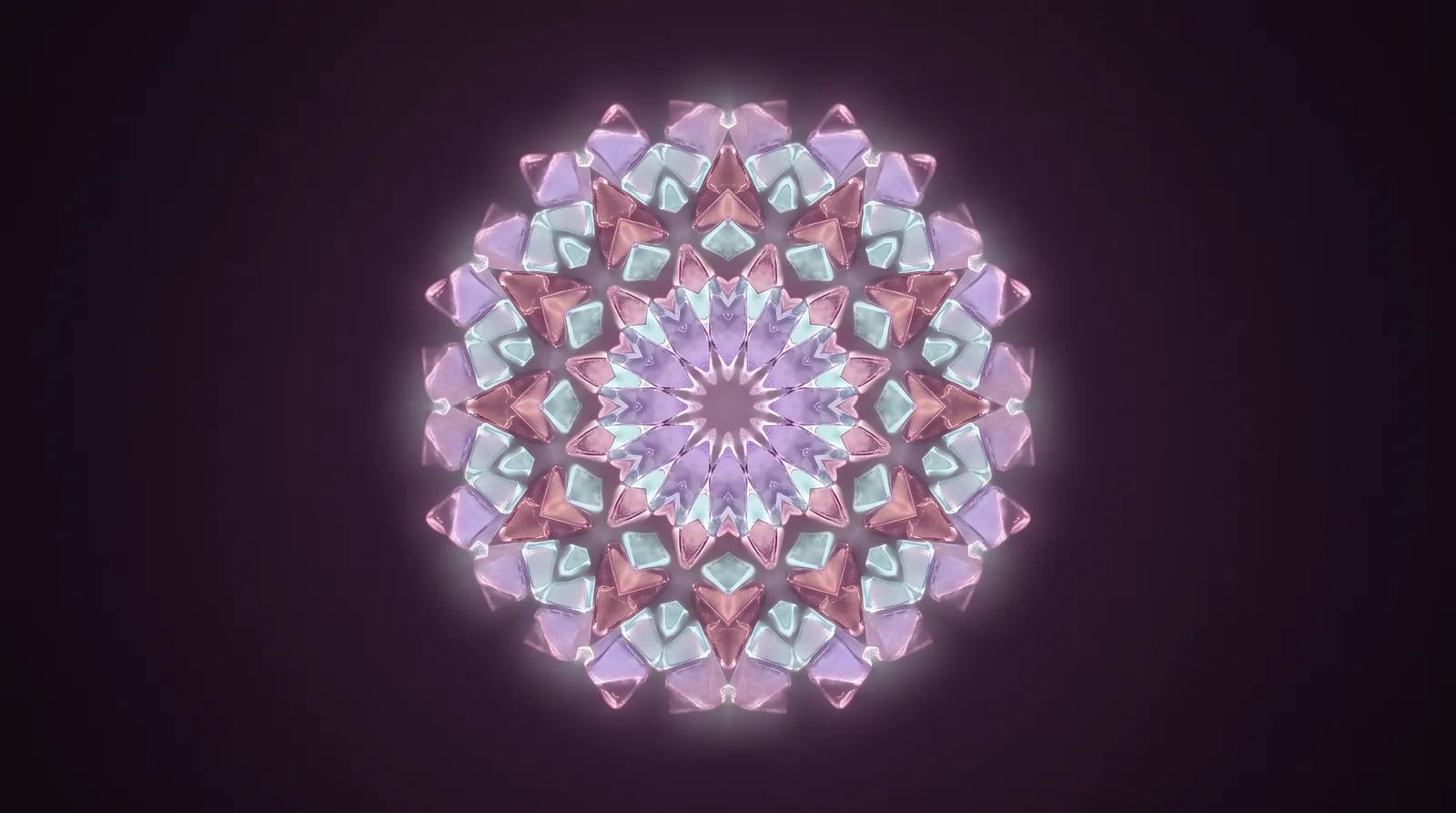
Somewhere in most childhoods there is a cardboard tube with a peephole at one end, and inside it a fistful of broken glass. Held to the light and turned, the rubble becomes a rose window; turned again, the window collapses and instantly reassembles into another, and another, none of them repeatable, all of them perfect. The kaleidoscope may be the only toy whose contents are junk and whose effect is awe. Adults who would not dream of buying one still slow down when they encounter kaleidoscopic patterns, in mosque tiles, in rose windows, in the swirling screens of visual apps, and the pull is worth taking seriously, because it says something rather precise about what the eye finds restful.
An instrument of ordered light
The kaleidoscope was not designed as a toy at all. The Scottish physicist Sir David Brewster assembled the first one in 1816 while studying the polarisation of light, noticed that mirrors set at an angle multiplied whatever lay between them into radial symmetry, and patented the device the following year. He named it from the Greek: kalos, beautiful; eidos, form; skopein, to look at. An instrument for the viewing of beautiful forms. Brewster imagined it as a serious tool for designers and artists; the public disagreed, bought them in vast numbers, and turned the philosopher's instrument into a parlour amusement within a season. The physics is disarmingly simple: two or three mirrors, a chamber of loose fragments, and the law of reflection doing all of the work. Chance arranges the glass; the mirrors impose order on the chance. Every turn of the tube is a small argument that chaos and pattern are closer neighbours than they look.
What symmetry does to the brain
The human visual system is a connoisseur of symmetry. We detect it fast, almost pre-attentively, and we like it: symmetrical faces, buildings, flowers and abstract patterns are reliably judged more pleasing than lopsided versions of the same material. Neuroscience has begun to sketch out why. In one line of research, scientists recorded the visual cortex responding strongly and preferentially to symmetrical abstract patterns, and found that the strength of that neural response predicted how much people liked what they were looking at, a result that held across participants from quite different cultures (Makin, Helmy and Bertamini, 2018, Quarterly Journal of Experimental Psychology). The pleasure of symmetry, in other words, is not an acquired taste layered on top of seeing. It appears to be woven into seeing itself.
One plausible reading is that symmetry is easy in a particular, delicious way. A symmetrical image is highly organised, so the visual system can compress it: understand one wedge and you have understood the whole. The kaleidoscope exploits this ruthlessly. It hands the eye an image of enormous apparent complexity that is secretly one sixth as complicated as it looks, and the gap between apparent richness and actual effort is experienced as pleasure. It is the visual equivalent of rhyme.
The kaleidoscope hands the eye enormous apparent complexity that is secretly one sixth as complicated as it looks, and the gap is experienced as pleasure.
Children arrive at this pleasure before anyone explains it to them, which is telling. Hand a five year old a kaleidoscope and no instruction is needed; the turning begins at once, and so does the particular open mouthed stillness that adults spend money trying to recover. Whatever the tube is doing, it is not an acquired sophistication. It is closer to a key that happens to fit a very old lock.
Order without stakes
Yet symmetry alone does not explain the trance. A wallpaper pattern is symmetrical and holds nobody. What the kaleidoscope adds is motion and mortality: each mandala exists for a second, trembles at the edge of the next turn, and is gone without residue. The viewer is watching a continuous, gentle catastrophe from which something whole always emerges. This is the same quality that makes fractals, lava lamps and drifting clouds so absorbing: variation that never repeats, unfolding inside a rule that never breaks. Attention is occupied but never ambushed. Nothing in the tube can go wrong, because there is no wrong; whatever falls, the mirrors will forgive it into pattern. For a mind that spends its day managing outcomes, ten minutes with a machine that cannot produce a bad one is a genuine holiday.
There is a reason so many contemplative traditions arrived at the same geometry by hand. The rose windows of Gothic cathedrals, the tiled domes of Isfahan, the sand mandalas of Tibet: radially symmetrical images built to be gazed at, and in the mandala's case, destroyed on completion. The kaleidoscope is those objects made domestic and endless, a mandala factory in a tube. Brewster's Greek was more apt than he knew; the viewing of beautiful forms is one of humanity's oldest doors into stillness.
A practice for the eyes
To use kaleidoscopic pattern as an actual practice rather than a passing pleasure, the method is borrowed from slow looking. Take a kaleidoscope, a length of patterned tilework, or a screen-based equivalent; I am partial to setting Feelsy's kaleidoscope texture drifting of an evening, since it turns itself and never runs out of glass. Then resist the itch to hurry to the next configuration. Stay with one pattern until you have actually seen it: the sixfold repeat, the one blue fragment doing its work in six places at once, the place where two colours meet. When the pattern changes, let it, and begin again. The instruction is the same one the falling snow gives, and the fire, and the fish tank: watch fully, hold nothing. The kaleidoscope simply makes the instruction unusually easy to follow, because what you are holding was never going to last, and what comes next was always going to be beautiful.
Feelsy is a wellness product, not medical advice. If stress, anxiety or sleep problems persist, please speak with a qualified professional.
References
- Makin, A. D. J., Helmy, M., & Bertamini, M. (2018). Visual cortex activation predicts visual preference: Evidence from Britain and Egypt. Quarterly Journal of Experimental Psychology.
Frequently Asked Questions
Who invented the kaleidoscope and why?
The Scottish physicist Sir David Brewster assembled the first kaleidoscope in 1816 while studying the polarisation of light, and patented it the following year. He named it from the Greek for the viewing of beautiful forms and intended it as a serious tool for designers and artists, but the public adopted it as an amusement almost immediately.
Why are kaleidoscopes so satisfying to look at?
Kaleidoscopes combine two things the visual system loves: symmetry and unrepeating change. Research has found that the visual cortex responds strongly to symmetrical patterns and that this neural response predicts how much people like them. Each turn also produces a pattern that exists briefly and is replaced, so attention stays occupied without any possibility of a bad outcome.
Why does symmetry feel pleasing to the brain?
A symmetrical image is highly organised, so the eye can compress it: understand one wedge and you have understood the whole. The gap between how rich the image looks and how little effort it takes to process appears to be felt as pleasure, and studies suggest this preference is woven into vision itself rather than being an acquired taste.
Can you meditate with a kaleidoscope?
Yes, and the method is simple slow looking. Stay with one pattern until you have actually seen it, notice the repeats and the places where colours meet, and when the pattern changes, let it go and begin again. A physical kaleidoscope works, as does patterned tilework or a screen-based version such as Feelsy's kaleidoscope texture, which turns itself.

About the author
Contributing writer
Eleonor writes about contemplative traditions, attention and the cultural history of calm. She has spent two decades collecting the rituals humans use to slow down, from zazen halls to hammams, and translating them for modern, screen-lit lives.
Feel it for yourself.
Feelsy turns reading about calm into practising it. Two minutes of a slow texture is often the whole difference.


Related reading
 Visual Meditation
Why Fractals Calm the Mind: The Quiet Mathematics of Ferns and Coastlines
Ferns, clouds and coastlines share a repeating geometry called fractals. Here is why nature's self-similar patterns soothe the eye, and how to use them.
 Ancient Wisdom
Sand Mandalas and the Art of Letting Go
Tibetan monks spend days building an intricate sand mandala, then sweep it away. What the ritual teaches about impermanence, process and why watching can be meditation.
 Visual Meditation
Why Lava Lamps Are So Mesmerizing: The Science of Watching Wax
Why staring at a lava lamp feels so calming: slow unpredictable motion, soft fascination, and what a 1963 novelty knew about soothing a busy brain.
 Visual MeditationNew
Highway Hypnosis: Why You Can't Remember the Last Ten Miles
You arrive at your exit with no memory of driving there. Highway hypnosis is real and common: here's the science of the road trance and how to use it safely.
 Visual Meditation
Why the Northern Lights Mesmerise Us: Aurora Watching as Visual Meditation
What causes the northern lights, why the aurora feels so calming to watch, and how to turn sky watching into a simple visual meditation practice.
 Visual Meditation
Blue Mind: Why Being Near Water Calms the Brain
What blue mind theory says about why oceans, lakes and rivers soothe us: the research on blue space, water's pull on the eye, and how to use it daily.