Yūgen: The Japanese Art of Beauty Half-Hidden
Yūgen is the Japanese word for beauty half-hidden: mist, moonlight, depths you sense but cannot see. What it means and how to practise noticing it.
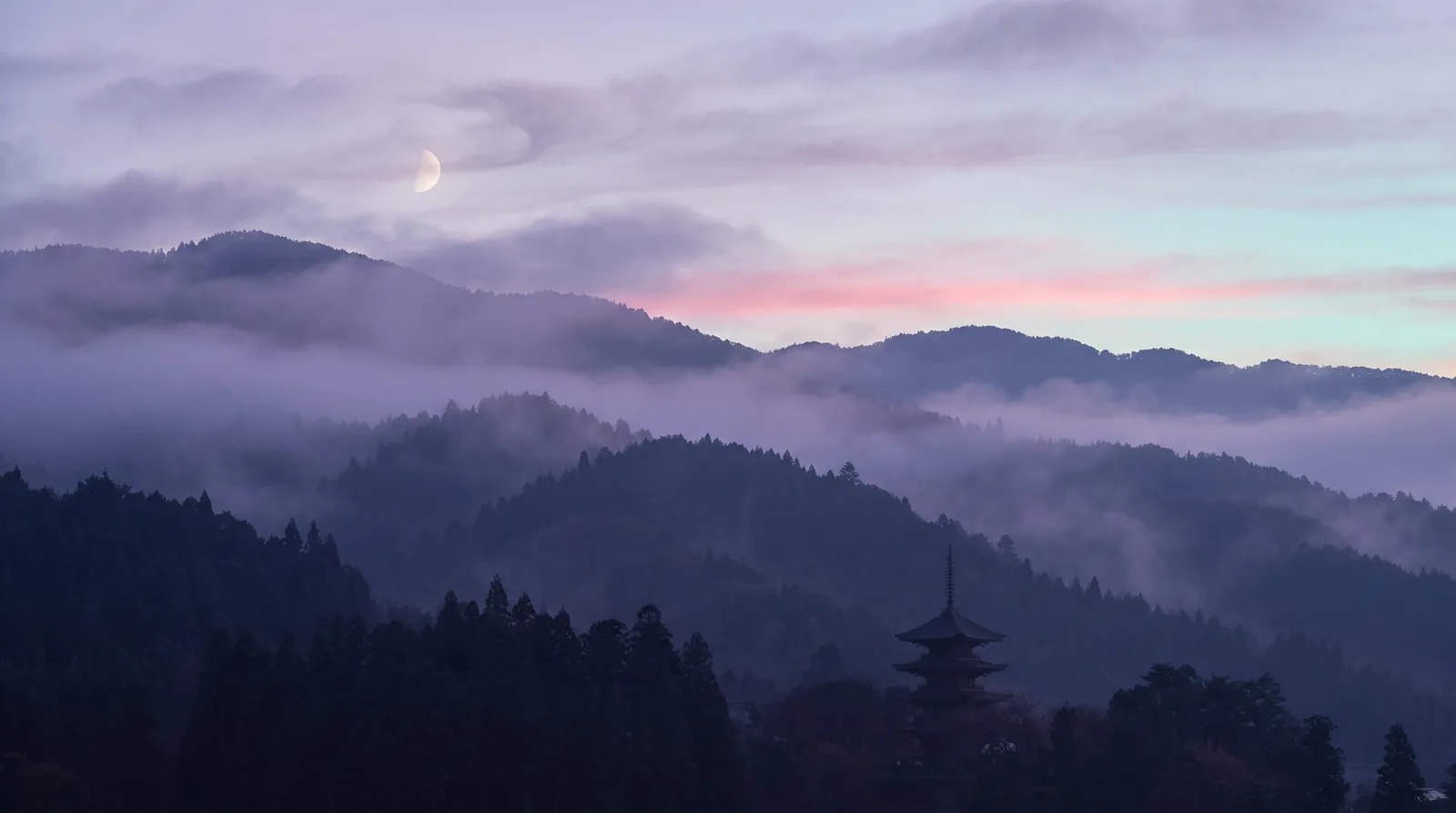
Think of the moments that have genuinely stopped you. Not the postcard views, but the stranger ones: headlights dissolving in fog, a mountain suggested rather than shown behind cloud, the moon smudged by thin overcast, a lit window across a valley at dusk. In each case, part of the scene is missing, and the missing part is doing most of the work. Japanese aesthetics has a word for the beauty of exactly this: yūgen.
It is usually translated as mysterious depth, or subtle profundity, and the translators themselves tend to apologise, because yūgen names something that by definition resists being fully shown. The word is built from characters suggesting dimness and depth; what it points to is the specific pleasure of sensing more than you can see. Of the great Japanese aesthetic terms, wabi-sabi may be the most famous and mono no aware the most touching, but yūgen is, I think, the most useful to a modern nervous system, because it turns the half-seen, which anxiety treats as a threat, back into a source of wonder.
A word with a long career
Yūgen came to Japan from Chinese philosophical writing, where the term carried senses of the dark, the subtle and the unfathomable, and it was taken up by Japanese poets and critics in the Heian and medieval periods as a term of highest praise. In the poetry of the era, and in the grave, dreamlike Noh theatre that followed, yūgen described art that gestured beyond its own edges: the poem about autumn dusk that says almost nothing and implies a whole world, the masked actor whose slightest tilt of the head suggests an interior no audience will ever be shown directly.
The Noh master Zeami, writing in the early fifteenth century, made yūgen the heart of his craft, and the images the tradition reaches for again and again are telling: the moon behind a veil of cloud, mist across a mountain slope, a boat that slowly disappears behind an island, birds vanishing into dusk. Notice what these have in common. Nothing is broken, nothing is mournful; something is simply withheld, and the withholding deepens it.
Yūgen begins at the point where seeing ends and sensing continues.
Why the half-hidden calms us
There is a reason fog quietens a landscape and the landscape's visitors along with it. When a scene is fully lit and fully legible, the eye darts, itemising; there is always another detail to collect. Veil the scene, and the itemising stops. The eye slows to the pace of what can actually be discerned, and the imagination is invited to furnish the rest, which it does at its own unhurried tempo. Attention shifts from grasping to receiving. That shift, from inspection to reverie, is precisely the one that contemplative practices of every tradition are trying to produce, and yūgen names the way certain sights produce it unbidden.
There is also a humbler comfort in it. A world with depths you cannot see to the bottom of is a world still larger than your accounting of it. The half-hidden mountain says: you do not have to hold all of this, and you were never expected to. For a mind that spends its days trying to render everything visible, measurable and resolved, a few minutes of unresolvable depth is a genuine rest.
Where to find it
The classical images remain the reliable ones, and most of them are free and close to home.
- Weather that veils: fog, mist, drizzle, falling snow at dusk, the times when the far end of your own street softens into suggestion.
- Light that withholds: the last quarter hour of dusk, moonlight through cloud, a landscape lit from behind so that its faces are shadow.
- Distance and disappearance: hills behind hills, a path curving out of sight into trees, a boat or a train diminishing until you cannot say when it is gone.
- Sound at the edge of hearing: a temple bell across water, wind in far trees, music from another room.
The practice is simply to stop for them. Where a view is transparent, we glance and move on; where it is veiled, there is something to stay for. Give the veiled thing two full minutes, without narrating it or photographing it, and notice the particular quality of quiet that arrives, deeper than pretty and closer to awe.
A dusk practice, and a pocket version
The most direct way to practise yūgen is to keep an appointment with dusk once or twice a week: no destination, just the fifteen minutes in which the world withdraws detail by detail, and the lit windows come on one by one. Walk slowly and let the half-seen stay half-seen. It pairs beautifully with the unhurried walking of a walking meditation, though it asks even less of you.
And for the evenings that end indoors, it is worth noticing that slow, veiling motion carries the same signature on a screen: drifting particles, colour sinking through colour, fog rolling through a texture with no edge ever quite resolving. Feelsy's slower textures are built on exactly this grammar of the half-hidden, motion that suggests more than it shows, and watching one for a few minutes with the lights low is a small, reliable dose of depth at the end of a day that has been far too legible. The point, on the street or on the screen, is the same: let something stay hidden, and feel the mind stop reaching.
Feelsy is a wellness product, not medical advice. If stress, anxiety or sleep problems persist, please speak with a qualified professional.
Frequently Asked Questions
What does yugen mean?
Yūgen is a Japanese aesthetic term usually translated as mysterious depth or subtle profundity. It names the beauty of things half-hidden: mist across a mountain, the moon behind cloud, a boat disappearing behind an island. Rather than describing something broken or sad, it describes the specific pleasure of sensing more than you can see, where the withheld part of a scene deepens it.
What is the difference between yugen and wabi-sabi?
Wabi-sabi finds beauty in imperfection and impermanence, in worn, weathered and humble things, while yūgen finds beauty in depth and concealment, in what is sensed but not shown. A cracked, mended bowl is wabi-sabi; a mountain suggested behind mist is yūgen. The two often keep company in Japanese art, but one is about the truthful surface of things and the other about their unseen depths.
Why does fog or mist feel so calming?
When a scene is fully visible, the eye darts from detail to detail, itemising. When it is veiled, that inspection stops: the eye slows to the pace of what can be discerned and the imagination furnishes the rest at its own tempo, so attention shifts from grasping to receiving. A veiled world also feels larger than your accounting of it, which is a quiet relief for a mind that spends all day trying to resolve things.
How do you practise noticing yugen?
Keep an appointment with dusk once or twice a week and walk slowly through the quarter hour when detail withdraws, letting the half-seen stay half-seen. Reliable places to look include fog and falling snow, moonlight through cloud, paths curving out of sight, and sounds at the edge of hearing. Give any veiled thing two unhurried minutes without narrating or photographing it, and notice the quality of quiet that arrives.

About the author
Contributing writer
Eleonor writes about contemplative traditions, attention and the cultural history of calm. She has spent two decades collecting the rituals humans use to slow down, from zazen halls to hammams, and translating them for modern, screen-lit lives.
Feel it for yourself.
Feelsy turns reading about calm into practising it. Two minutes of a slow texture is often the whole difference.


Related reading
 Ancient Wisdom
Mono no Aware: Japan's Word for the Beautiful Sadness of Passing Things
Mono no aware is Japan's term for the gentle sadness of passing things. Here is what the phrase means, where it comes from, and why it deepens everyday calm.
 Ancient Wisdom
Wabi-Sabi: The Japanese Art of Finding Calm in Imperfection
What wabi-sabi really means: the Japanese aesthetic of imperfect, impermanent beauty, and how its quiet philosophy softens perfectionism and stress.
 Visual Meditation
Why Fog Is So Calming: The Strange Peace of a World Gone Soft
Foggy mornings quiet something in us. The psychology of why fog feels so calming, from softened light and sound to the restful pull of a smaller world.
 Ancient WisdomNew
Ho'oponopono: The Hawaiian Practice of Setting Things Right
What ho'oponopono means, where the Hawaiian practice of reconciliation comes from, the four phrases, and how to fold forgiveness into a quiet evening.
 Ancient WisdomNew
Sisu: The Finnish Art of Quiet Endurance
What sisu means in Finnish culture, how it differs from grit and resilience, and how to borrow its quiet endurance for ordinary hard days and long winters.
 Ancient Wisdom
Sobremesa: The Spanish Art of Lingering at the Table
What sobremesa means, why Spaniards stay talking at the table long after a meal ends, and how this unhurried ritual can slow down an anxious day.