Do Blue Light Glasses Actually Work? A Skeptic Reads the Receipts
Blue light glasses promise better sleep and less eye strain. Here's what a major 2023 evidence review actually found, and what to do instead at night.
By Kurt Woleret
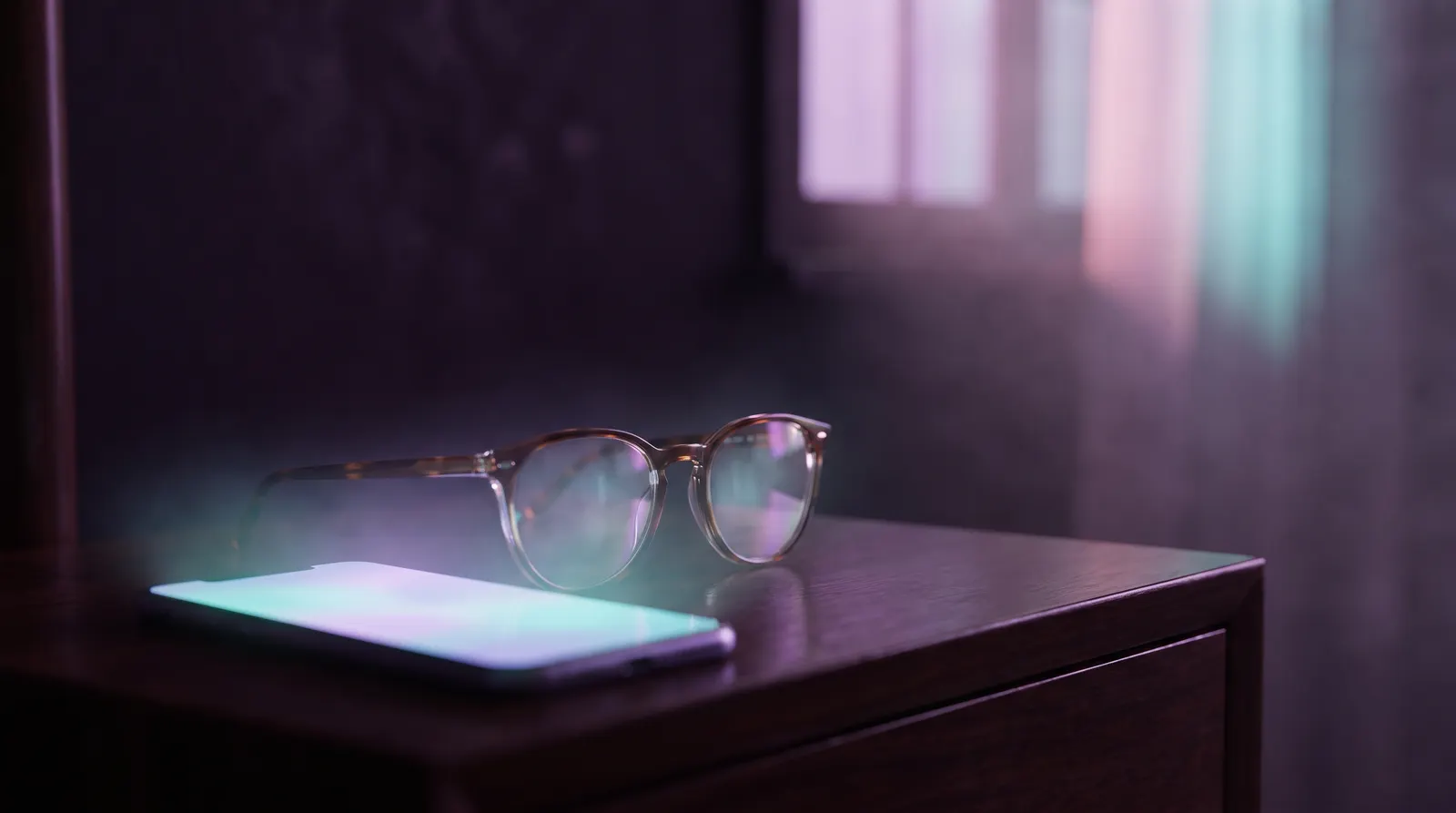
Two deadline weeks ago I bought a pair of blue light glasses off a subway ad. Amber-ish lenses, vaguely Scandinavian frames, forty dollars. The pitch was irresistible: keep staring at screens all night, but filter out the bad wavelength, and your eyes will stop aching and your sleep will repair itself. I wore them for a week and felt very optimized. Then I did the thing I always regret doing after a purchase, which is reading the research. Here's what I found, so you can spend your forty dollars on something that works.
The pitch, and why it sounds so reasonable
The theory isn't crazy; that's what makes it good marketing. Your circadian clock takes its cues from light, and short-wavelength light, the blue end of the spectrum, is what the clock listens to hardest. Bright blue-rich light in the evening can delay melatonin, the hormone that tells your body night has started. Screens emit some blue light. So the leap goes: block the blue at the lens, and you can doomscroll at midnight consequence-free, like a decaf version of your phone. The biology in the first half of that story is real. The leap in the second half is where the money changes hands.
What the evidence actually says
In 2023, the Cochrane Collaboration, the outfit that does the most rigorous evidence reviews in medicine, published a systematic review of randomized controlled trials on blue-light filtering spectacle lenses. Cochrane reviews are the adult in the room: they pool every decent trial, grade the quality, and say what can honestly be concluded. The verdict was not kind to my forty dollars. Across seventeen randomized trials, blue-light filtering lenses probably made no difference to eye strain from computer use compared with ordinary lenses. And for sleep, the trials were too small, too short, and too inconsistent to show any clear benefit at all. Not a ringing endorsement, not even a shrug; closer to a raised eyebrow.
The biology in the first half of the story is real. The leap in the second half is where the money changes hands.
It's worth being precise about what this does and doesn't mean. It doesn't mean evening light is harmless; light at night genuinely can push your body clock later. It means the specific product, a filter baked into your glasses, hasn't shown it can rescue you from your screen habits. The glasses are treating the wavelength while you keep the brightness, the timing, and the group chat.
Why the theory falls apart at the dose
Here's the part the subway ad skips: dose. Your phone emits blue light the way a birthday candle emits heat. Step outside on a cloudy afternoon and you're getting orders of magnitude more blue-rich light than any screen delivers to your couch. Your circadian system evolved to read skies, not smartphones. What screens do have going for them, clock-wise, is timing and proximity: a bright rectangle held close to your face during the exact hours your brain is trying to wind down. That's a brightness-and-behavior problem, and a tinted lens doesn't fix behavior.
As for the ache in your eyes after a long screen day, that's mostly not blue light either. When you stare at a screen you blink less, so your eyes dry out, and your focusing muscles hold one position for hours like a subway pole grip that never ends. Dryness plus focus fatigue explains the gritty, heavy feeling far better than any wavelength does, which is presumably why filtering the wavelength did nothing measurable in the trials.
What actually helps at night
The unglamorous fixes are the ones with the mechanism behind them:
- Turn the brightness down. Total light matters more than color. A dim screen with warm settings beats a bright screen with fancy glasses.
- Push screens further away and further from bedtime. The last hour is worth more than any accessory; even trimming twenty minutes helps.
- Give your eyes breaks during the day. Look at something far away regularly so your focusing muscles get to let go; your blink rate recovers too.
- Have a wind-down that isn't a feed. Feeds are engineered to be bright, fast, and endless, which is the exact opposite of a lullaby.
And if a screen is going to be part of your wind-down anyway, and let's be honest, it is, pick content that's dim, slow, and finite instead of bright, fast, and infinite. This is the reason Feelsy's textures run on a near-black palette with slow, repetitive motion, and why its autoplay mode exists: the screen stays dark and quiet and you're not tapping through bright menus at 11:45 pm. Better still, close your eyes entirely and let the 4-7-8 breathing exercise walk you down instead; no wavelength required.
So should you buy them?
If you already own blue light glasses and like them, keep wearing them; they're harmless, and a ritual that signals winding down has its own small value. But if you're deciding where to put forty dollars of sleep budget, the evidence says: don't put it in a lens. Dim the room, shrink the last hour of screen time, keep a consistent wake time, and let the glasses stay on the subway ad. My pair now lives in the drawer with the fitness bands. It's getting crowded in there.
Feelsy is a wellness product, not medical advice. If stress, anxiety or sleep problems persist, please speak with a qualified professional.
References
- Singh, S., Downie, L. E., & Anderson, A. J. (2023). Blue-light filtering spectacle lenses for visual performance, sleep, and macular health in adults. Cochrane Database of Systematic Reviews, Issue 8, CD013244.
Frequently Asked Questions
Do blue light glasses help you sleep?
The best available evidence says don't count on it. A 2023 Cochrane systematic review of randomized trials found the studies on sleep were too small, short, and inconsistent to show any clear benefit from blue-light filtering lenses. Evening light habits, like screen brightness and timing, matter more than a filter in your glasses.
Do blue light glasses reduce eye strain?
Probably not. Across seventeen randomized trials reviewed by Cochrane in 2023, blue-light filtering lenses made no measurable difference to computer-related eye strain compared with ordinary lenses. Screen-day eye ache is mostly caused by reduced blinking and focus fatigue, not by blue light.
Is blue light from screens bad for your eyes?
Screens emit far less blue light than ordinary daylight, and the tired, gritty feeling after a screen day is better explained by dryness and focusing fatigue than by any wavelength. The bigger issue with screens at night is total brightness and timing, which can delay your body clock.
What should I do instead of buying blue light glasses?
Lower your screen brightness in the evening, keep screens further from your face and further from bedtime, give your eyes regular distance breaks during the day, and use a wind-down routine that is dim, slow, and finite rather than a bright, endless feed. Those changes act on the mechanisms that actually affect sleep and eye comfort.
Are blue light glasses harmful?
No. If you already own a pair and enjoy wearing them, there is no evidence of harm, and the ritual of putting them on can be a useful signal that the day is ending. Just don't let them substitute for dimming screens and protecting the last hour before bed.

About the author
Contributing writer
Kurt is a New York based writer covering the practical science of stress, sleep and focus. He is the resident sceptic of the Journal: if a technique cannot survive a crowded subway commute and a deadline week, he is not interested in it.
Feel it for yourself.
Feelsy turns reading about calm into practising it. Two minutes of a slow texture is often the whole difference.


Related reading
 Sleep
SleepDoes Screen Time Before Bed Really Wreck Your Sleep?
Phones before bed: sleep villain or overblown? What the research on screens, blue light and melatonin actually shows, and what to do that isn't 'never look at a screen.'
 Visual Meditation
The 20-20-20 Rule: Does It Actually Fix Screen Eye Strain?
Eyes burning after a long screen day? What the 20-20-20 rule really does, what the evidence says about it, and better ways to give tired eyes a break.
 Sleep
SleepHow to Fall Asleep Faster: Sound, Light and Ritual
Falling asleep is a skill, not a stroke of luck. Here is how sound, light and a 15-minute ritual can quiet a racing mind and shorten the trip to sleep.
 SleepNew
Night Owl vs Early Bird: The Science of Chronotypes
Night owl or early bird isn't a personality flaw or a virtue. It's a chronotype. Here's what the science says about your body clock and how to work with it.
 SleepNew
How to Wake Up Early (Without Hating Your Life)
Want to become a morning person? Here's how to wake up early using light, timing and consistency, based on what circadian science actually shows.
 Sleep
SleepCan't Sleep? Why Getting Out of Bed Is the Counterintuitive Fix
Lying awake trying harder is the one thing that makes insomnia worse. Here's the 20-minute rule, the science of stimulus control, and how to use it.