Does Alcohol Help You Sleep? The Nightcap, Fact-Checked
Alcohol really does make you fall asleep faster, then quietly wrecks the second half of the night. What the research shows, and what to try instead.
By Kurt Woleret
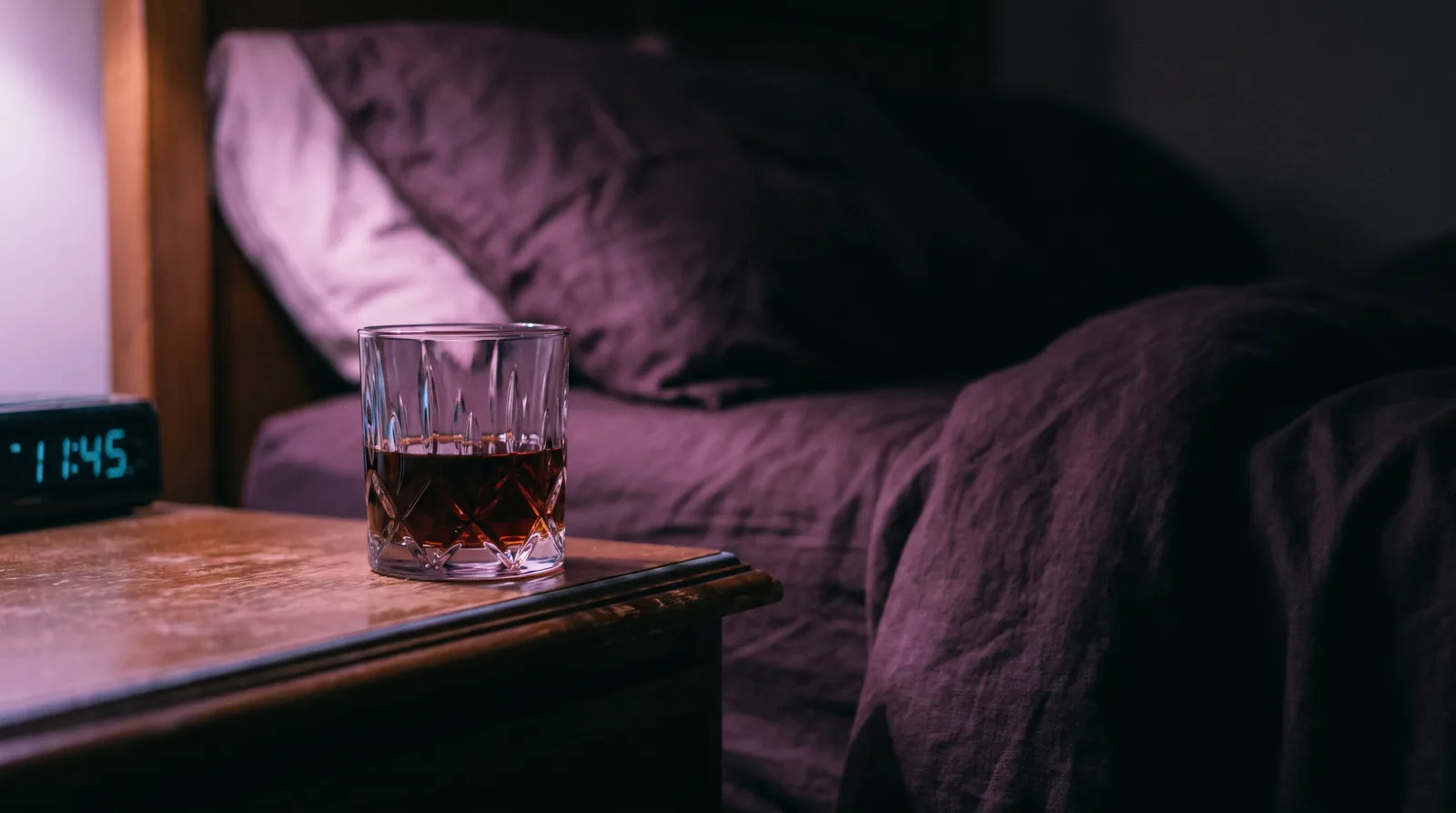
The nightcap has better PR than almost anything else in sleep culture. It has centuries of tradition, a cozy name, and the testimony of every uncle who ever announced that a whiskey 'knocks him right out.' And here's the annoying thing: the uncle isn't lying. Alcohol genuinely does help you fall asleep faster. It just charges an interest rate on the back half of the night that would embarrass a payday lender. Let's look at what the research actually found, because this is one of those cases where both the folk wisdom and the buzzkill are technically correct.
The part your uncle got right
The most thorough look at this is a 2013 review by Ebrahim and colleagues in Alcoholism: Clinical and Experimental Research, which pulled together the experimental studies of alcohol's effects on the sleep of healthy people. The consistent finding: alcohol before bed shortens the time it takes to fall asleep, and in the first half of the night it actually increases deep, slow-wave sleep. At any dose. If you stopped measuring at 2 a.m., the nightcap would look like medicine.
That's the whole trick, and it's why the belief survives. You experience falling asleep. You remember falling asleep. The sedation is real, immediate, and pleasant. Nobody experiences their own REM suppression at 4 a.m. as a line item labeled 'the drink did this.' The costs arrive hours after the purchase, unsigned.
The part the second half of the night pays for
Keep measuring past 2 a.m. and the picture flips. The same review found that alcohol disrupts the second half of the night: REM sleep, the dream-heavy stage that matters for memory and emotional processing, gets delayed and reduced, with the disruption growing as the dose goes up. As your body finishes clearing the alcohol, the sedation rebounds into shallow, fragmented sleep: more awakenings, more tossing, that distinctive 4 a.m. wide-eyed clarity where you're suddenly reviewing everything you've ever said at a party.
Stack that against what a night is supposed to look like. Deep sleep front-loads the night on its own; you didn't need the whiskey for that. REM concentrates in the second half, exactly where alcohol does its damage. So the trade is: a faster descent into a stage you were getting anyway, paid for with the stage you can least afford to lose. Add the practical taxes, a bladder alarm at 3 a.m., a snore-prone airway made floppier, and the nightcap starts looking less like a sleep aid and more like a loan shark with a soothing voice.
The sedation is real and the bill is real. It just arrives four hours later, when you can't connect it to the drink.
The habituation problem
There's one more wrinkle worth knowing: the sedative effect fades with repetition. Use alcohol as a sleep tool nightly and the falling-asleep benefit shrinks within days, while the second-half disruption keeps showing up to work. That's the definition of a bad deal: diminishing returns on the upside, full price on the downside. It's also how a harmless-seeming habit quietly escalates, because when one drink stops working, the intuitive fix is not zero drinks.
None of this is a temperance lecture. A drink with dinner, hours before bed, is a rounding error for most people's sleep. The problem is specifically the drink whose job is to make you sleepy: the one timed to land on the pillow with you. That's the one the research keeps catching.
What to do instead of the nightcap
Here's the awkward truth about why nightcaps work as a ritual: it's not only the ethanol. It's the sitting down, the slowing down, the warm glass, the signal that the day is over. The ethanol is the ingredient that backfires; the ritual is the ingredient that works. So keep the ritual and swap the active ingredient. Give the last drink a cutoff a few hours before bed, then build a short off-ramp that does the nightcap's psychological job: lights down, something warm and decaf in the same heavy glass if you like, and ten minutes of something genuinely undemanding. Mine is Feelsy on the nightstand: a slow dark texture drifting on autoplay, sound low, sometimes the guided 4-7-8 breathing when my brain insists on one more lap. It signals 'done' the way the whiskey used to, minus the 4 a.m. invoice.
So, does alcohol help you sleep? It helps you fall asleep, which is a different product than it appears to be. It buys the first twenty minutes and sells off the last three hours. If falling asleep is your struggle, there are tools that don't cannibalize the rest of the night. And if you do have that drink, have it early, count it as recreation rather than medication, and let the actual wind-down do the tucking in.
Feelsy is a wellness product, not medical advice. If stress, anxiety or sleep problems persist, please speak with a qualified professional.
References
- Ebrahim, I. O., Shapiro, C. M., Williams, A. J., & Fenwick, P. B. (2013). Alcohol and Sleep I: Effects on Normal Sleep. Alcoholism: Clinical and Experimental Research, 37(4), 539-549.
Frequently Asked Questions
Does alcohol make you fall asleep faster?
Yes. Experimental research consistently shows alcohol before bed shortens the time it takes to fall asleep and can even increase deep sleep in the first half of the night. That's why the nightcap feels like it works. The problem is what happens later: more awakenings, suppressed REM, and shallower sleep in the second half.
Why do I wake up at 3 or 4 a.m. after drinking?
As your body finishes clearing the alcohol, its sedative effect rebounds into fragmented, shallow sleep, so you surface far more easily. Alcohol also delays and reduces REM sleep in the second half of the night, and adds practical disruptions like needing the bathroom. The early-morning wide-awake feeling after an evening of drinks is the textbook signature.
How long before bed should I stop drinking alcohol?
Give the last drink a cutoff of at least a few hours before bed, so most of the alcohol is metabolized before your sleep's second half begins. A drink with dinner is a rounding error for most people; the drink timed to land on the pillow with you is the one that damages the night.
Is a nightcap bad for you every night?
Nightly use is where the deal gets worst, because the falling-asleep benefit fades with repetition within days while the second-half disruption continues at full strength. That tempts people toward higher doses, which disrupt REM even more. If alcohol has become your primary sleep tool, that's the pattern worth replacing.
What works instead of alcohol for sleep?
Keep the ritual, swap the ingredient. Much of the nightcap's power is the wind-down ceremony around it: sitting down, slowing down, marking the day as over. A warm decaf drink, dim lights, slow breathing like 4-7-8, or a few quiet minutes with something visually calming does the same signaling job without sabotaging the second half of the night.

About the author
Contributing writer
Kurt is a New York based writer covering the practical science of stress, sleep and focus. He is the resident sceptic of the Journal: if a technique cannot survive a crowded subway commute and a deadline week, he is not interested in it.
Feel it for yourself.
Feelsy turns reading about calm into practising it. Two minutes of a slow texture is often the whole difference.


Related reading
 Sleep
SleepHow Late Is Too Late for Coffee? Your Caffeine Cutoff, Explained
Caffeine six hours before bed can still cut an hour of sleep. What the research says about your last-cup cutoff, half-lives, and smarter timing.
 Sleep
SleepDoes Melatonin Actually Work? What the Science Says
Melatonin is everywhere, but does it actually work? Here's what meta-analyses show about the famous sleep supplement, and when it helps or doesn't.
 Sleep
SleepWhy You Wake Up at 3 AM (and How to Get Back to Sleep)
Waking at 3 AM isn't a curse or a sign something's broken. Here's the sleep science behind those small-hours wake-ups, and what actually gets you back down.
 SleepNew
Night Owl vs Early Bird: The Science of Chronotypes
Night owl or early bird isn't a personality flaw or a virtue. It's a chronotype. Here's what the science says about your body clock and how to work with it.
 SleepNew
How to Wake Up Early (Without Hating Your Life)
Want to become a morning person? Here's how to wake up early using light, timing and consistency, based on what circadian science actually shows.
 Sleep
SleepCan't Sleep? Why Getting Out of Bed Is the Counterintuitive Fix
Lying awake trying harder is the one thing that makes insomnia worse. Here's the 20-minute rule, the science of stimulus control, and how to use it.