Why Sleeping With One Foot Out of the Covers Works
Sticking one foot out of the blanket isn't a quirk, it's thermoregulation. The science of warm feet, core temperature, and faster sleep, explained simply.
By Kurt Woleret
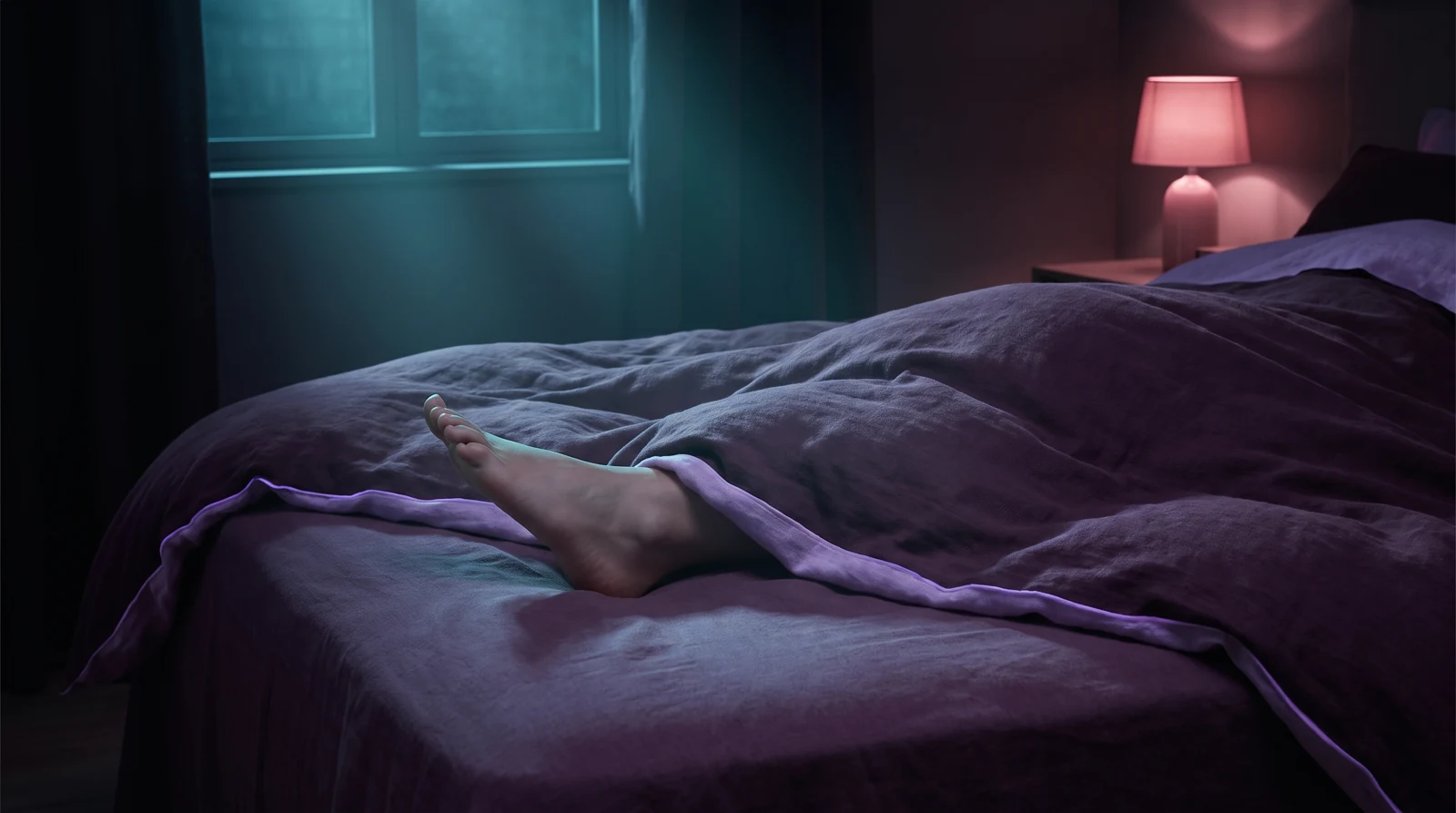
Somewhere tonight, millions of adults will perform the same ritual: get into bed, pull up the covers, lie there for eight minutes, and then deploy one foot out the side like a periscope. Not two feet. Not a whole leg. One foot, out in the open air, while the rest of the body stays mummified. Ask them why and you'll get a shrug. It just works.
I love this move because it looks like superstition and turns out to be physiology. The foot thing isn't a quirk. It's your body hacking its own thermostat, and the science behind it is some of the most solid in sleep research. Let me walk you through why the periscope works, and how to use the same principle on nights when sleep won't come.
Falling asleep is a temperature event
Here's the part most people don't know: your body doesn't just get sleepy at night, it gets cooler. Core body temperature runs on a daily curve, peaking in the early evening and dropping through the night to a low in the early morning hours. Sleep onset rides that downhill slope. Your brain treats a falling core temperature as one of the signals that it's time to shut down, which is why a stuffy, overheated bedroom can keep you awake even when you're exhausted.
But the body has a problem. Core heat doesn't just evaporate; it has to be moved somewhere. And the way your body dumps heat is weirdly specific: it shunts warm blood to the skin of your hands and feet, where the heat radiates off into the room. Hands and feet are your radiators. They're loaded with special blood vessels built for exactly this job, and when they open up, core temperature starts to fall.
Warm feet, fast sleep: the actual study
In 1999, researchers in Basel published a short paper in Nature with one of the great titles in the field: warm feet promote the rapid onset of sleep. They tracked how quickly people fell asleep against a stack of physiological signals, and the single best predictor wasn't melatonin level or core temperature itself. It was the temperature gradient between the hands and feet and the core, a measure of how wide open those radiators were. The more heat flowing out through warm hands and feet, the faster people fell asleep (Kräuchi et al., 1999, Nature).
Read that again, because it sounds backwards. Warm feet mean fast sleep. Not cold feet. The feet get warm because they're releasing heat, and that release is what cools the core. People with chronically cold feet, bad circulation, or Raynaud's often struggle to fall asleep for exactly this reason: their radiators won't open.
Your feet aren't getting cold out there. They're doing a job: dumping the heat your core needs to lose.
So why does the foot go OUT of the covers?
Because radiators need somewhere to send the heat. A foot under a thick duvet is a radiator pointed at a wall of insulation: the blood arrives warm, but the heat has nowhere to go. Stick the foot out and you've exposed one of your highest-capacity heat exchangers directly to cool room air. Heat pours off it, core temperature drops a little faster, and the slide into sleep gets a push. The rest of you stays covered because comfort matters too; you want a controlled leak, not a cold body.
This is also why the move gets deployed mid-process rather than at lights out. Early on, the blanket helps by warming your skin and opening those vessels. Ten minutes in, you've gone from warming up to overheating, and the foot goes out to bleed off the surplus. You've been running a two-stage thermal protocol your whole life without knowing it.
Using the thermostat on purpose
Once you know the mechanism, a bunch of standard sleep advice stops being folklore and starts being plumbing. A warm bath or shower an hour before bed pulls blood to the skin, so you step out pre-dilated and your core cools on schedule. Socks in bed help people with cold feet for the same reason: warm the feet, open the vessels, let the heat flow. A cool bedroom, somewhere in the 65 to 68 Fahrenheit range for most people, gives all that heat somewhere to go. And the one-foot move remains the free, adjustable release valve: foot out when warm, foot back in when the balance tips.
What the thermostat can't fix is a loud head. Cooling handles the body's half of sleep onset; the other half is mental arousal, and no amount of foot deployment beats a mind that's still writing emails. On those nights I treat it as a two-front problem: foot out for the thermals, and something slow and dim for the brain. Lately that's Feelsy on the nightstand, a dark drifting texture on autoplay with the volume barely on, which gives my eyes something pointless to follow while the radiator does its work. Body cooling down, mind idling, and sleep shows up without being chased.
It's a nice reminder that not every sleep fix needs a subscription or a supplement stack. Some of the best ones are preinstalled. You've had a precision thermostat on the end of your leg this whole time.
Feelsy is a wellness product, not medical advice. If stress, anxiety or sleep problems persist, please speak with a qualified professional.
References
- Kräuchi, K., Cajochen, C., Werth, E., & Wirz-Justice, A. (1999). Warm feet promote the rapid onset of sleep. Nature, 401(6748), 36–37.
Frequently Asked Questions
Why does sticking one foot out of the blanket help you sleep?
Your core body temperature needs to drop for sleep to start, and your body dumps that heat through the skin of your hands and feet. A foot under a duvet can't release much heat, but a foot exposed to cool room air radiates it quickly. That speeds up the core temperature drop that signals your brain it's time to sleep.
Do warm feet really help you fall asleep faster?
Yes, and it's one of the better-documented findings in sleep research. A study published in Nature found the best predictor of how fast people fell asleep was how much heat their hands and feet were releasing. Feet get warm when they're radiating heat, and that release is what cools the core. Cold, constricted feet hold heat in and delay sleep.
Should I wear socks to bed?
If your feet run cold, it's worth trying. Cold feet mean the blood vessels that release core heat are closed, which slows sleep onset. Warming the feet with socks opens those vessels so heat can flow out. People whose feet run warm usually don't need them and may prefer the foot-out approach instead.
What is the best bedroom temperature for sleep?
Most people sleep best in a cool room, roughly 65 to 68 degrees Fahrenheit, or about 18 to 20 Celsius. A cool room gives your body somewhere to send the heat it needs to lose at sleep onset. You can fine-tune from there with bedding and the classic one-foot-out release valve.
Why does a warm bath before bed make you sleepy?
A warm bath an hour or so before bed pulls blood to your skin and opens the vessels in your hands and feet. When you get out, all that opened-up skin releases heat fast, so your core temperature drops right on schedule for sleep. The bath doesn't heat you to sleep; it sets up the cooling that follows.

About the author
Contributing writer
Kurt is a New York based writer covering the practical science of stress, sleep and focus. He is the resident sceptic of the Journal: if a technique cannot survive a crowded subway commute and a deadline week, he is not interested in it.
Feel it for yourself.
Feelsy turns reading about calm into practising it. Two minutes of a slow texture is often the whole difference.


Related reading
 Sleep
The Best Temperature for Sleep (and Why Your Bedroom Runs Hot)
What's the best temperature for sleep? Why cooler rooms help you fall asleep faster, what the research says about heat, and how to fix a hot bedroom.
 Ancient Wisdom
The Warm Bath Before Bed: An Old Ritual Science Happens to Agree With
From Roman baths to the Japanese ofuro, cultures have always bathed before rest. Here is why a warm bath before bed helps you sleep, and how to time it.
 Sleep
Why You Can't Sleep Without Your Fan (It's Not Just the Breeze)
Millions can't fall asleep without a fan running. The science of why fan noise and moving air knock you out, plus when the habit works against you.
 Sleep
Falling Back: A Survival Guide for the End of Daylight Saving Time
Clocks fall back this weekend, and the free hour is slightly fake. What the end of daylight saving time really does to your sleep, and how to land it well.
 Sleep
The Best Alarm Sound to Wake Up To, According to Research
Harsh beeping may be making your mornings worse. What research says about the best alarm sound to wake up to, and how to choose one your brain won't fight.
 Sleep
Can You Learn While You Sleep? What the Science Actually Says
Sleep learning is an old dream and mostly a myth, but not entirely. What research really shows about learning, memory and your sleeping brain.