Sleeping With Socks On: The Dorkiest Sleep Hack Science Loves
Wearing socks to bed looks ridiculous and works anyway. Here's the thermoregulation science of warm feet, faster sleep onset and fewer wake-ups.
By Kurt Woleret
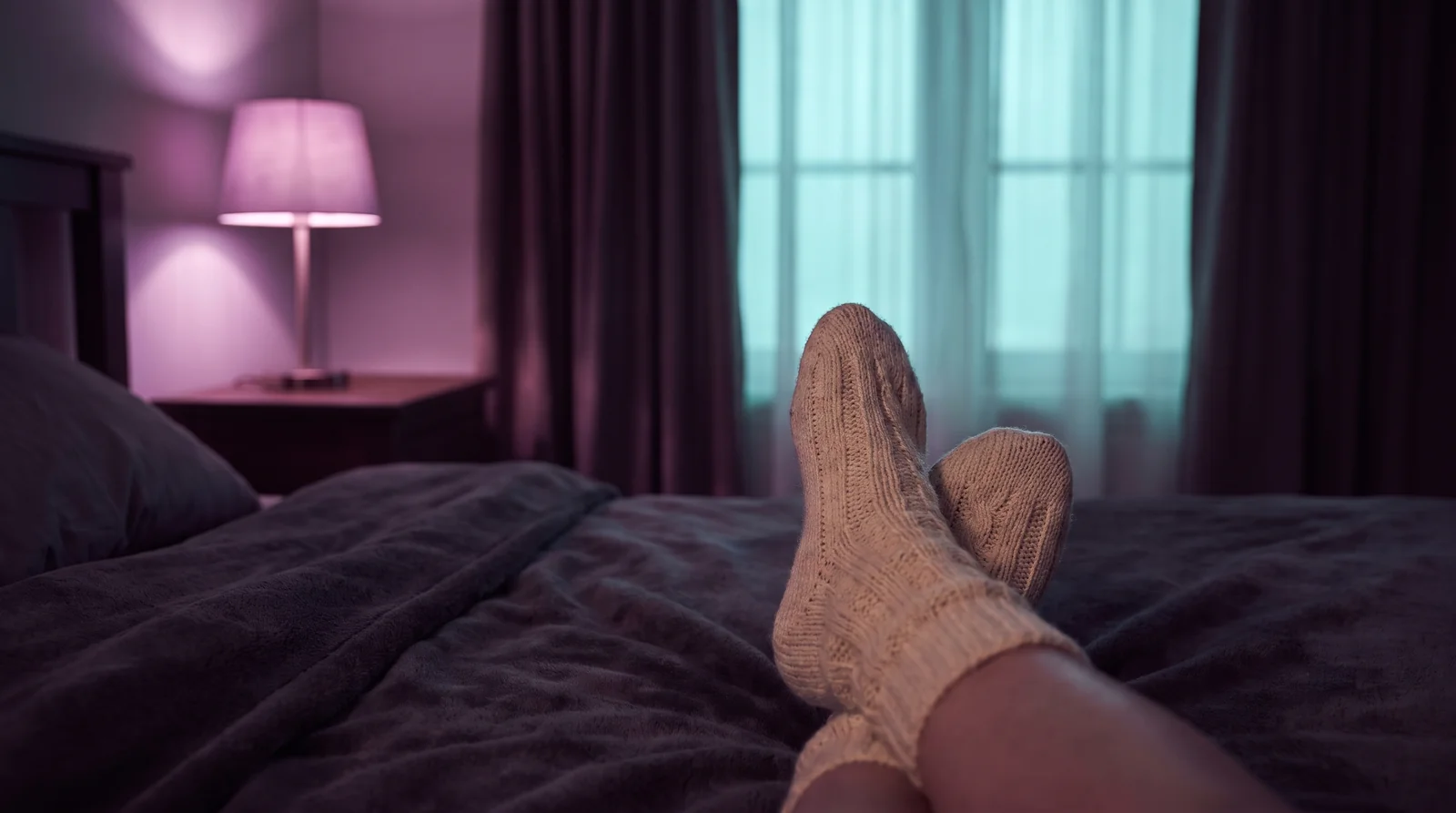
There are two kinds of people: the ones who sleep in socks, and the ones who find that genuinely upsetting. I used to be the second kind. Socks in bed felt like a small surrender, the pajama equivalent of giving up. Then my radiator died in January, New York landlord response time being what it is, and I spent a week sleeping in wool socks out of pure necessity. I fell asleep faster that week than I had all winter. Naturally I assumed it was a coincidence, because admitting the dorky thing works is painful. It's not a coincidence. The socks have peer review.
Your body has to cool down to shut down
Sleep onset is partly a thermal event. In the hour or two before sleep, your core body temperature starts dropping, and that drop is one of the signals that tells the brain it's time to power down. But here's the counterintuitive part: to cool the core, the body heats the extremities. Blood vessels in your hands and feet dilate, blood flows to the skin, and heat radiates out through them like little heat sinks. Swiss researchers measured this cascade and found that the degree of blood vessel dilation in the hands and feet was the best physiological predictor of how quickly someone fell asleep, better than melatonin levels or core temperature itself (Kräuchi et al., 1999, Nature). The finding ran in Nature under the extremely unglamorous title of warm feet promoting rapid sleep onset. Cold feet constrict those vessels, the heat can't leave, the core stays warm, and the brain keeps waiting for a signal that never comes.
To cool the core, the body heats the feet. Socks aren't cozy nonsense. They're a heat-transfer assist.
What the sock studies found
So warming your feet should speed up the whole cascade, and when researchers tested exactly that, it did. In one study, young men who wore warmed socks to bed fell asleep about seven and a half minutes faster, slept over half an hour longer, and woke up during the night notably less often than the same men sleeping barefoot (Ko & Lee, 2018, Journal of Physiological Anthropology). Seven and a half minutes might sound small, but as sleep interventions go it's a solid return on an investment of one pair of socks. For comparison, people will buy a four-figure mattress for less measurable benefit. The socks cost eight dollars and have no app.
Doing it right
A few practical notes from a reformed skeptic. Material matters: wool or soft cotton breathes, so your feet stay warm without marinating; anything synthetic and tight can trap moisture and turn cozy into clammy by 3 a.m. Loose is the rule, since compression socks are a daytime tool and you don't want anything squeezing while circulation is doing its nighttime work. If socks are a bridge too far for your dignity, the same physics works in other formats: a warm foot soak before bed, a hot water bottle at the foot of the mattress, or a warm bath an hour or two before lights out, which triggers the identical warm-then-cool cascade for your whole body. And the sock trick stacks nicely with a proper wind-down. I pull the socks on, kill the overheads, and put ten minutes of Feelsy's slow textures on the screen with the sound low, which keeps my brain off the day's ledger while the thermal plumbing does its thing. By the time the feet are warm, the mind is usually quiet enough to follow.
Why your feet are cold at midnight in the first place
Worth asking, because the answer explains why this hack lands hardest on exactly the people who need it. Cold extremities at bedtime usually aren't about your apartment's thermostat; they're about your nervous system's. Stress narrows the blood vessels in your hands and feet, because a body braced for action routes blood toward the core and the big muscles. Which means the anxious, wired, deadline-week version of you climbs into bed with the circulation of someone expecting trouble, and the warm-feet signal the brain is waiting for physically cannot be sent. It's a tidy little trap: the stress keeps the feet cold, and the cold feet keep sleep away, which gives you more time to lie there being stressed. Warming the feet from the outside breaks the loop at the cheapest point, no insight or willpower required. It also explains the seasonal pattern, since the trap tightens in winter and in over-air-conditioned summer bedrooms, and why women, who on average run colder in the extremities, tend to be the household's committed sock-sleepers. They weren't being precious. They were ahead of the literature.
Who should skip it
The honest caveats. If you run hot or your bedroom is already warm, socks can tip you into overheating, and a too-warm core is as bad for sleep as cold feet; the goal is warm extremities in a cool room, somewhere in the mid-sixties Fahrenheit. If your feet are persistently ice cold no matter what, or you have circulation issues, numbness or tingling, that's a conversation for a doctor rather than a sock drawer, since chronically cold extremities can occasionally point at something that deserves actual attention. And if you simply hate the feeling, don't force it; a foot soak or the one-foot-out-of-the-covers thermostat method gets you similar control from the other direction. The underlying principle is the useful part: your feet are the radiator valves of your sleep system. However you choose to operate them, operate them on purpose.
Feelsy is a wellness product, not medical advice. If stress, anxiety or sleep problems persist, please speak with a qualified professional.
References
- Kräuchi, K., Cajochen, C., Werth, E., & Wirz-Justice, A. (1999). Warm feet promote the rapid onset of sleep. Nature, 401(6748), 36-37.
- Ko, Y., & Lee, J. Y. (2018). Effects of feet warming using bed socks on sleep quality and thermoregulatory responses in a cool environment. Journal of Physiological Anthropology, 37(1), 13.
Frequently Asked Questions
Does sleeping with socks on actually help you fall asleep?
Yes, the evidence supports it. In one study, young men who wore warmed socks to bed fell asleep about seven and a half minutes faster, slept over half an hour longer, and woke up less often during the night than when sleeping barefoot (Ko & Lee, 2018).
Why do warm feet help you sleep?
Sleep onset is partly a thermal event: your core temperature has to drop, and the body cools the core by sending heat out through dilated blood vessels in the hands and feet. Swiss researchers found that the degree of this blood vessel dilation in the extremities was the best predictor of how fast someone fell asleep (Kräuchi et al., 1999). Warming your feet speeds up that heat-release cascade.
What kind of socks are best for sleeping?
Loose, breathable ones. Wool or soft cotton keeps feet warm without trapping moisture, while tight synthetic socks can turn clammy overnight. Avoid anything compressive in bed; compression socks are a daytime tool and you don't want squeezing while nighttime circulation does its work.
Is it bad to sleep with socks on?
For most people, no. The main risk is overheating if you run hot or your bedroom is already warm, since a too-warm core disrupts sleep just like cold feet do. Aim for warm feet in a cool room. If your feet are persistently ice cold or you have circulation issues or numbness, mention it to a doctor.
What can I do instead of wearing socks to bed?
The same physics works in other formats: a warm foot soak before bed, a hot water bottle at the foot of the mattress, or a warm bath an hour or two before lights out, which triggers the same warm-then-cool cascade for the whole body. Sticking one foot out of the covers works the thermostat from the other direction.

About the author
Contributing writer
Kurt is a New York based writer covering the practical science of stress, sleep and focus. He is the resident sceptic of the Journal: if a technique cannot survive a crowded subway commute and a deadline week, he is not interested in it.
Feel it for yourself.
Feelsy turns reading about calm into practising it. Two minutes of a slow texture is often the whole difference.


Related reading
 Sleep
The Best Temperature for Sleep (and Why Your Bedroom Runs Hot)
What's the best temperature for sleep? Why cooler rooms help you fall asleep faster, what the research says about heat, and how to fix a hot bedroom.
 Ancient Wisdom
The Warm Bath Before Bed: An Old Ritual Science Happens to Agree With
From Roman baths to the Japanese ofuro, cultures have always bathed before rest. Here is why a warm bath before bed helps you sleep, and how to time it.
 Sleep
Why Sleeping With One Foot Out of the Covers Works
Sticking one foot out of the blanket isn't a quirk, it's thermoregulation. The science of warm feet, core temperature, and faster sleep, explained simply.
 Sleep
Falling Back: A Survival Guide for the End of Daylight Saving Time
Clocks fall back this weekend, and the free hour is slightly fake. What the end of daylight saving time really does to your sleep, and how to land it well.
 Sleep
The Best Alarm Sound to Wake Up To, According to Research
Harsh beeping may be making your mornings worse. What research says about the best alarm sound to wake up to, and how to choose one your brain won't fight.
 Sleep
Can You Learn While You Sleep? What the Science Actually Says
Sleep learning is an old dream and mostly a myth, but not entirely. What research really shows about learning, memory and your sleeping brain.