Tibetan Singing Bowls: Why an Old Bronze Bowl Calms a Modern Mind
Why Tibetan singing bowls calm the nervous system: their Himalayan history, what a small study measured about mood and tension, and how to begin at home.
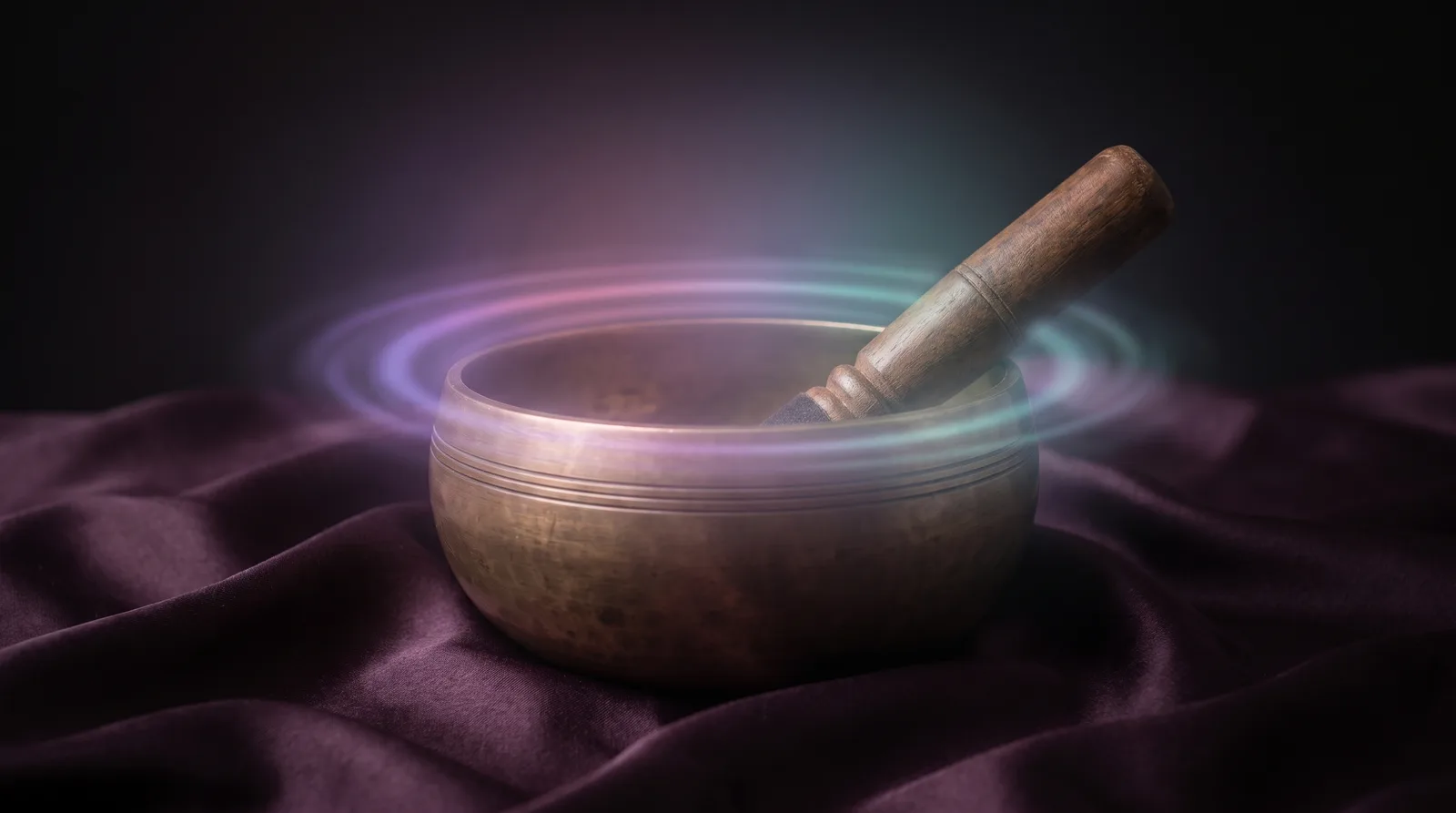
There is a moment, a few seconds after a singing bowl is struck, when the first bright clang has faded and what remains is something closer to weather than to music: a low, wavering hum that seems to come from the walls, the floor, the inside of your own chest. People who have never meditated in their lives go quiet in that moment. It is one of the most reliable hushes in the world, and human beings have been producing it with hammered metal for a very long time.
The singing bowl is having a renaissance at the moment, appearing in yoga studios, sleep playlists and spa menus, usually wearing the word Tibetan. The truth of its history is more tangled and, I think, more interesting. And the question of what the sound actually does to a body turns out to have at least the beginnings of an answer.
A short, honest history
Standing bells, which is what a singing bowl technically is, a bell that rests on its rim rather than hanging from its crown, have been made across Asia for well over a thousand years. Bronze bowls of this family were cast and hammered in China, Japan, Korea and across the Himalayas, where they served in temples as instruments of ritual timekeeping: a strike to open a period of sitting, a strike to close it. In Japanese Zen practice the standing bell, the rin, still marks the boundaries of zazen with a single clean tone.
The specific story of the Tibetan singing bowl as an ancient, secret meditation technology is, historians of the region generally agree, largely a modern invention, assembled in the West from the 1970s onwards as the bowls became popular imports. This is worth saying plainly, not to diminish the object but to relieve it of a burden. The bowl does not need an invented lineage. What it has instead is something better: a genuinely old craft of hammered bronze, a genuinely old role as the punctuation of contemplative practice, and a sound that does something to the human nervous system regardless of what story is wrapped around it.
You do not so much listen to a singing bowl as sit inside its sound while it slowly lets you go.
Why the sound is so strange and so steadying
Two things make a singing bowl unlike almost any other instrument. The first is how long the sound lasts. A struck bowl can ring for a minute or more, decaying so gradually that the ear cannot find the moment the sound becomes silence. Attention, given a slope that gentle, follows it all the way down; the fade of a good bowl is a guided descent.
The second is the wobble. A hammered bowl is never perfectly symmetrical, so it vibrates at several closely neighbouring frequencies at once, and these interfere with one another to produce slow, pulsing beats, the shimmer that makes the tone seem to breathe. When a bowl is played by friction instead, the mallet circling the rim the way a wet finger circles a wine glass, the tone swells continuously and that pulse becomes the whole texture of the sound. It is rhythmic without being music, patterned without being predictable, and it asks nothing of you. In this it belongs to the same family as rain on a roof and waves on a shore: sound with enough structure to hold the ear and no structure that demands the mind.
What the research actually shows
The scientific literature on singing bowls is young and modest, and it deserves to be reported that way. The most cited work is an observational study in which sixty-two adults attended an hour-long sound meditation built around singing bowls, with mood, tension and anxiety measured before and after. The participants reported significantly less tension, anger, fatigue and low mood afterwards, with the effects on tension particularly striking, and first-timers showed some of the largest shifts (Goldsby et al., 2017, Journal of Evidence-Based Complementary and Alternative Medicine).
An honest reading adds the caveats: there was no control group, everyone knew what they were receiving, and an hour of lying still in a dim room is itself relaxing. What the study establishes is not magic but plausibility: people consistently feel calmer after this practice, and the effect is large enough to measure. For an unhurried hour that costs nothing and harms no one, that is a perfectly respectable evidence base to begin from, and it sits comfortably alongside what we know about slow, low-frequency, softly pulsing sound in general.
Choosing and playing a bowl at home
You do not need an antique, and you do not need a note chart promising that a particular frequency will realign a particular organ; that arithmetic belongs to marketing rather than acoustics. You need a bowl whose tone you actually like, because you are the instrument it will be played upon. Machine-made bowls are cheaper and purer in tone; hand-hammered bowls wobble more, which is precisely their charm. If you can, listen before you buy, and choose the sound that makes your shoulders drop.
- Set the bowl on its cushion on a table, or on the flat of your palm, fingers spread and still, never gripping the sides, which mutes it.
- Strike the outer rim gently with the padded end of the mallet and let the tone decay all the way to nothing. Follow it with your ears the entire way down. That following is the meditation.
- To make the bowl sing, press the wooden side of the mallet against the outer rim and circle slowly with even pressure, as though stirring something reluctant. The hum will rise after a few circuits. Slow down when it stutters; speed is the usual beginner's error.
- Try three strikes at the end of the day, one minute of listening each. It is a smaller commitment than almost any other practice, and it ends in silence, which is rather the point.
When the bowl is not to hand
The deeper principle travels well: long decays, slow pulses, sound that asks nothing. It is the same principle at work in a sound bath, in the hum of bhramari breathing, and in the layered ambient textures Feelsy pairs with its slow visuals, where a tone can shimmer and fade against drifting colour for as long as you care to watch. I keep a small bowl on my desk, and on the days I forget it is there, a few minutes of sound and slow motion on a screen does a gentler version of the same work: it gives the ear a slope to descend, and the mind follows.
Feelsy is a wellness product, not medical advice. If stress, anxiety or sleep problems persist, please speak with a qualified professional.
References
- Goldsby, T. L., Goldsby, M. E., McWalters, M., & Mills, P. J. (2017). Effects of Singing Bowl Sound Meditation on Mood, Tension, and Well-being: An Observational Study. Journal of Evidence-Based Complementary and Alternative Medicine, 22(3), 401-406.
Frequently Asked Questions
What is a Tibetan singing bowl?
A singing bowl is a standing bell: a bronze bell that rests on its rim rather than hanging, played either by striking it or by circling the rim with a mallet until it produces a continuous hum. Bowls of this family have been made across Asia for over a thousand years and were used in temples to mark the beginning and end of meditation periods. The specifically Tibetan meditation lore around them is largely a modern Western addition, but the craft and the sound are genuinely old.
Do singing bowls actually do anything?
The research is young but promising. In an observational study of sixty-two adults, an hour-long singing bowl sound meditation was followed by significant drops in reported tension, anger, fatigue and low mood, with newcomers showing some of the largest changes. The study had no control group, so relaxation from simply lying still contributed too, but the consistent, measurable calming effect makes the practice a reasonable one to try.
How do you use a singing bowl for meditation?
Rest the bowl on a cushion or on your flat palm, strike the rim gently, and follow the tone with your ears all the way down to silence; that act of following is the meditation itself. To make the bowl sing continuously, press the wooden side of the mallet to the outer rim and circle slowly with even pressure. Three strikes with a minute of listening each makes a complete evening practice.
Does the frequency of a singing bowl matter?
Choose a bowl by ear rather than by charts promising that particular frequencies heal particular organs, which is marketing rather than acoustics. What matters is that the tone genuinely pleases you, since you are the one who will sit inside it. Hand-hammered bowls have a more wavering, breathing tone; machine-made bowls are purer and cheaper. The right bowl is the one that makes your shoulders drop.

About the author
Contributing writer
Eleonor writes about contemplative traditions, attention and the cultural history of calm. She has spent two decades collecting the rituals humans use to slow down, from zazen halls to hammams, and translating them for modern, screen-lit lives.
Feel it for yourself.
Feelsy turns reading about calm into practising it. Two minutes of a slow texture is often the whole difference.


Related reading
 ASMR
ASMRWhat Is a Sound Bath? Bathing the Nervous System in Tone
What is a sound bath and what does it actually do? The history of singing bowls and gongs, what research suggests, and how to try one at home tonight.
 ASMR
ASMRDo Solfeggio Frequencies Actually Work? 528 Hz, Fact-Checked
528 Hz gets called the love frequency and a DNA repair tone. Here's what the one real study found, and what matters far more than the hertz.
 Breath & Body
Bhramari: The Humming Bee Breath That Quietens a Racing Mind
Bhramari, the humming bee breath, uses your own voice to settle the nervous system. Here is how to practise it, why humming soothes, and what research suggests.
 ASMRNew
Why the Sound of Pouring Water Is So Soothing
Why the sound of pouring water is so soothing: what tea pourers have always known, what research says about water sounds, and how to listen on purpose.
 ASMR
ASMRPsithurism: Why the Sound of Wind in the Trees Calms the Mind
Psithurism is the whispering sound of wind through leaves. Here is why this natural broadband sound soothes the nervous system, and what research says about it.
 ASMR
ASMRVisual ASMR: Why Some People Get Tingles With the Sound Off
Slow hands, slime folds, drifting light: visual ASMR calms some people with no audio at all. Here's what research says about watching your way to relaxed.