Why Glassblowing Videos Are So Mesmerising: Breath, Fire and Molten Patience
Glassblowing videos hold millions of viewers in a happy trance. Why molten glass, furnace glow and a maker's steady breath are so satisfying to watch.
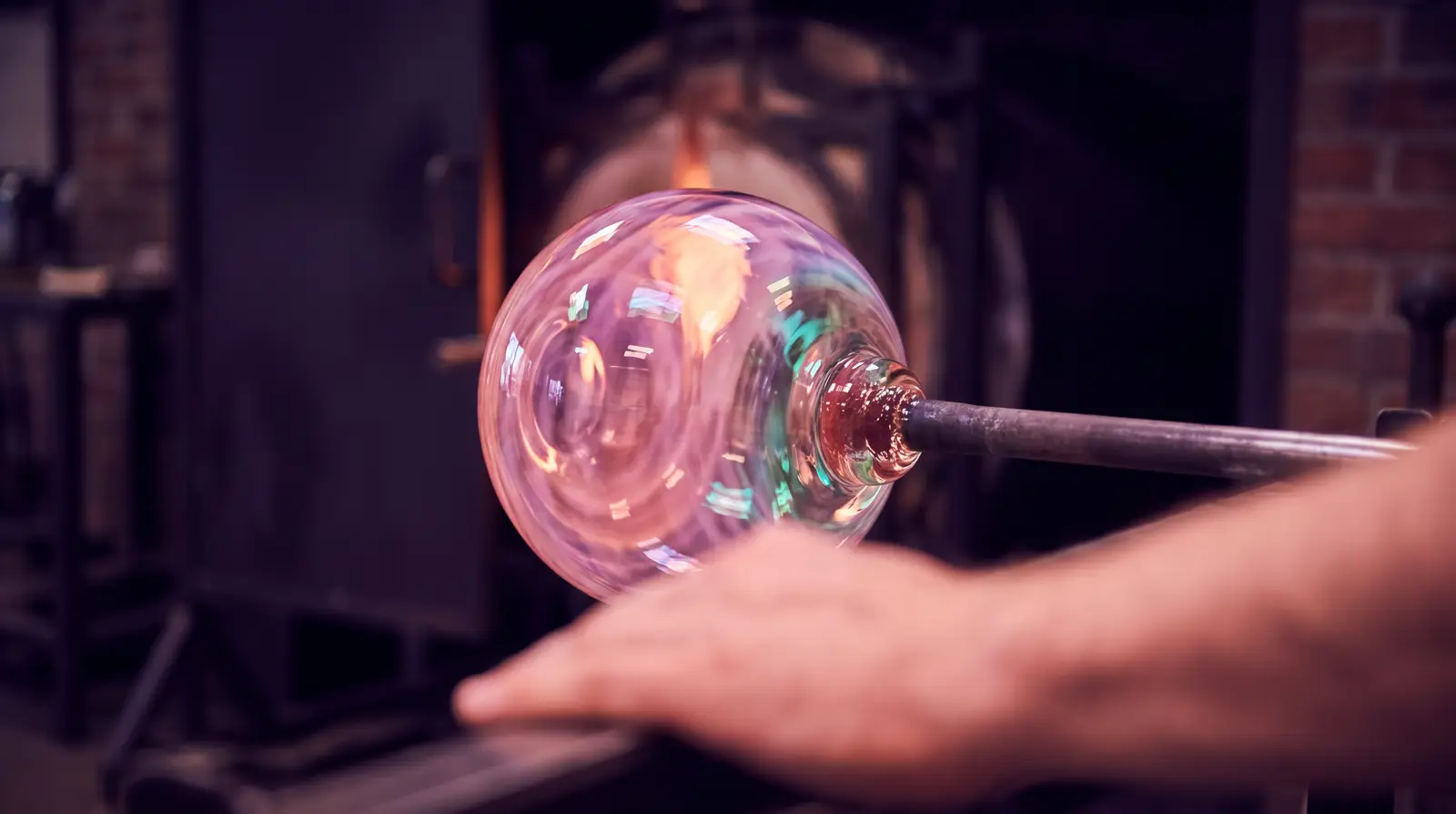
Somewhere on your feed tonight, a person you have never met is turning a steel pipe with a ball of orange-hot glass at the end of it, and you will not be able to look away. Glassblowing has become a staple of the oddly satisfying internet, watched by millions who have no intention of ever entering a hot shop. The comments underneath are a chorus of the same confession: I have no idea why this is so relaxing. The reasons turn out to be rather old ones. Fire, breath, molten movement and visible mastery, gathered around a single glowing point in the dark.
Molten glass moves like slow honey
Glass at working temperature is neither liquid nor solid but something dreamlike in between, and it moves accordingly: sagging, swelling and stretching with the thick, unhurried grace of honey leaving a spoon. The eye finds this kind of motion inherently soothing. It is the same slow fluid drift that makes lava lamps, ink in water and rolling waves so watchable: continuous, curved, and utterly without suddenness. Molten glass cannot jump or startle. Every change of shape is announced seconds in advance by the shape before it, so attention glides along the surface with nothing to brace against.
Then there is the glow. Hot glass wears the colour of its own temperature, shading from rose gold at the edges to a deep ember orange at the heart, and the workshop around it is usually dark. The scene composes itself into a single luminous object floating in shadow: a natural point of focus, arranged almost exactly like a candle flame at the centre of a darkened room.
The oldest screen: why we stare at glow
Humans have gathered around glowing light after dark for a very long time, and watching a furnace mouth or a radiant gather of glass borrows that ancient furniture. Warm light in surrounding darkness is the visual grammar of the hearth: it signals evening, gathering, food and safety rather than alarm. Glassblowing footage delivers that grammar with an artisan bent over the glow, and the effect on the viewer is much like firelight's: the gaze settles, the shoulders drop, and time begins to pass at the furnace's pace rather than the feed's.
Watching mastery: flow by proxy
A large part of the pleasure is simply watching someone who knows exactly what they are doing. The psychologist Mihaly Csikszentmihalyi described flow as the state of total absorption that arises when skill meets a challenge that stretches it, a state in which action and awareness merge and self-consciousness falls away (Csikszentmihalyi, 1990). A practised glassblower at the bench is flow made visible: no wasted motion, no hesitation, tools picked up and set down without a glance, the pipe turning steadily the whole while. Watching it, we borrow a little of that absorption for ourselves. The maker's calm is contagious in the way a companion's slow breathing is contagious.
The glass is always falling. The maker is always, calmly, catching it.
What sharpens the spell is that the calm is earned. Molten glass never pauses; gravity is a constant collaborator, and the material must be kept turning or it will slump off centre. The whole craft is a continuous, unhurried urgency, and the artisan meets it not with frantic speed but with rhythm. For anyone whose own deadlines produce rather less composure, there is something deeply reassuring about watching pressure met by patience, again and again, until the pressure becomes the shape of a vase.
Breath made visible
And at the centre of it all, quite literally, is breath. The vessel exists because a human being exhaled into it: one long, slow, controlled breath travelling down the pipe and blooming as a bubble inside the glowing gather. It may be the only craft in which the maker's breathing is the actual raw material of the work. Viewers seem to sense this even when they could not name it. Watching the glass swell with a slow exhale, one's own breath tends to lengthen in sympathy, the same quiet entrainment that makes waves and slow music such reliable company at the end of a day.
How to watch deliberately
A few small choices turn idle scrolling into something closer to a rest:
- Choose long, single-take videos with natural workshop sound, the roar of the glory hole and the tick of tools, rather than fast cuts and music.
- Watch full screen with the lights low and the volume gentle, so the glow sits in darkness the way it does in the workshop.
- Let your exhale keep company with the maker's: when the glass swells, breathe out slowly with it.
- If molten glass is not to hand, the slow glassy textures in Feelsy move with the same honeyed weight; let one drift with the screen dimmed while you practise a longer exhale, or let the app's 4-7-8 breathing exercise set the pace.
Sand, fire and patience
Perhaps the deepest satisfaction is the transformation itself. The process begins with the humblest material imaginable, sand, and ends, after fire and breath and several hundred practised turns of a pipe, as something luminous and fragile and finished. Oddly satisfying videos of every kind trade on completed transformations, but glassblowing offers the grandest arc of them all, and it asks the viewer to wait through every second of the middle. That waiting is the point. In a feed engineered for instant everything, here is one glowing thing that will not be hurried, made by someone who has stopped trying to hurry it. Watch to the end, when the finished piece is cracked off the pipe and stands on its own: it is remarkable how often the viewer exhales too.
Feelsy is a wellness product, not medical advice. If stress, anxiety or sleep problems persist, please speak with a qualified professional.
References
- Csikszentmihalyi, M. (1990). Flow: The Psychology of Optimal Experience. New York: Harper & Row.
Frequently Asked Questions
Why are glassblowing videos so satisfying to watch?
They combine several reliably calming ingredients at once: slow fluid motion, since molten glass moves like thick honey and can never startle; warm glow surrounded by darkness, the same visual grammar as firelight; visible mastery, with a practised maker working in unhurried rhythm; and a completed transformation, from plain sand to a finished luminous vessel.
What does flow have to do with watching craft videos?
Flow is Mihaly Csikszentmihalyi's term for the state of total absorption that arises when skill meets a challenge that stretches it. A practised glassblower at work is flow made visible, with no wasted motion or hesitation, and viewers seem to borrow a little of that absorption, the way a companion's slow breathing steadies your own.
Why does molten glass move like honey?
At working temperature, glass is neither properly liquid nor solid but a thick in-between state, so it sags, swells and stretches with a slow continuous grace. Every change of shape is announced by the shape before it, which means the eye can follow the motion with nothing to brace against, much like watching waves or ink in water.
Are glassblowing videos good for winding down before bed?
They can be, if you watch deliberately: choose long single-take videos with natural workshop sound rather than fast cuts and music, watch with the lights low and volume gentle, and let your exhale lengthen along with the maker's slow breaths into the pipe. The glow-in-darkness scene sits close to firelight, which most people find sleepy rather than stimulating.

About the author
Contributing writer
Eleonor writes about contemplative traditions, attention and the cultural history of calm. She has spent two decades collecting the rituals humans use to slow down, from zazen halls to hammams, and translating them for modern, screen-lit lives.
Feel it for yourself.
Feelsy turns reading about calm into practising it. Two minutes of a slow texture is often the whole difference.


Related reading
 Visual Meditation
Why Watching Fire Is So Calming
Why is watching fire so relaxing? The science of flames, flicker and fireside calm, and how to borrow the campfire effect from a screen on an ordinary night.
 Visual Meditation
Why Ink Blooming in Water Is So Mesmerizing
A drop of ink unfurls underwater like slow smoke, and you cannot look away. The science and the old floating-ink arts behind one of the calmest sights there is.
 ASMR
ASMRWhy Soap Cutting Videos Are So Satisfying
Soap cutting videos rack up billions of views. Here's the science of why crisp cuts and curling ribbons calm your brain, and how to use that effect on purpose.
 Visual MeditationNew
Why Fog Is So Calming: The Strange Peace of a World Gone Soft
Foggy mornings quiet something in us. The psychology of why fog feels so calming, from softened light and sound to the restful pull of a smaller world.
 Visual MeditationNew
Why Bioluminescence Is So Mesmerising: The Sea's Living Light
Glowing waves stop us mid-sentence and slow the breath. Here is what makes the sea shine at night, and why watching living light calms the nervous system.
 Visual Meditation
Zentangle: The Meditative Drawing Practice Anyone Can Learn
Zentangle turns simple repeated pen strokes into a calming ritual. Learn how the method works, why structured drawing soothes anxiety, and how to begin tonight.